
Euro Medium-Term Notes (EMTNs): A Comprehensive Guide
Euro medium-term notes, or EMTNs, are unsecured debt instruments that mature in five to 10 years. They are usually issued in countries that deal with euro currencies. Euro currency is a type of currency that is held outside of the country of origin. EMTNs provide investors with an opportunity to access foreign currencies and markets.
Summary
- Euro Medium-Term Notes (EMTNs) are issued outside the US and Canada and in the markets that deal euro currencies. The securities enable investors to get access to foreign currencies.
- EMTNs pay a higher rate of interest. Since the securities are customized to the needs of the investor, they involve high dealer expenses.
- They are unsecured debt securities, which means that if the issuer defaults, the investor has little recourse to collect the principal amount as there are no assets to back the debt.
Example of Euro Medium-Term Notes
As an example, consider Banco Latinoamericano de Comercio Exterior, a bank in Panama, that offers euro medium-term notes to investors. The notes will bear an interest rate of 3.25% per year, starting on May 7, 2015, and will mature on May 7, 2020. The interest is paid on May 7 and November 7 every year, with the first interest to be paid on November 7, 2015.
Moody’s rating of Baa2 for the Banco Latinoamericano de Comercio Exterior indicates that the note comes with moderate credit riskCredit RiskCredit risk is the risk of loss that may occur from the failure of any party to abide by the terms and conditions of any financial contract, principally,. It means that the risk that the Panamian bank defaulting is lower than average. Also, it is a fixed-interest, medium-term note.
Advantages of Euro Medium-Term Notes
- Euro medium-term notes pay a higher interest rate compared to other short- term investments.
- EMTNs help investors gain access to new markets and currencies.
- Since euro medium-term notes are transferred from the issuer to the investor, the entity can raise money privately.
Disadvantages of a Euro Medium-Term Note
- Euro medium-term notes are expensive and the premium can offset the interest received by the investor, thereby leaving very little earnings to the investor.
- Since the notes involve other foreign currencies, the laws of the foreign jurisdiction would apply.
Risk with Medium-Term Notes
More than a decade ago, Lehman Brothers, which was one of the biggest investment banks in the world, issued medium-term notes with a face value of $1,000 and promised returns based on the performance of the S&P 500 IndexS&P 500 IndexThe Standard and Poor’s 500 Index, abbreviated as S&P 500 index, is an index comprising the stocks of 500 publicly traded companies in the. Lehman brothers publicized the notes as offering huge earning potential, as they were matched to the S&P 500 Index and also guaranteed 100% return of the principal amount within three months in case of default.
However, when Lehman Brothers declared bankruptcy in 2008, investors could not recover the principal amount, as a release clause stated that it depended on the creditworthinessCreditworthinessCreditworthiness, simply put, is how "worthy" or deserving one is of credit. If a lender is confident that the borrower will honor her debt obligation in a timely fashion, the borrower is deemed creditworthy. of the bank. Hence, when the notes defaulted investors were forced to sell the notes in the secondary market for around 10-55 cents on the dollar.
Euro Medium-Term Note Program
EMTN programs are meant to be offered outside the U.S. As many companies have a constant need for capital, these programs provide easy access to the notes, as constant submission of documents is not required.
While U.S. companies have Euro MTN and U.S. MTN programs, European companies usually maintain only Euro MTNs. A European company can maintain a U.S. MTN if it is registered with the Securities Exchange Commission (SEC) in the U.S. A non-European company and a non-U.S. company can have a European MTN if they want to issue the debt securities in the European markets.
Related Readings
CFI offers the Capital Markets & Securities Analyst (CMSA)™Program Page - CMSAEnroll in CFI's CMSA® program and become a certified Capital Markets &Securities Analyst. Advance your career with our certification programs and courses. certification program for those looking to take their careers to the next level. To keep learning and developing your knowledge base, please explore the additional relevant resources below:
- Debt SecurityDebt SecurityA debt security is any debt that can be bought or sold between parties in the market prior to maturity. Its structure represents a debt owed
- Equity-Linked Note (ELN)Trading & InvestingCFI's trading & investing guides are designed as self-study resources to learn to trade at your own pace. Browse hundreds of articles on trading, investing and important topics for financial analysts to know. Learn about assets classes, bond pricing, risk and return, stocks and stock markets, ETFs, momentum, technical
- Direct Market Access (DMA)Direct Market Access (DMA)Direct market access (DMA) refers to a method of electronic trading where investors can execute trades by directly interacting with an
- Secondary MarketSecondary MarketThe secondary market is where investors buy and sell securities from other investors. Examples: New York Stock Exchange (NYSE), London Stock Exchange (LSE).
-

Investment-Grade Bonds: Understanding Credit Risk & Ratings
An investment-grade bond is a bond classification used to denote bonds that carry a relatively low credit riskCredit RiskCredit risk is the risk of loss that may occur from the failure of any party to
-
Understanding Junk Bonds: Risks, Rewards, and Investment Strategies
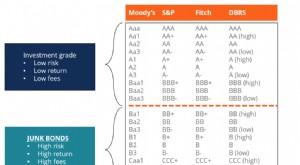
Junk bonds, also known as high-yield bonds, are bonds that are rated below investment grade by the big three rating agencies (see image below). Junk bonds carry a higher risk of defaultMarket Ri
invest
- Baby Bonds: A Comprehensive Guide to Investing in Children's Futures
- Understanding Bonds: A Comprehensive Guide for Investors
- Understanding Commodities: A Beginner's Guide to Investing
- Defensive Industries: Stability in Economic Uncertainty | [Your Company Name]
- Medium-Term Notes (MTNs): Definition, Features & How They Work
- Understanding Notes: Definition, Types & Issuance
- Understanding Financial Statement Notes: A Comprehensive Guide
- Understanding Notes Payable: A Comprehensive Guide
- Understanding Notes Receivable: A Comprehensive Guide
-
 Understanding Historical Returns: A Guide for Investors
The historical return of a financial asset, such as a bond, stock, security, index, or fund, is its past rate of return and performance. The historical data is commonly used in financial analysisTypes...
-
 Income Stocks: A Guide to Dividend Investing
Income stocks are equity financial securities that pay regular and predictable dividendsDividendA dividend is a share of profits and retained earnings that a company pays out to its shareholders. When...