
Medallion Signature Guarantee: What It Is & How It Works
A medallion signature guarantee is a certification stamp that lenders – such as banks and other financial institutions – provide to allow investors to transfer ownership of securities. It will generally be required by parties when the owner intends to transfer securitiesPublic SecuritiesPublic securities, or marketable securities, are investments that are openly or easily traded in a market. The securities are either equity or debt-based..
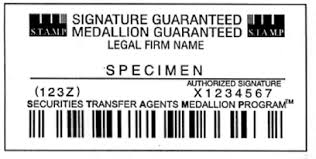
The medallion signature guarantee protects shareholder accounts by limiting illegal transfers and potential losses by investors. However, the stamp is not required when a stock owner wants to sell or transfer stocks through a broker.
Summary
- A medallion signature guarantee is a unique stamp by a signature guarantor that guarantees the authenticity of a signature to conduct a transfer of securities.
- The guarantee protects investors by curbing forgery of signatures on the securities certificate.
- An institution must be a member of the Medallion programs to offer medallion signatures guarantee.
Understanding Medallion Signature Guarantees
A medallion signature provides a guarantee that a signature’s owner is the legal owner of securities and hence, possesses the power to initiate a transfer of ownership. In the case of forgery, the financial institution will accept liability. It can be issued by a trust company, clearing agency, domestic bank, broker-dealer, or any other financial institution.
The guarantee is only valid provided that the sale or transfer of securities does not exceed the relevant surety coverage of the program. Signature guarantees from financial institutions that do not participate in either Stamp or NYSE Medallion program are not accepted.
It is worth noting that a notary public is not bound to produce a medallion signature guarantee when transferring stocks. In such a case, the officer must first verify the identity and acknowledge the signature owner before giving the nod to proceed with the sale or transfer.
Prefixes and Financial Institutions’ Policies
Medallion signature guarantees do not bear similar values. Each stamp is assigned a special coded prefix to determine the relevant surety coverage level. For example, a prefix C is needed in the medallion signature guarantee for a transaction that is worth $400,000. The prefix is suitable for up to $500,000.
A prefix D stamp will automatically be rejected in such a transaction since it is only suitable for up to $250,000. In the same vein, policies that specify the type of identification required to issue the medallion signature guarantee and where to charge a fee for the service vary by institution. Most guarantor institutions will issue a stamp for an established customer, but not for unknown persons.
How Medallion Signature Guarantee Works
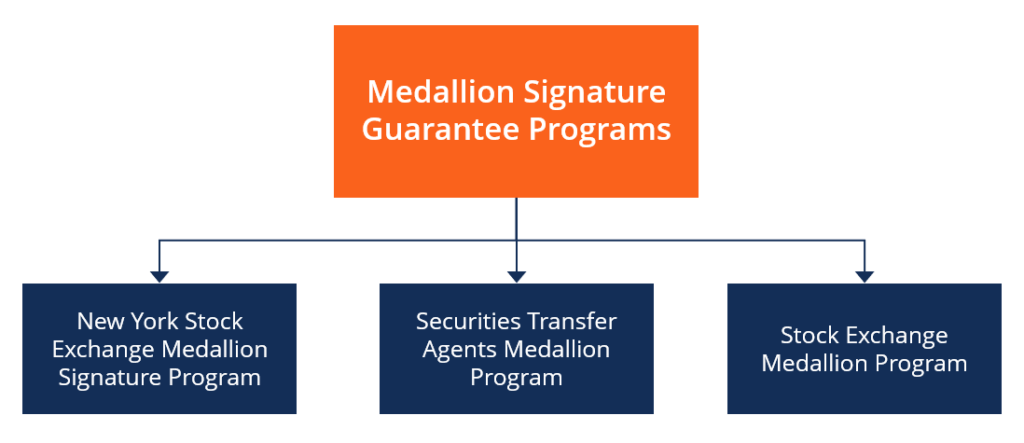
An institution providing a medallion signature guarantee must be a participant in one of the three Medallion programs – i.e., the New York Stock Exchange Medallion Signature Program, Securities Transfer Agents Medallion Program, and the Stock Exchange Medallion Program.
The Securities and Exchange Commission (SEC)Securities and Exchange Commission (SEC)The US Securities and Exchange Commission, or SEC, is an independent agency of the US federal government that is responsible for implementing federal securities laws and proposing securities rules. It is also in charge of maintaining the securities industry and stock and options exchanges regulations determine eligible providers of a medallion signature guarantee. The stamp can guarantee proper endorsements in transactions involving mutual stocks, funds, bonds and savings bonds, warrants and other securities, and unit investment trusts.
The institutions offering the stamp may charge a small fee to its customers. A medallion signature guarantee stamp cannot be given to individuals outside the U.S. Some institutions may accept the U.S. embassy seal if notified of the substitutions in advance. Several endorsing institutions outside the U.S. with a correspondence relationship with a U.S. bank issue their existing customers with a medallion signature guarantee stamp.
Special Details
Financial institutions offer holders with a security certificate a medallion signature guarantee. Institutions offer the written document to their customers to prove the ownership of different classes of a company’s shares.
The share certificate has key information that generally includes shares issue date, the name and address of the shareholder, certificate number, full amount paid on shares, classes of shares, the name and registration number of a company, and the number of shares. Institutions may issue shares in different classes.
One company that offers different classes of shares is Berkshire Hathaway. The holding company offers Class A (BRK.A) and Class B (BRK.B) shares. Other renowned companies, such as Facebook (F) or Ford Group (F), issue shares in dual-class structures. A company with dual-class stockDual-Class StocksDual-class stocks refer to a stock offering structure within a company. A dual-class structure means that a company offers two types (or means that it possesses more than one class of stocks, with every class having distinct features.
Multiple share classes are also offered in some companies, such as Google. The different share classes for Google’s parent company Alphabet (GOOG) are as follows:
- Class A shares offer voting rights
- Class C shares don’t offer voting rights
- Class B shares give the stock owner ten voting rights
Another person can act as a proxy to the shareholder and vote on matters of company policy. The company may replace a lost, stolen, or damaged certificate. In the case of damage, the owner of the document must return it to the company.
The stock certificate can either be in a bear form or be registered. The bear form gives the owner all the legal rights that apply to the stock. Presently, electronic records are preferred over physical possession of share certificates.
Additional Resources
CFI is the official provider of the Commercial Banking & Credit Analyst (CBCA)™Program Page - CBCAGet CFI's CBCA™ certification and become a Commercial Banking & Credit Analyst. Enroll and advance your career with our certification programs and courses. certification program, designed to transform anyone into a world-class financial analyst.
To keep learning and developing your knowledge of financial analysis, we highly recommend the additional resources below:
- Automated Clearing House (ACH)Automated Clearing House (ACH)The Automated Clearing House network, also known as ACH, is a channel run by the National Automated Clearing House Association (NACHA), which transfers
- Preferred SharesPreferred SharesPreferred shares (preferred stock, preference shares) are the class of stock ownership in a corporation that has a priority claim on the company’s assets over common stock shares. The shares are more senior than common stock but are more junior relative to debt, such as bonds.
- BrokerageBrokerageA brokerage provides intermediary services in various areas, e.g., investing, obtaining a loan, or purchasing real estate. A broker is an intermediary who
- Express WarrantyExpress WarrantyAn express warranty is a guarantee by a seller to provide replacement or repairs for a faulty product or service within a specified time
-
Banker's Acceptance: Definition, Function & Key Features
A banker’s acceptance refers to a financial instrument that represents a promised future payment from a bank. It states the name of the entity to which the funds need to be transferred, along wi
-

Barrier Options: Understanding and Trading Strategies
A barrier option is a type of derivative option contract, the payoff of which depends on the value of the underlying asset. In other words, the payoff only comes into effect if the asset underlying th
invest
- Understanding Guarantor Signatures: What You Need to Know
- Signature Guarantee Stamp: What It Is & How to Get One
- Signature Guarantee: Selling Securities & Preventing Fraud
- Cross Guarantee: Definition, Purpose & Examples
- Financial Guarantee: Definition, Types & How They Work
- Understanding Guarantees: Protecting Lenders and Borrowers
- Letter of Guarantee: Definition, Purpose & How It Works
- Medallion Signature Guarantee: What It Is & When You Need One
- Signature Loans: A Comprehensive Guide for Borrowers
-
 Understanding Average Return: A Simple Guide
Average return is the mathematical average of a sequence of returns that have accrued over time. In its simplest terms, average return is the total return over a time period divided by the number of p...
-
 Backtesting: A Comprehensive Guide to Strategy Validation
Backtesting involves applying a strategy or predictive model to historical data to determine its accuracy. It can be used to test and compare the viability of trading strategies so tradersSix Essentia...