
Understanding Notes: Definition, Types & Issuance
A note is a debt security that obligates issuers to repay the creditor the principal amount of the loan and any interest payments within a defined time frame. Individuals, companies, and even financial institutions may issue a note, and it allows them to obtain financingFinancingFinancing refers to the methods and types of funding a business uses to sustain and grow its operations. It consists of debt and equity capital, which are used to carry out capital investments, make acquisitions, and generally support the business. from any other source other than a bank.
The source can be an individual or company that agrees to provide the financing under the terms of the contract. In essence, the individual or company that agrees to carry the note becomes the lenderLenderA lender is defined as a business or financial institution that extends credit to companies and individuals, with the expectation that the full amount of. Depending on the terms of the agreement, a note can become payable at a predetermined date or on-demand by the note holder or lender.
Summary
- A note is a legal document that obligates an issuer to repay the creditor the principal amount of a loan plus any interest payments at a predetermined date.
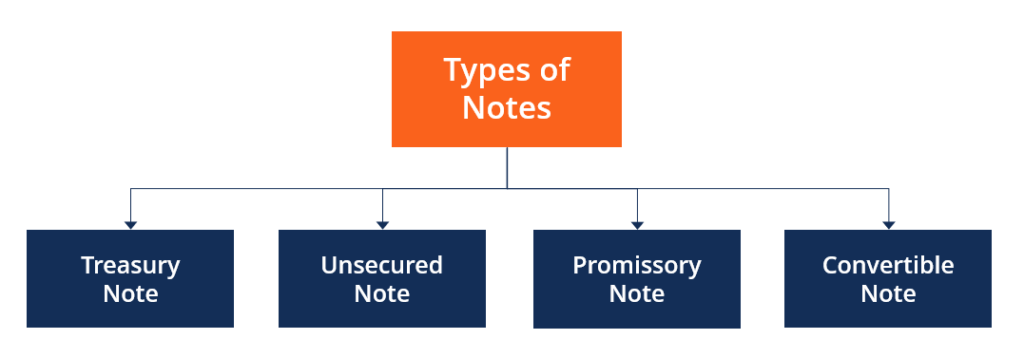
- The main types of notes include promissory notes, Treasury notes, unsecured notes, convertible notes, and structured notes.
- A note includes all the terms of debt, including the principal amount, interest rate, terms of repayment, and maturity date.
Types of Notes
The following are the main types of notes:
1. Treasury Note
Treasury notes are fixed-income investments that are issued by the U.S. government through the Department of Treasury. These instruments are guaranteed by the U.S. government, making them some of the safest investments for investors. Treasury notes are issued when the government intends to raise funds to undertake infrastructural projects, pay maturing debts, or undertake new projects in the economy.
Usually, Treasury notes come with a fixed interest rate and maturities of 2, 3, 5, 7, and 10 years. Treasury notes pay interest every six months for the full term of the instrument. Treasury notes are available in either competitive or uncompetitive bid. Competitive bids allow investors to specify the yield they expect to earn from the note, at the risk that the specified yield may not be approved.
An uncompetitive bid is a bid where investors accept the yield determined automatically during an auction. Treasury notes are different from Treasury bonds, which come with a longer maturity period of between 10 years and 30 years.
2. Unsecured Note
An unsecured note is a debt instrument that comes with a maturity of three to ten years. The note is not secured by the issuer’s assets, as is the case with other types of notes. Instead, it is backed by the issuer’s promise to pay, which makes it riskier than other security investments.
Due to the increased level of risk associated with unsecured notes, it offers a higher rate of return than secured notes to compensate for the risk of loss. Companies issue unsecured notes through private offerings to raise capital for corporate activities, such as share repurchasesShare RepurchaseA share repurchase refers to when the management of a public company decides to buy back company shares that were previously sold to the public. A company may decide to repurchase its sharesto send a market signal that its stock price is likely to increase, to inflate financial metrics denominated by the number of shares outstanding (e.g., earnings per share or EPS), or simply because it wants to increase its own equity stake in the company..
Secured notes, on the other hand, are secured by the issuer’s assets such as insurance policies or auto loans. If the borrower defaults on the loan, the assets pledged as collateral can be auctioned to settle the missed payments.
3. Promissory Note
A promissory note is a promise by one party (note issuer) to pay another party (note payee) a specified sum of money at a predetermined date or on-demand. A promissory note includes all the terms of debt such as principal amount, maturity date, and terms of repayment. Sometimes, a promissory note may include a provision that details the payee’s rights in the event of an issuer’s default.
A promissory note uses the term “pay to the order of” to specify the party who will receive the loan repayment when it is due. When borrowing money, the issuer signs the note and hands it over to the lender as proof of the commitment to pay the loan principal, plus interest, if any. Promissory notes are used as a form of short-term financing for companies, where the issuer agrees to pay the payee an agreed sum of money within a defined period.
4. Convertible Note
A convertible note is a short-term instrument that converts into equity. It is used by angel investorsAngel InvestorAn angel investor is a person or company that provides capital for start-up businesses in exchange for ownership equity or convertible debt. They may provide a one-time investment or an ongoing capital injection to help the business move through the difficult early stages. who want to avoid placing a definite value on a company, which provides them the option of converting their creditor position into an equity position at an agreed price.
The convertible note is structured like a debt such that the capital invested into the company can be converted to an equity position at a later date in the future. The number of shares an investor gets for each note held is determined by a conversion rate, which may be fixed or changed over time, depending on the initial terms of the agreement.
For example, a conversion rate of 50 may mean that the investor will receive 50 shares of common stock per $1,000 of a par value of the convertible note. The investor may receive additional shares as a reward for being the initial investor.
Related Readings
CFI offers the Commercial Banking & Credit Analyst (CBCA)™Program Page - CBCAGet CFI's CBCA™ certification and become a Commercial Banking & Credit Analyst. Enroll and advance your career with our certification programs and courses. certification program for those looking to take their careers to the next level. To keep learning and advancing your career, the following resources will be helpful:
Debts CovenantsDebt CovenantsDebt covenants are restrictions that lenders (creditors, debt holders, investors) put on lending agreements to limit the actions of the borrower (debtor).
Negotiable Certificate of Deposit (NCD)Negotiable Certificate of Deposit (NCD)A negotiable certificate of deposit (NCD) refers to a certificate of deposit with a minimum par value of $100,000, although typically, NCDs will carry a
Short Term LoanShort Term LoanA short term loan is a type of loan that is obtained to support a temporary personal or business capital need.
Treasury BillsTreasury Bills (T-Bills)Treasury Bills (or T-Bills for short) are a short-term financial instrument issued by the US Treasury with maturity periods from a few days up to 52 weeks.
-

Variable Rate Demand Notes (VRDNs): Understanding Floating Rate Debt
A variable rate demand note (VRDN) is a long-term floating rate instrument. It carries an interest rate that accrues periodically in line with the current money markets. From the outset of the loan, t
-
Understanding Cryptocurrency: A Beginner's Guide to Digital Currency
Cryptocurrency is a kind of digital currency that is intended to act as a medium of exchange. Cryptocurrency has become popular in the last decade, in particular, with Bitcoin becoming the most widel
invest
- Loan Note: Definition, Purpose & Key Features - [Your Company Name]
- Understanding the 10-Year US Treasury Note: Definition & Key Features
- Convertible Notes: A Comprehensive Guide for Investors & Startups
- What is an Equity-Linked Note (ELN)?
- Medium-Term Notes (MTNs): Definition, Features & How They Work
- Structured Notes: Understanding Hybrid Investments & Potential Returns
- Understanding Notes Payable: A Comprehensive Guide
- Understanding Notes Receivable: A Comprehensive Guide
- Promissory Note: Definition, Types & Key Terms - [Your Company Name]
-
 Reverse Convertible Notes (RCNs): A Comprehensive Guide
A Reverse Convertible Note (RCN) is a short-term investment option that can be very helpful to investors suffering from some cash flow problems. RCNs are securitiesMarketable SecuritiesMarketable secu...
-
 Variable Coupon Renewable Notes (VCRs): Explained
A variable coupon renewable note (VCR) is a type of fixed-income security that is renewable. Its distinguishing characteristic is that the return, which is known as the variable coupon rate, is subjec...