
Reverse Convertible Notes (RCNs): A Comprehensive Guide
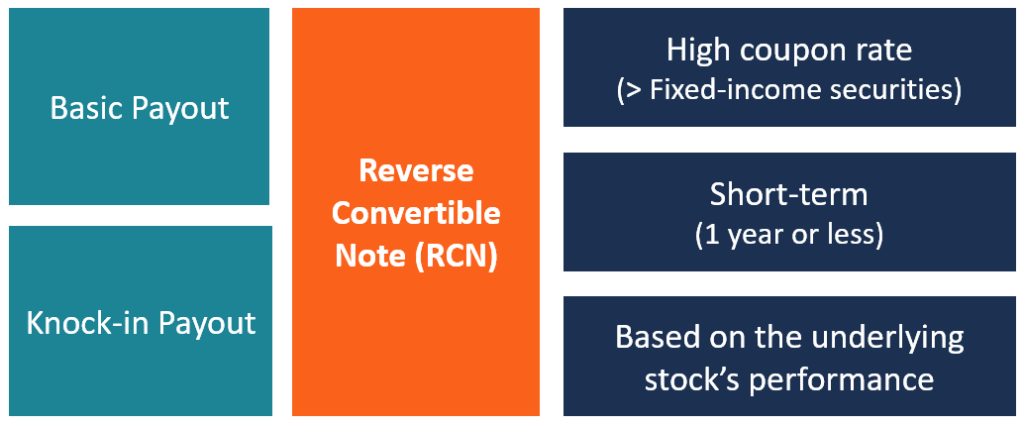
A Reverse Convertible Note (RCN) is a short-term investment option that can be very helpful to investors suffering from some cash flow problems. RCNs are securitiesMarketable SecuritiesMarketable securities are unrestricted short-term financial instruments that are issued either for equity securities or for debt securities of a publicly listed company. The issuing company creates these instruments for the express purpose of raising funds to further finance business activities and expansion. that offer a consistent and predictable income, rivaling and surpassing traditional returns, including returns investors generally only see from high-yield bonds. The annualized coupon rateCoupon RateA coupon rate is the amount of annual interest income paid to a bondholder, based on the face value of the bond. on a reverse convertible note may exceed 25%. RCNs are sometimes referred to as “revertible notes” or “reverse exchangeable securities”.
How do RCNs work?
Reverse convertible notes are investments that are coupon-bearing, paying out interest to investors until they reach maturity. The maturities on RCNs vary from as little as a few months to as much as a couple of years. For the most part, the securities are based on the performance of the stockStockWhat is a stock? An individual who owns stock in a company is called a shareholder and is eligible to claim part of the company’s residual assets and earnings (should the company ever be dissolved). The terms "stock", "shares", and "equity" are used interchangeably. that underlies them. In most cases, the notes are issued by major financial institutionsTop Banks in the USAAccording to the US Federal Deposit Insurance Corporation, there were 6,799 FDIC-insured commercial banks in the USA as of February 2014. . The companies that initially issued the stocks linked to the notes are not involved in any way.
There are two primary parts to a reverse convertible note: a put option and a debt instrument. When a note is purchased, the buyer is giving the RCN’s issuer the opportunity to provide him or her with the underlying asset in the future.
Determining Reverse Convertible Note Payouts
A reverse convertible note pays the investor a predetermined coupon rate before it reaches maturity. Payments are typically made quarterly. The consistency of the rate is a reflection of the volatility of the RCN’s underlying stock. The investor assumes more risk when the stock’s potential for volatility is higher. For investors willing to take greater risks, more is offered for the put option, which means a higher coupon rate.
Upon reaching maturity, the investor receives either a full reimbursement of the original investment or a previously determined quantity of shares of the stock that is the underlying asset for the reverse convertible note. The number of shares is calculated by dividing the investor’s original investment amount by the initial price of the stock.
Structures of Payouts
There are two structures that are used to determine whether an investor receives his initial investment back or shares of the stock.
1. Basic structure
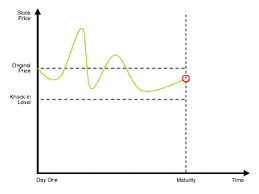
In a basic structure, the investor will receive 100% of his original investment back if the RCN’s underlying stock closes at or above its initial price. The investor receives payment in the form of stock shares if the stock closes below its initial price, meaning the investor doesn’t get a full refund on his initial investment.
2. Knock-in structure
The knock-in structure for a reverse convertible note involves the same principles as the basic structure. However, the investor also gets some downside protection. For example, suppose an investor makes a $20,000 RCN investment that includes a 70% knock-in level, which acts as a protective barrier.
If the initial price of the RCN’s underlying stock is $60, and the stock’s price at maturity of the RCN is higher than the $42 knock-in price, the investor will receive his initial $20,000 investment back. If the stock goes below the knock-in price during its lifetime and closes below it at the note’s maturity, the investor will receive stock shares. For our example, the investor would receive about 333 shares ($20,000 ÷ $60).
Risks of RCNs
The basic risk of a reverse convertible note is losing a portion of the principal investment once the note matures. Remember that the maximum amount an investor can receive is limited to the coupon interest rate. There are a few more risks to be aware of:
1. Taxes
RCNs are two-part investments, comprised of a put option and a debt instrument. This makes the tax treatment of RCNs complex and means that an investor could be required to pay ordinary income tax and capital gains taxes on his returns.
2. Default risk
By purchasing an RCN, the investor must rely on the ability of the issuing company to make regular interest payments during the note’s lifetime and to be able to make the principal payment once the note reaches maturity.
3. Call provisions
Certain RCNs include a mitigating feature that can strip the investor of the RCN when it begins to yield fruitfully and when interest rates are low.
4. Secondary market limitations
Each investor must be willing to hold the RCN to maturity. In most cases, the financial institution that issues the RCN attempts to maintain a secondary marketSecondary MarketThe secondary market is where investors buy and sell securities from other investors. Examples: New York Stock Exchange (NYSE), London Stock Exchange (LSE). so that investors can sell an RCN before it matures. There is, however, no guarantee that a secondary market will be available, and the investor runs the additional risk of getting less than the RCN’s original cost if he sells.
More Resources
We hope you enjoyed reading the CFI guide to reverse convertible notes. To learn more about this subject and many more, CFI offers a number of additional free resources that may be helpful:
- Expected ReturnExpected ReturnThe expected return on an investment is the expected value of the probability distribution of possible returns it can provide to investors. The return on the investment is an unknown variable that has different values associated with different probabilities.
- Market Risk PremiumMarket Risk PremiumThe market risk premium is the additional return an investor expects from holding a risky market portfolio instead of risk-free assets.
- Finance Terms and DefinitionsTermsImportant finance and accounting terms defined. Learn about a wide range of topics for financial analysts performing financial modeling and valuation work. These terms will give you quick answers to your most common questions
- Investing: A Beginner’s GuideInvesting: A Beginner's GuideCFI's Investing for Beginners guide will teach you the basics of investing and how to get started. Learn about different strategies and techniques for trading
-

Black Monday 1987: Causes, Impact & Historical Significance
“Black Monday” – as it is referenced today – took place on October 19 (a Monday) in 1987. On this day, stock markets around the world crashed, though the event didn’t hap
-

Black Tuesday: Causes, Impact, and Historical Significance
Black Tuesday is the stock market crash that occurred on October 29, 1929. It is considered the most disastrous market crash in the history of the United States. The Black Tuesday event was preceded b
invest
- Convertible Notes: A Comprehensive Guide for Investors & Startups
- Understanding Downtrends: Definition, Identification & Reversal
- Fair Value Security: Understanding Valuation & the Discounted Cash Flow (DCF) Method
- Margin Trading Explained: Borrowing Money to Invest
- Understanding Non-Assessable Stock: Limited Liability Explained
- Understanding Notes: Definition, Types & Issuance
- Understanding Overweight Stocks: A Comprehensive Guide
- Reverse Stock Split Explained: What It Is & How It Works
- Stock Indexes Explained: A Beginner's Guide to Market Benchmarks
-
 Activist Investors: Definition, Strategy & Impact
An activist investor is an individual or institutional investor that seeks to acquire a controlling interest in a target company by gaining seats on the company’s board of directorsBoard of Dire...
-
 Allotment Explained: Resource & Equity Distribution in Business
The term allotment, in business, refers to the structured and systematic distribution of the business’ resources. Commonly, the term allotment is used in the context of equity distribution in fi...