
Understanding NAV Return: A Key Performance Indicator
NAV return, or net asset value return, is a performance measurement for an entity’s assets minus liabilities. NAV return is typically used to measure the performance of mutual funds, open-end funds, or exchange traded funds (ETFs)Exchange Traded Fund (ETF)An Exchange Traded Fund (ETF) is a popular investment vehicle where portfolios can be more flexible and diversified across a broad range of all the available asset classes. Learn about various types of ETFs by reading this guide. because shares of the funds are typically purchased at their NAV.

Net asset value return can also be used to measure the value of a company – it is comparable to using the book or equity valueEquity ValueEquity value can be defined as the total value of the company that is attributable to shareholders. To calculate equity value follow, this guide from CFI.. Furthermore, NAV return is useful in finding intrinsic value, as it takes the change in net assets over time.
Summary
- NAV return, or net asset value return, is a performance measurement for mutual funds, ETFs, and open-end funds.
- There are two methods to find NAV return: (1) finding the return of total NAV or (2) finding the return of NAV per share.
- NAV return is calculated by finding the percentage change of NAV over a time period.
How to Calculate NAV Return
NAV return can be calculated using two methods:
1. Find the return of total NAV.
2. Find the return of NAV per shareNet Asset Value Per Share (NAVPS)The Net Asset Value Per Share (NAVPS) is a metric used to assess the value of a real estate investment trust (REIT), and it indicates the worth of one share.
NAV Return Formula using Total NAV

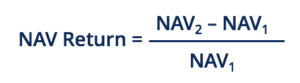
Where:
- NAV1 = NAV at time 1
- NAV2 = NAV at time 2
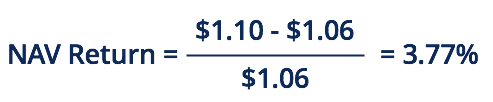
NAV Return Formula using NAV Per Share


Where:
- NAV1/Share = NAV per share at time 1
- NAV2/Share = NAV per share at time 2
Example of NAV Return
A mutual fund’s been open for exactly one year and would like to calculate the net asset value return per share. The following information is given:
- Value of securities in the portfolio at time 1: $50 million (based on end-of-day closing prices)
- Value of securities in the portfolio at time 2: $75 million (based on end-of-day closing prices)
- Cash and cash equivalents at time 1: $15 million
- Cash and cash equivalents at time 2: $10 million
- Short-term liabilities at time 1: $2 million
- Short-term liabilities at time 2: $4 million
- Long-term liabilities at time 1: $10 million
- Long-term liabilities at time 2: $15 million
- 50 million shares outstanding at time 1
- 60 million shares outstanding at time 2


Application of NAV Return
NAV return is typically calculated daily for mutual funds, open-end funds, and ETFs based on the daily NAV of the fund, which is reported at the end of each trading day. The NAV value changes daily, as assets are based on their market values.
In addition, the net asset value return is a transparent performance measure, as it only includes the actual assets in the fund at the end of each day. Unlike other performance measures, it does not include capital gainsCapital Gains YieldCapital gains yield (CGY) is the price appreciation on an investment or a security expressed as a percentage. Because the calculation of Capital Gain Yield involves the market price of a security over time, it can be used to analyze the fluctuation in the market price of a security. See calculation and example distributions, dividends paid, or interest paid to shareholders unless they were reinvested into the fund. The value is typically calculated by the fund’s accountants.
Net Asset Value Return vs. Total Return
The total return of a fund includes distribution payouts, such as dividendsDividendA dividend is a share of profits and retained earnings that a company pays out to its shareholders. When a company generates a profit and accumulates retained earnings, those earnings can be either reinvested in the business or paid out to shareholders as a dividend.; thus, it includes distribution that’s not been reinvested into the fund, whereas net asset value return only includes distributions that are reinvested. Additionally, the total return of a fund includes the capital gains and losses from the securities held in the fund; also, it includes any expenses charged by the fund.
The total return is argued to be the better performance measurement of a fund, as it more accurately reflects what a shareholder would receive. An investor must look at the total return of a fund as a whole, for example, a dividend-seeking investor may only focus on the fund’s dividend yield, yet there may be high-performing funds that don’t give out dividends.
Additionally, since the net asset value return does not include dividends and other types of distributions, it may not accurately depict the return a shareholder would receive in a fund with a high dividend yield. Therefore, when analyzing a fund’s performance, it is important to not look at only one return or one aspect of a return in isolation; analyzing a fund’s performance is best done by using multiple returns and ratios.
Additional Resources
CFI is the official provider of the global Commercial Banking & Credit Analyst (CBCA)™Program Page - CBCAGet CFI's CBCA™ certification and become a Commercial Banking & Credit Analyst. Enroll and advance your career with our certification programs and courses. certification program, designed to help anyone become a world-class financial analyst. To keep advancing your career, the additional resources below will be useful:
- Net Asset Value Per Share (NAVPS)Net Asset Value Per Share (NAVPS)The Net Asset Value Per Share (NAVPS) is a metric used to assess the value of a real estate investment trust (REIT), and it indicates the worth of one share
- Open-end vs Closed-end Mutual FundsOpen-end vs Closed-end Mutual FundsMany investors consider open-end vs. closed-end mutual funds similar due to both mutual funds allowing them a low-cost way to pool capital together and
- Intrinsic ValueIntrinsic ValueThe intrinsic value of a business (or any investment security) is the present value of all expected future cash flows, discounted at the appropriate discount rate. Unlike relative forms of valuation that look at comparable companies, intrinsic valuation looks only at the inherent value of a business on its own.
- Rate of ReturnRate of ReturnThe Rate of Return (ROR) is the gain or loss of an investment over a period of time copmared to the initial cost of the investment expressed as a percentage. This guide teaches the most common formulas
-

Return on Invested Capital (ROIC): Definition & Calculation
Return on Invested CapitalInvested CapitalInvested capital is the investment made by both shareholders and debtholders in a company. When a company needs capital to expand, it can obtain it either by
-

Understanding Return on Investment (ROI): A Comprehensive Guide
Return on Investment (ROI) is a performance measure used to evaluate the returns of an investment or to compare the relative efficiency of different investments. ROI measures the return of an investme
invest
- Understanding Alpha: A Guide to Investment Performance
- Cash-on-Cash Return: Definition, Calculation & Importance
- Understanding Rate of Return: A Comprehensive Guide
- Return on Ad Spend (ROAS): Definition & Importance for eCommerce
- Understanding Abnormal Returns: A Guide to Investment Performance
- Understanding Absolute Return: A Comprehensive Guide
- Annual Return: Definition, Calculation & Understanding
- Understanding Average Return: A Simple Guide
- Understanding Expected Return: A Comprehensive Guide
-
 Continuous Compounding Return: Definition & Calculation
Continuously compounded return is what happens when the interest earned on an investment is calculated and reinvested back into the account for an infinite number of periods. The interest is calculate...
-
![Return on Equity (ROE): Definition & Calculation | [Your Company Name]](https://www.etffin.com/article/uploadfiles/202110/2021100815173670_S.png) Return on Equity (ROE): Definition & Calculation | [Your Company Name]
Return on Equity (ROE): Definition & Calculation | [Your Company Name]Return on Equity (ROE) is the measure of a company’s annual return (net incomeNet IncomeNet Income is a key line item, not only in the income statement, but in all three core financial statement...