
Continuous Compounding Return: Definition & Calculation
Continuously compounded return is what happens when the interest earned on an investment is calculated and reinvested back into the account for an infinite number of periods. The interest is calculated on the principal amount and the interest accumulated over the given periods and reinvested back into the cash balance.
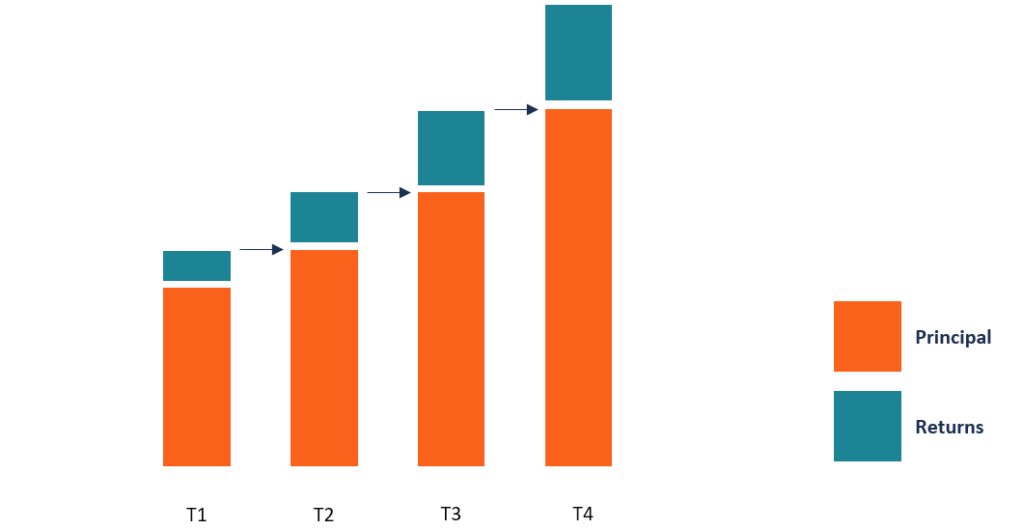
Regular compounding is calculated over specific time intervals such as monthly, quarterly, semi-annually and on an annual basis. Continuous compounding is an extreme case of this type of compounding since it calculates interest over an infinite number of periods, rather than assuming a specific number of periods. The difference between the interest earned through the traditional compounding method and the continuous compounding method may be significant.
Annual Compounding vs. Continuously Compounded Return
Investors calculate the interest or rate of returnRate of ReturnThe Rate of Return (ROR) is the gain or loss of an investment over a period of time copmared to the initial cost of the investment expressed as a percentage. This guide teaches the most common formulas on their investments using two main techniques: annual compounding and continuous compounding.
Annual compounding
Annual compounding means that the return on an investment is calculated every year, and it is different from simple interest. The annual compounding method uses the following formula:
Total = [Principal x (1 + Interest)] ^Number of years
The return on investment is obtained by deducting the principal amount from the total returns obtained using the above formula.
Assume that Company ABC invested $10,000 to purchase a financial instrument, and the rate of return is 5% for two years. Therefore, the interest earned from ABC’s investment for the two-year period is as follows:
= [10,000 x (1+0.05)^2
= (10,000 x 1.1025)
= 11,025 – 10,000
= $1,025
Therefore, Company ABC earned interest of $1,025 on its investment of $10,000 over two years.
Continuously Compounded Return
Unlike annual compounding, which involves a specific number of periods, the number of periods used for continuous compounding is infinitely numerous. Instead of using the number of years in the equation, continuous compounding uses an exponential constant to represent the infinite number of periods. The formula for the principal plus interest is as follows:
Total = Principal x e^(Interest x Years)
Where:
- e – the exponential function, which is equal to 2.71828.
Using Company ABC example above, the return on investment can be calculated as follows when using continuous compounding:
= 10,000 x 2.71828^(0.05 x 2)
= 10,000 x 1.1052
= $11,052
Interest = $11,052 – $10,000
= $1,052
The difference between the return on investmentReturn on Investment (ROI)Return on Investment (ROI) is a performance measure used to evaluate the returns of an investment or compare efficiency of different investments. when using continuous compounding versus annual compounding is $27 ($1,052 – $1025).
Daily, Monthly, Quarterly, and Semi-annual Compounding
Apart from the annual and continuous compounding methods, interest can also be compounded at different time intervals such as daily, monthly, quarterly and semi-annually.
To illustrate compounding at different time intervals, we take an initial investment of $1,000 that pays an interest rateInterest RateAn interest rate refers to the amount charged by a lender to a borrower for any form of debt given, generally expressed as a percentage of the principal. of 8%.
Daily compounding
The formula for daily compounding is as follows:
= Principal x (1+Interest/365)^365
= 1,000 x (1 + 0.08/365) ^ 365
= 1,000 x (1 + 0.00022)^365
= 1,000 x (1.00022) ^ 365
= 1,000 x 1.0836
= $1,083.60
Monthly compounding
The formula for the monthly intervals is as follows:
= Principal x (1+Interest/12)^12
= 1,000 x (1+0.08/12) ^12
= 1,000 x [1+0.0067)^12
= 1,000 x (1.0067)^12
= 1,000 x (1.083)
= $1,083.00
Quarterly compounding
The formula for quarterly compounding is as follows:
= Principal x (1 + interest/4)^4
= 1,000 x (1 +0.08/4)^4
= 1,000 x (1 + 0.02)^4
= 1,000 x (1.02)^4
= 1,000 x 1.0824
= $1,082.40
Semi-annual compounding
The formula for semi-annual compounding is as follows:
= Principal x (1 + interest/2)^2
= 1,000 x (1 + 0.08/2)^2
= 1,000 x (1 + 0.04)^2
= 1,000 x (1.04)^2
= 1,000 x 1.0816
= $1,081.60
Conclusion on Compounding Intervals
From the above calculations, we can conclude that all the intervals produce an almost equal interest, but with a small variation. For example, quarterly compounding produces an interest of $82.40, which is slightly higher than the interest produced by semi-annual compounding at $81.60.
Also, the monthly rate yields an interest of $83, which is slightly higher than the interest produced by quarterly rates at $82.40. Daily compounding yields a higher interest of $83.60, which is slightly higher than the interest at monthly rates of $82.60.
From the pattern above, we can also say that small interest compounding intervals produce higher interest rates compared to large compounding intervals.
Importance of Continuous Compounding
Continuous compounding offers various benefits over simple interestSimple InterestSimple interest formula, definition and example. Simple interest is a calculation of interest that doesn't take into account the effect of compounding. In many cases, interest compounds with each designated period of a loan, but in the case of simple interest, it does not. The calculation of simple interest is equal to the principal amount multiplied by the interest rate, multiplied by the number of periods. and regular compounding. The benefits include:
1. Reinvest gains perpetually
One of the benefits of continuous compounding is that the interest is reinvested into the account over an infinite number of periods. It means that investors enjoy the continuous growth of their portfolios, as compared to when they earn interest monthly, quarterly, or annually with regular compounding.
2. Interest amount will keep on growing
In continuous compounding, both the interest and the principal keep on growing, which makes it easier to multiply the returns in the long term. Other forms of compounding only earn interest on the principal and that interest is paid out as it is earned. Reinvesting the interest allows the investor to earn at an exponential rate for an infinite number of periods.
Additional Resources
Thank you for reading CFI’s explanation of continuously compounded return. CFI offers the Financial Modeling & Valuation Analyst (FMVA)™Become a Certified Financial Modeling & Valuation Analyst (FMVA)®CFI's Financial Modeling and Valuation Analyst (FMVA)® certification will help you gain the confidence you need in your finance career. Enroll today! certification program for those looking to take their careers to the next level. To keep learning and advancing your career, the following CFI resources will be helpful:
- Annual Percentage Rate (APR)Annual Percentage Rate (APR)The Annual Percentage Rate (APR) is the yearly rate of interest that an individual must pay on a loan, or that they receive on a deposit account. Ultimately, APR is a simple percentage term used to express the numerical amount paid by an individual or entity yearly for the privilege of borrowing money.
- Compound Annual Growth Rate (CAGR)CAGRCAGR stands for the Compound Annual Growth Rate. It is a measure of an investment’s annual growth rate over time, with compounding taken into account.
- Interest Rate CalculatorInterest Rate CalculatorInterest Rate Calculator to help you compute the effective interest rate based on the number of periods, type of interest rate, and initial balance amount.
- Principal PaymentPrincipal PaymentA principal payment is a payment toward the original amount of a loan that is owed. In other words, a principal payment is a payment made on a loan that reduces the remaining loan amount due, rather than applying to the payment of interest charged on the loan.
-

Return on Capital Employed (ROCE): Definition & Calculation
Return on Capital Employed (ROCE), a profitability ratio, measures how efficiently a company is using its capitalCapital StructureCapital structure refers to the amount of debt and/or equity employed
-
Return on Common Equity (ROCE): Definition & Importance
The Return on Common Equity (ROCE) ratio refers to the return that common equity investors receive on their investment. ROCE is different from Return on Equity (ROE)Return on Equity (ROE)Return on Equ
finance
- Continuously Compounded Return: Calculation & Investment Analysis
- Understanding Alpha: A Guide to Investment Performance
- Cash-on-Cash Return: Definition, Calculation & Importance
- Understanding Continuously Compounded Interest & Key Financial Ratios
- Understanding Rate of Return: A Comprehensive Guide
- Return on Ad Spend (ROAS): Definition & Importance for eCommerce
- Understanding Average Return: A Simple Guide
- Understanding Expected Return: A Comprehensive Guide
- Understanding NAV Return: A Key Performance Indicator
-
 Indexed Annuities: A Comprehensive Guide for Retirees
An indexed annuity is a financial product that pays out a return based on the performance of a linked index. The contract is backed by an insurance company and is popular among retirees because it pro...
-
 Operating Return on Assets (OROA): Definition & Calculation
Operating return on assets (OROA), an efficiency or profitability ratioProfitability RatiosProfitability ratios are financial metrics used by analysts and investors to measure and evaluate the ability...