
Return on Ad Spend (ROAS): Definition & Importance for eCommerce
ROAS stands for “Return on Ad Spend,” a very popular financial metric in the world of digital marketing in particular, and a similar alternative metric to ROI, or “Return on Investment.” ROAS is commonly used in eCommerce businesses to evaluate the effectiveness of a marketing campaign.
It should be noted that having a high return on ad spend does not necessarily mean a company is profitable, as there are many other expenses that have to be deducted before determining a company’s net profit margin. This metric does, however, show the existing correlation between advertising efforts and revenues.
In addition to gauging how generally effective a company’s advertising is in terms of generating sales, ROAS can also be used to compare the cost-effectiveness of one marketing campaign against another. For example, advertising campaign “A” may generate twice as large an increase in sales volume as advertising campaign “B” does, but if campaign “B” costs only one-fifth the price of campaign “A”, then “B” is a more cost-efficient advertising expenditure.
Some advertising efforts can boost total sales without measurably improving profitability, while other efforts may show a significant rise in net profit margin even though sales only rise slightly. This might be due to the fact that campaign “B” primarily helped to increase sales of products with very high profit margins.
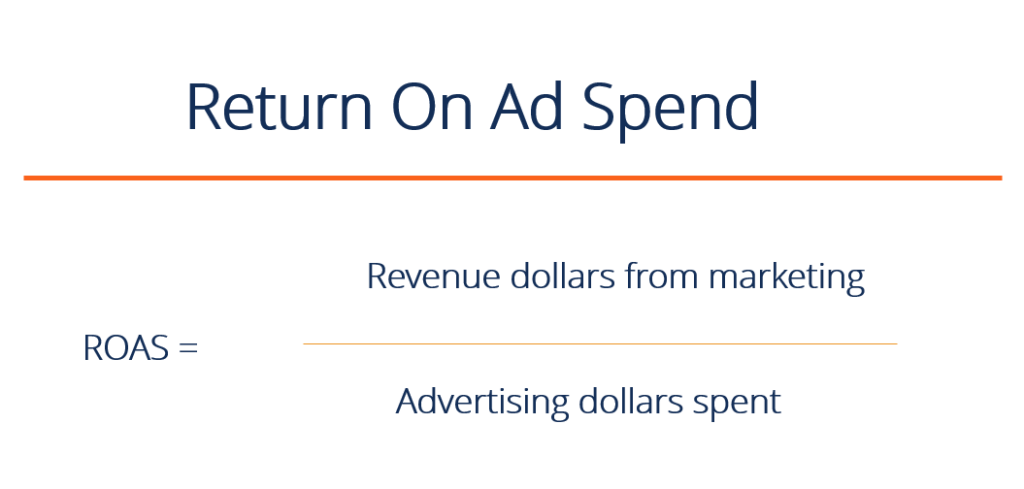
What is the ROAS Formula?
Below is the Return on Advertising Spend formula:
Revenue Dollars / Advertising Spend Dollars
See an example in Excel here.
Example Calculation
An eCommerce company spends $100,000 on a Google AdWords campaign and generates $250,000 of product sales on its website, directly from those ads.
Revenue = $250,000
Advertising = $100,000
= $250,000 / $100,000
ROAS = 2.5
If ROAS > 1, then you are at least covering your marketing expenses with revenue, but are likely losing money after deducting expenses. In broad, general terms, a ROAS of 3 or more – which means every one dollar spent on advertising generates three dollars in revenue – is considered “good.” What constitutes a desirable ROAS varies significantly according to industry, type of business, size of the business, etc. As with most financial metrics, examining a company’s ROAS is most meaningful when compared with other very similar companies, and with the company’s own financial history. A company that gradually raises its number from 4 to 7 during its first five years in business is apparently getting better and better at producing cost-effective marketing campaigns.
Challenges with ROAS
Revenue from ads is not necessarily a good indication of economic benefit because Return on Ad Spend may be considered a vanity metric. A vanity metric is a figure that managers/owners favor mostly due to ego, and that doesn’t necessarily contribute to long-term business viability.
A better metric to use may be something such as Contribution Margin, which is equal to revenue minus variable costs, e.g., cost of goods sold (COGS)AccountingOur Accounting guides and resources are self-study guides to learn accounting and finance at your own pace. Browse hundreds of guides and resources. and shipping. For many eCommerce businesses, cost of goods sold and shipping are major expenses, and may not leave much of a net return.
To learn more about ROAS and contribution margin, check out our online course on eCommerce Financial Modeling. This course will show you, step by step, how to model the economics of a marketing campaign for an eCommerce business.
More learning
Thank you for reading this guide to Return on Ad Spend. To learn more about other ways of measuring return on investment for corporations, check out the following CFI resources:
- LTV/CAC ratioCAC LTV RatioThe LTV/CAC ratio compares the average cost of acquiring a customer to the average lifetime value of a customer. It is used in eCommerce and SaaS
- Hurdle ratesHurdle Rate DefinitionA hurdle rate, which is also known as minimum acceptable rate of return (MARR), is the minimum required rate of return or target rate that investors are expecting to receive on an investment. The rate is determined by assessing the cost of capital, risks involved, current opportunities in business expansion, rates of return for similar investments, and other factors
- Return on AssetsReturn on Assets & ROA FormulaROA Formula. Return on Assets (ROA) is a type of return on investment (ROI) metric that measures the profitability of a business in relation to its total assets.
- Return on EquityReturn on Equity (ROE)Return on Equity (ROE) is a measure of a company’s profitability that takes a company’s annual return (net income) divided by the value of its total shareholders' equity (i.e. 12%). ROE combines the income statement and the balance sheet as the net income or profit is compared to the shareholders’ equity.
- What is Financial ModelingWhat is Financial ModelingFinancial modeling is performed in Excel to forecast a company's financial performance. Overview of what is financial modeling, how & why to build a model.
- Financial Modeling for DummiesFinancial Modeling for BeginnersFinancial modeling for beginners is our introductory guide to financial modeling - we cover how to build a model, Excel formulas, best practices, and more.
To find out more about finance careers out our interactive Career Map.
-

Understanding Risk and Return in Investing
In investing, risk and return are highly correlated. Increased potential returns on investment usually go hand-in-hand with increased risk. Different types of risks include project-specific
-

Amended Tax Return: Definition, Filing & 1040-X Form
An amended return is filed with the tax authority to make corrections to a previous year’s tax return. The tax return’s amended version can increase tax benefits or tax liability, dependin
finance
- Understanding Alpha: A Guide to Investment Performance
- Understanding CAPM: A Comprehensive Guide to Capital Asset Pricing
- Cash-on-Cash Return: Definition, Calculation & Importance
- Continuous Compounding Return: Definition & Calculation
- Understanding Rate of Return: A Comprehensive Guide
- Return on Equity (ROE): Definition & Calculation | [Your Company Name]
- Understanding Average Return: A Simple Guide
- Understanding Expected Return: A Comprehensive Guide
- Understanding NAV Return: A Key Performance Indicator
-
 K-Ratio Explained: Measuring Investment Growth & Consistency
The K-Ratio is a statistical tool that helps us measure two things – the growth of return and the consistency of that growth over a specified period. It is often used to determine the risk vs. r...
-
 Understanding Negative Investment Returns: Causes & Impact
A negative return represents an economic loss incurred by an investment in a project, a business, a stock, or other financial instruments. As a result of an investment failure, a negative return happe...