
What is a Nest Egg? Definition, Benefits & How to Build One
A nest egg is a large amount of money and assets that have been accumulated and saved up over time for a specific purpose. A nest egg can be saved up for buying a house or funding college education. However, it is most commonly used to refer to saving for retirement.

Understanding Nest Eggs
It is called a nest egg because it is a valuable amount of money that is set aside and invested throughout working years so that a person can have it grow over time for the purpose that they require it for.
The term originated from the practice of farmers putting eggs into the nest of hens to induce them to lay even more eggs. When you put money into a “nest egg” savings accountSavings AccountA savings account is a typical account at a bank or a credit union that allows an individual to deposit, secure, or withdraw money when the need arises. A savings account usually pays some interest on deposits, although the rate is quite low., you are putting in that initial capital that will hopefully grow into a greater sum over time. Over long periods of time, the compounding effect will increase the funds exponentially.
Compounding
Compounding is the process in which an investment’s returns grow exponentially over time due to the accumulation of reinvested earnings. It is an exponential process as opposed to linear, meaning that the rate at which the investment grows actually increases over time.
Compounding results in returns on returns that accumulate to greater sums over time.
Example
Let’s take an example where you make a $1,000 investment that returns exactly 10% in cash every year. Assume you are able to reinvest the cash at the same 10% rate.
In the first year, you will receive simply $100 cash ($1,000 x 10%). However, when you reinvest the $100, your investment is now $1,100.
Therefore, in the second year, the amount received is $110 ($1,100 x 10%), which is more than the first year. In the third year, you receive $121, and the process continues as you accumulate money at an increasing rate over time.
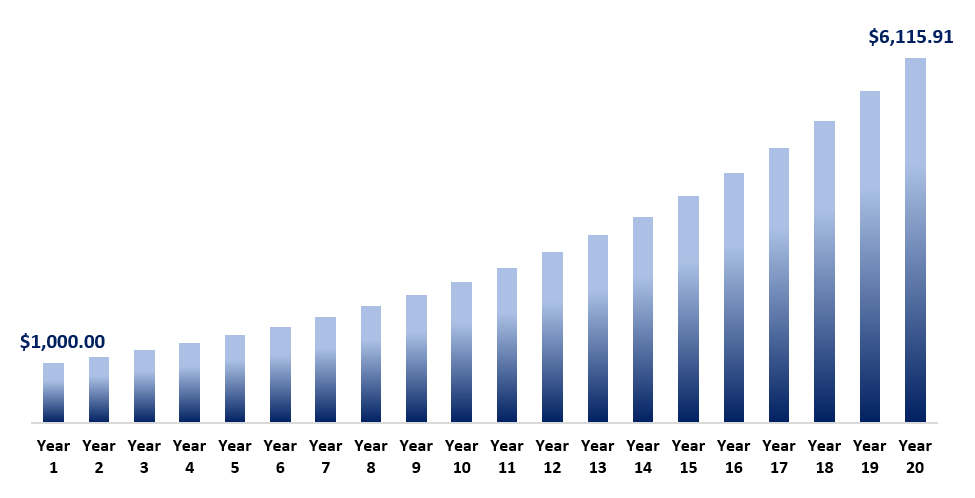
By the end of 20 years, the $1,000 investment, with no additional investments other than the reinvesting of earnings, has grown by six times the initial amount. It goes to show the power of compounding over time.
Starting a Nest Egg
Starting a nest egg can be for a variety of reasons. The reasons can range from saving for retirement to saving to purchase a house or even smaller reasons, such as to buy a car or to create an emergency fund.
The best way to start building a nest egg is to have a goal set out.
Example
For example, if you wish to buy a $500,000 house, then you should set up a financial plan. The plan will include the various components of a time value of money (TVM)Time Value of MoneyThe time value of money is a basic financial concept that holds that money in the present is worth more than the same sum of money to be received in the future. This is true because money that you have right now can be invested and earn a return, thus creating a larger amount of money in the future. (Also, with future calculator:
- Present value
- Interest yield
- Number of periods
- Payments
- Future value
The present value will include the amount of money you have to start saving with.
The interest yield is the expected interest, or return you expect on your investments.
The number of periods would be the number of periods until you reach your goal based on how often you are contributing. For example, if you want to reach $500,000 in two years, making monthly payments, then that would be 24 periods (12 months x 2 years).
Payments are the value of periodic contributions you are making to reach your goal.
The future value, in this case, will be $500,000.
Using a TVM calculator, you can calculate each component by specifying the other components.
For example, you can calculate how long it will take to save $500,000 with $10,000 monthly contributions at a 5% interest yield. Or, you can calculate what monthly contributions you will need to make to save up $500,000 in three years at a 5% interest rate.
Retirement Savings
Although many governments provide public funding for senior citizens, such as Social Security in the U.S or Canadian Pension Plan (CPP) and Old Age Security (OAS) in Canada, the funding is likely not enough for retirement. Therefore, it is very important for individuals to build a nest egg so that they can retire comfortably when they are no longer able to work.
The key to building a nest egg is to start as early as possible. It is so that you can reap the benefits of compounding. As mentioned earlier, compounding is more effective over longer periods of time.
Importance of a Nest Egg
Many people go through their careers without planning for retirement correctly, and without building a proper nest egg. It leaves many people disadvantaged and panicked by the time they start coming close to retirement. By this time, it is too late to reap the full benefits of compounding.
As mentioned earlier, it is important to start saving early and often. Life is unpredictable, and having a strong nest egg can increase the security and reduce the stress of a person and their family.
A nest egg can be stored in various asset classes – cash, bonds, stocks, real estateReal EstateReal estate is real property that consists of land and improvements, which include buildings, fixtures, roads, structures, and utility systems. Property rights give a title of ownership to the land, improvements, and natural resources such as minerals, plants, animals, water, etc., etc. Consulting with a financial planner and utilizing tax-free savings accounts are methods to ensure that your nest egg is being saved up as efficiently as possible.
More Resources
CFI is the official provider of the Commercial Banking & Credit Analyst (CBCA)™Program Page - CBCAGet CFI's CBCA™ certification and become a Commercial Banking & Credit Analyst. Enroll and advance your career with our certification programs and courses. certification program, designed to transform anyone into a world-class financial analyst.
In order to help you become a world-class financial analyst and advance your career to your fullest potential, these additional resources will be very helpful:
- 401(k) Plan401(k) PlanThe 401(k) plan is a retirement savings plan that enables employees to save a portion of their salary before taxes throguh contributing to a retirement fund
- Personal FinancePersonal FinancePersonal finance is the process of planning and managing personal financial activities such as income generation, spending, saving, investing, and protection. The process of managing one’s personal finances can be summarized in a budget or financial plan.
- Roth IRARoth IRARoth IRA refers to a type of individual retirement account that a holder funds with no tax deduction and makes tax-free withdrawals while being retired.
- Vanilla StrategyVanilla StrategyVanilla strategy refers to a mainstream approach to investment-related decision-making in businesses. The broad characteristics of a vanilla strategy are
-

Securities Explained: A Beginner's Guide to Stocks, Bonds & More
Many people wondering what securities are may not realize that they're likely already familiar with this investment category. The most common examples include stocks and bonds.Along with commodit
-
Registered Retirement Income Funds (RRIF): Your Guide to Retirement Income
So, what is it exactly? RRIF stands for Registered Retirement Income Fund. It’s essentially a basket of investments—you can choose from GICs, mutual funds, ETFs, or stocks and bonds—that earns money d
invest
- Venmo: A Comprehensive Guide to Peer-to-Peer Payments
- Electronic Money Explained: Types, Benefits & How It Works
- Understanding Money: Definition, History & Value
- Understanding Hot Money Investments: Strategies & Capital Gains Yield
- Understanding Money Flow: A Guide for Traders
- Understanding Smart Money: Definition & Strategies
- Building a Strong Nest Egg: Your Guide to Financial Security
- Understanding Your Nest Egg: Savings for Financial Goals
- Time Value of Money: Understanding Its Importance & Calculations
-
 Earnest Money Explained: What It Is & Why It Matters
Earnest money is a deposit a potential homebuyer places to signal to the seller that they have serious interest in a property. Also called a “good faith” deposit, this money benefits both...
-
Understanding Time Value of Money: Practical Examples & Calculations
Imagine your company gives you an option: receive a one-time bonus of $500 today or the same amount of money in two weeks. You’re probably going to take the money immediately. But why? First and forem...