
NDS Explained: India's Electronic Government Securities Trading Platform
The Negotiated Dealing System (NDS) is a fully electronic trading platform that is instituted and operated by the Reserve Bank of India (RBI) with the mandate of facilitating the issuance and secondary trading of government-issued securities and other types of money market instruments.
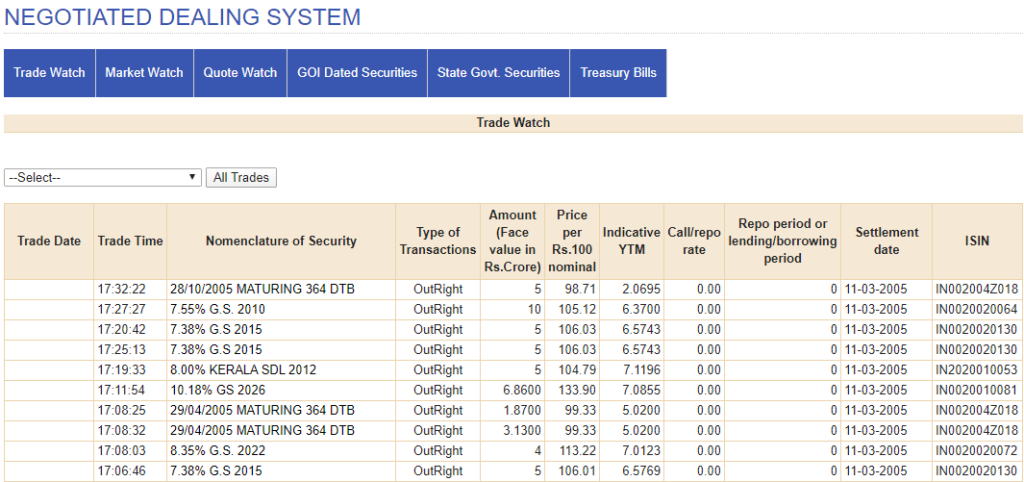
In February 2002, the Reserve Bank of India established the fully electronic Negotiated Dealing System, following the trend set by many other financial exchanges. The NDS was intended to be a more efficient alternative to physical security certificates and manual trading for government securities.
The Central Government of India issues bonds, treasury bills, and State Development Loans from the NDS platform.
The Negotiated Dealing System (NDS) Explained
The Negotiated Dealing System (NDS) was implemented in 2002 by the Reserve Bank of India, with the aim of improving the efficiency and liquidity of the fixed income market within India. The RBI’s move follows other central banks that use electronic systems for managing the issuance and secondary sale of government securities and money market accounts. The systems improve transparency, increase overall efficiency, and lower costs.
Before the NDS was implemented, most of India’s government securities were traded manually through telephone orders and physical paperwork. Buyers and sellers would place trades over the telephone, submit transfer forms, and issue physical checks to settle trades with the RBI. Clearly, it was an inefficient system, given that many of the world’s central banks in the developed world already made the switch to fully electronic trading platforms earlier.
The NDS initially was used for the issuance of government securities in the primary market. However, in August 2005, the Reserve Bank of India introduced the Negotiated Dealing System-Order Matching system (NDS-OM), which was an electronic, platform-based, anonymous, order-matching trading system for dealing in government securities on the secondary marketSecondary MarketThe secondary market is where investors buy and sell securities from other investors. Examples: New York Stock Exchange (NYSE), London Stock Exchange (LSE)..
The system was implemented to bring greater transparency and liquidity to secondary market transactions, while simultaneously allowing members of the NDS to place bids and offers directly on the NDS-OM platform.
Secondary market trading is essential to providing liquidity to government-issued securities. Enhancing the liquidity and secondary market activity was a vital step for the RBI to improve the attractiveness of their bonds, treasury bills, money-market accounts, and other securities.
Characteristics of the NDS
1. Membership
The NDS-OM platform comprises two types of members:
- Direct members
- Indirect members
Direct members hold accounts directly with the Reserve Bank of India and can settle trades directly through trades on the NDS-OM platform.
Indirect members do not hold accounts with the RBI and must settle indirectly through NDS-OM direct members who hold accounts with the Reserve.
2. Modules
The NDS comes in two modules that are designed for different types of institutions. The modules are:
- Primary market module
- Secondary market module
The primary market module is a primary auction system that is for the initial listing of federal and state securities and treasury bills. The module enables members to submit their bids on auctions fully electronically and receive trading reports.
The secondary market module is an over-the-counter (OTC)Over-the-Counter (OTC)Over-the-counter (OTC) is the trading of securities between two counter-parties executed outside of formal exchanges and without the supervision of an exchange regulator. OTC trading is done in over-the-counter markets (a decentralized place with no physical location), through dealer networks. trading platform that is cleared over the phone but is required to be reported to the NDS secondary market module. The inputted data is transferred to the Clearing Corporation of India Ltd., which proceeds to complete the trade through clearing and settlement.
Benefits of the NDS
The benefits for the Reserve Bank of India are as follows:
- Liquidity: Government securities are much more liquid and easily tradeable.
- Attractiveness: Government securities are more attractive to investors.
- Legitimacy: The legitimacy of the RBI is improved from a global perspective.
- Efficiency: Trading speed, clearing, and settlement are faster and cost less.
The benefits to investors are as follows:
- Ease of access: More investors can easily access and buy or sell government securities.
- Cost: The cost of brokers and other trading services is reduced.
- Direct investing: Investors can manage their own securities and investment portfolios more easily.
- Convenience: It is much more convenient, as trades can be made from anywhere through the access of the internet.
Related Readings
CFI is the official provider of the global Commercial Banking & Credit Analyst (CBCA)™Program Page - CBCAGet CFI's CBCA™ certification and become a Commercial Banking & Credit Analyst. Enroll and advance your career with our certification programs and courses. certification program, designed to help anyone become a world-class financial analyst. To keep advancing your career, the additional CFI resources below will be useful:
- LiquidityLiquidityIn financial markets, liquidity refers to how quickly an investment can be sold without negatively impacting its price. The more liquid an investment is, the more quickly it can be sold (and vice versa), and the easier it is to sell it for fair value. All else being equal, more liquid assets trade at a premium and illiquid assets trade at a discount.
- Marketable SecuritiesMarketable SecuritiesMarketable securities are unrestricted short-term financial instruments that are issued either for equity securities or for debt securities of a publicly listed company. The issuing company creates these instruments for the express purpose of raising funds to further finance business activities and expansion.
- Securities Investor Protection Corporation (SIPC)Securities Investor Protection Corporation (SIPC)The Securities Investor Protection Corporation (SIPC) is a non-profit, member-funded organization that works to protect customers from financial loss when a
- Trading MechanismsTrading MechanismsTrading mechanisms refer to the different methods by which assets are traded. The two main types of trading mechanisms are quote driven and order driven trading mechanisms
-

Understanding Derivatives: A Comprehensive Overview
The derivatives market refers to the financial market for financial instruments such as futures contracts or options that are based on the values of their underlying assets. SummaryThe deri
-

Money Market Funds: A Comprehensive Guide to Liquidity & Safety
Money market funds are open-ended fixed income mutual funds that invest in short-term debt securities, such as Treasury billsTreasury Bills (T-Bills)Treasury Bills (or T-Bills for short) are a short-t
invest
- Understanding the Secondary Market: A Guide for Investors
- Understanding the Call Market: Trading Hours & Price Determination
- Hindenburg Omen: Predicting Stock Market Crashes - A Comprehensive Guide
- Understanding Market Support: What is 'Holding the Market'?
- Understanding the Money Market: Short-Term Debt & Lending
- NASDAQ Explained: A Comprehensive Guide to the Stock Market Exchange
- Nasdaq Capital Market: A Guide to Small-Cap Investing
- National Market System (NMS): Understanding US Securities Trading
- No Dealing Desk (NDD) Forex Brokers: A Comprehensive Guide
-
 Australian Securities Exchange (ASX): Your Guide to Australia's Stock Market
The Australian Securities Exchange (ASX) is one of the world’s leading financial market exchanges based in Sydney, Australia. As a fully functioning securities exchange, the ASX provides a numbe...
-
 Capitalization-Weighted Index (CWI): Explained
The Capitalization-Weighted Index (cap-weighted index, CWI) is a type of stock market index in which each component of the index is weighted relative to its total market capitalizationMarket Capitaliz...