
Understanding Net Change: Definition & Calculation
Net change is the difference between the closing price of a prior trading period and the closing price of the current trading period for a financial security. Net change is generally used for stock prices, bond prices, mutual fundsMutual FundsA mutual fund is a pool of money collected from many investors for the purpose of investing in stocks, bonds, or other securities. Mutual funds are owned by a group of investors and managed by professionals. Learn about the various types of fund, how they work, and benefits and tradeoffs of investing in them, derivative products, and other tradeable securities. The net change usually refers to the daily change in price.

Net change represents the most common data represented for financial quotes. All trading platforms and real-time market data providers show net change when quoting prices. Net change is also an important information source for technical analysisTechnical Analysis - A Beginner's GuideTechnical analysis is a form of investment valuation that analyses past prices to predict future price action. Technical analysts believe that the collective actions of all the participants in the market accurately reflect all relevant information, and therefore, continually assign a fair market value to securities..
Practical Example
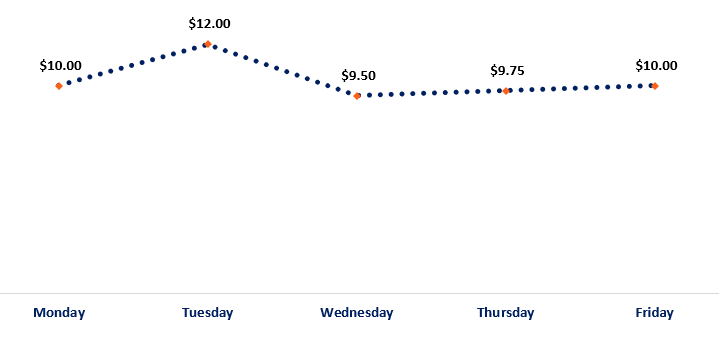
The closing price of a stock on day one (Monday) is $10.00. On day two (Tuesday), the stock closes at $12.00; on day three (Wednesday), the stock closes at $9.50; on day four (Thursday), the stock closes at $9.75; and on day five (Friday), the stock closes at $10.00.
What is the daily and weekly net change of the stock?
The net change on day two is +$2.00 ($12.00 – $10.00)
The net change on day three is -$2.50 ($9.50 – $12.00)
The net change on day four is +$0.25 ($9.75 – $9.50)
The net change on day five is +$0.25 ($10.00 – $9.75)
However, the net change over the week is $0.00 ($10.00 – $10.00) since a trading week is only five days.
Understanding Net Change
The net change can be the difference in price from any trading period, no matter the length, for various financial assets. Some examples of financial assets include:
- Stocks
- Bonds
- ETFsExchange Traded Fund (ETF)An Exchange Traded Fund (ETF) is a popular investment vehicle where portfolios can be more flexible and diversified across a broad range of all the available asset classes. Learn about various types of ETFs by reading this guide.
- Commodity contracts
- Mutual funds
- Futures
- Options
One thing to note is that all the financial assets trade in an active market or exchange. It allows for liquidity and price efficiency so that the net change can be accurately reflected. If there is no active market, it would be almost impossible to track the net change of prices.
Price Efficiency
Price efficiency is the concept that a market price reflects all the market conditions of supply and demandSupply and DemandThe laws of supply and demand are microeconomic concepts that state that in efficient markets, the quantity supplied of a good and quantity. Therefore, the price is an equilibrium containing all known information. It is an important underlying concept of financial markets, and what allows market participants to trust and trade assets with complete strangers.
How to Express Net Change
The difference between prices from different time periods is reported as the net change, but it can also be referred to as simply “change.” When an asset’s gained value, the positive net change is expressed with a plus sign, +0.50, which may represent 50 cents or any other denominated currency. If an asset’s lost value, the negative net change is expressed with a negative sign, -0.50.
The difference can also be expressed as a percentage amount. In fact, a percentage amount is more useful because it shows the relative return that is not captured by the absolute price change. It makes comparing net changes between assets easier.
An electronic quote, which is the most efficient and up-to-date to receive market information, will often retrieve information from multiple exchanges.
For stocks, the quotes will show the company name, ticker symbol, price, volume, high, low, close, and net change.

Use of Net Change in Technical Analysis
Net change is very important in technical analysis. Technical analysis is a trading philosophy and strategy that is utilized to evaluate and identify trading opportunities based on historical statistical data gathered from trading history. It refers to attempting to evaluate a security based on its historical price movements and volume trends. It is in contrast to fundamental analysis, which is focused on evaluating securities based on the underlying business results, such as earnings.
As mentioned, technical analysis makes use of the price history of assets in order to evaluate securities. Therefore, the net change in price is very important within the discipline. Net change is often represented in various stock charts. Some examples are:
- Line chart
- Bar chart
- OHLC (open-high-low-close) chart
- Candlestick chart
- Mountain chart
- Point-and-figure chartPoint and Figure (P&F) ChartA Point and Figure (P&F) chart is made up of multiple columns of X's that represent increases in a stock's price and O's that represent decreases in price. A column of X's is always followed by a column of O's and vice-versa. The chart is composed of multiple boxes
Technical analysis traders utilize the charts to identify trends in prices and volume. By analyzing the historical trends, the traders will forecast where the directional patterns will lead to in the future.
Net change represented in charts allows such traders to identify patterns during periods of time that they believe will eventually lead to a certain price target.
Related Readings
CFI offers the Commercial Banking & Credit Analyst (CBCA)™Program Page - CBCAGet CFI's CBCA™ certification and become a Commercial Banking & Credit Analyst. Enroll and advance your career with our certification programs and courses. certification program for those looking to take their careers to the next level. To keep learning and advancing your career, the following resources will be helpful:
- CommoditiesCommoditiesCommodities are another class of assets just like stocks and bonds. Most commodities are products that come from the earth that possess
- Futures and ForwardsFutures and ForwardsFuture and forward contracts (more commonly referred to as futures and forwards) are contracts that are used by businesses and investors to hedge against risks or speculate.
- Options: Calls and PutsOptions: Calls and PutsAn option is a derivative contract that gives the holder the right, but not the obligation, to buy or sell an asset by a certain date at a specified price.
- How to Read Stock ChartsHow to Read Stock ChartsIf you’re going to actively trade stocks as a stock market investor, then you need to know how to read stock charts. Even traders who primarily use fundamental analysis to select stocks to invest in still often use technical analysis of stock price movement to determine specific buy and sell, stock charting
-

Net Income Attributable to Shareholders: Definition & Significance
Close-up of shareholders key on keyboard Financial statements provide a lot of valuable information for investors, including the net income and the cash flow of a company. Both metrics are us
-

Profitability Ratios: Understanding Your Company's Profitability
Financial managers and analysts can discern how profitable a company is based on profitability ratios. A company is profitable when its expenses and other costs associated with producing products or o
invest
- Net Banking: A Comprehensive Guide to Online Banking Services
- Net Cash: Definition, Calculation & Importance for Businesses
- Net Settlement Explained: How Banks Settle Transactions
- Understanding Net Exposure in Hedge Funds: A Comprehensive Guide
- Net Volume Explained: Understanding Market Sentiment
- Understanding Value Change: How Share Prices Reflect Market Dynamics
- Gross vs. Net: Understanding the Difference - Definitions & Examples
- Understanding Net Income: A Comprehensive Guide
- Net Income Explained: A Comprehensive Guide for Businesses & Individuals
-
 Understanding Net Investment Income (NII): Definition & Calculation
Net investment income (NII) is the total income before taxes that an investor receives on their portfolio of investment assets. NII is generated from dividends, capital gainsCapital GainA capital gain...
-
Understanding Your Net Worth: A Simple Guide
You might ask yourself this question. If youre thinking about a philosophical kind of question, thats a much bigger answer. Those kinds of questions are life-long questions for which we are all lookin...