
NCAVPS: Understanding Net Current Asset Value Per Share
Net Current Asset Value Per Share, or NCAVPS for short, is a financial metric for evaluating the attractiveness of a stock. It is a term pioneered by American economist, investor, and professor, Benjamin Graham, who is widely considered the “Father of Value Investing.” Therefore, NCAVPS is a metric used for fundamental value investors to compare companies.
NCAVPS is calculated by subtracting total liabilities (including preferred shares) from a company’s current assetsCurrent AssetsCurrent assets are all assets that a company expects to convert to cash within one year. They are commonly used to measure the liquidity of a and dividing them by the number of shares outstanding.

History of Benjamin Graham
Benjamin Graham, born in 1894, was a very famous and influential investor who was a pioneer in driving the adoption of fundamental valuation through his research on finance and investing.
Fundamental analysis is the investing discipline that includes examining economic factorsEconomic IndicatorsAn economic indicator is a metric used to assess, measure, and evaluate the overall state of health of the macroeconomy. Economic indicators, financial statements, and competitive positioning to find the intrinsic value of a company. Then, making investments based on comparing the price a stock is trading at and what the stock is worth intrinsically to the investor.
In 1949, Graham wrote a then-controversial book titled “The Intelligent Investor.” In the book, he advises investors to focus on key fundamental principles while ignoring the market “herd” and market noise that comes with the emotional daily market sentiment.
In addition, Graham inspired famous institutional investorsInstitutional InvestorAn institutional investor is a legal entity that accumulates the funds of numerous investors (which may be private investors or other legal entities) to, such as Warren Buffett, and the principles and formulas that Graham developed, such as NCAVPS, are still referenced nowadays.
Net Current Asset Value Per Share Explained
Benjamin Graham noticed that many investors place too much emphasis on earnings power and the earnings potential of companies when evaluating them. He believed that the asset value of companies was grossly overlooked. Therefore, Graham developed the concept of NCAVPS to compare with the current share price to find attractive valuations for stocks.
NCAVPS is basically the liquidation value of a company on a per-share basis. The company’s liquidation value is generally the value of the physical assets that can be sold less the liabilities that a company owes.
If a stock were priced below its NCAVPS, then intuitively, an investor can buy all the shares, liquidate the company, and realize a gain. Therefore, if the stock price is less than NCAVPS, Graham felt that the company was likely undervalued as long as it was not fundamentally flawed.
66% Rule
Graham instituted a rule in which he would only consider buying a stock if its current price was trading at lower than 66% of its NCAVPS.
Practical Example
A stock, Company ABC, just missed its consensus earnings estimates by a significant amount. It then went from trading at $25 per share to only trading at $15 per share.
The company’s balance sheet is given below:
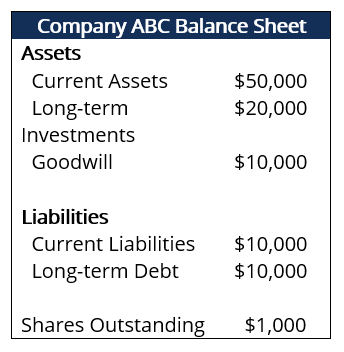
From the information above, is Company ABC undervalued based on the 66% rule?
1. First, we must calculate the NCAVPS, then compare it to the current share price.
The NCAVPS is calculated by subtracting total liabilities from current assets. It means that long-term assets and intangible assets like goodwill should be left out of the calculation.
Net Current Asset Value = Current Assets – (Current Liabilities + Long-Term Liabilities)
$50,000 – ($10,000 + $10,000) = $30,000
2. Then, by dividing by the number of shares, we arrive at the NCAVPS.
$30,000 / 1,000 Shares Outstanding = $30
3. Comparing the market price with the NCAVPS, we get:
$15 / $30 = 50%
Since 50% < 66%, we find that the stock of Company ABC is undervalued based on the 66% rule.
Limitations of NCAVPS
There is a limitation to comparing NCAVPS with the liquidation value of a company. Although the NCAVPS calculation may provide an estimated liquidation value of a company, the actual liquidation valueLiquidation ValueLiquidation value is an estimation of the final value which will be received by the holder of financial instruments when an asset is sold or liquidated. is likely to be much different. In a liquidation, most assets will need to be sold quickly, and therefore, they are likely to be sold at less than market value and potentially less than the book value.
The value of assets and liabilities on the balance sheet is usually recorded at book value. If the assets are sold for less than their book value, the NCAVPS formula will overestimate the company’s liquidation value.
More Resources
CFI is the official provider of the global Capital Markets & Securities Analyst (CMSA)®Program Page - CMSAEnroll in CFI's CMSA® program and become a certified Capital Markets &Securities Analyst. Advance your career with our certification programs and courses. certification program, designed to help anyone become a world-class financial analyst. To keep advancing your career, the additional CFI resources below will be useful:
- Net Asset ValueNet Asset ValueNet asset value (NAV) is defined as the value of a fund’s assets minus the value of its liabilities. The term "net asset value" is commonly used in relation to mutual funds and is used to determine the value of the assets held. According to the SEC, mutual funds and Unit Investment Trusts (UITs) are required to calculate their NAV
- Total AssetsTotal AssetsTotal assets refers to the sum of the book values of all assets owned by an individual, company, or organization.
- Warren Buffett – EBITDAWarren Buffett - EBITDAWarren Buffett is well known for disliking EBITDA. Warren Buffett is credited for saying “Does management think the tooth fairy pays for CapEx?"
- Weighted Average Shares OutstandingWeighted Average Shares OutstandingWeighted average shares outstanding refers to the number of shares of a company calculated after adjusting for changes in the share capital over a reporting period. The number of weighted average shares outstanding is used in calculating metrics such as Earnings per Share (EPS) on a company's financial statements
-

Net Working Capital (NWC): Definition, Calculation & Importance
Simply put, Net Working Capital (NWC) is the difference between a company’s current assetsCurrent AssetsCurrent assets are all assets that a company expects to convert to cash within one year. T
-

Ex-Post Analysis: Understanding Outcomes After Events
Ex-post is a Latin word that means “after the event,” and it is the opposite of the Latin word “ex-anteEx-AnteEx-ante is a Latin word that means “before the event.” The t
invest
- Net Asset Value (NAV): Definition & How It Works
- Understanding Net Asset Value Per Share (NAVPS) in REITs
- Understanding Current Face Value of Mortgage-Backed Securities (MBS)
- Impaired Assets: Definition, Recognition, and Accounting Standards
- Net Book Value (NBV): Definition & Calculation
- Earnings Per Share (EPS): A Comprehensive Guide for Investors
- Understanding Net Asset Value (NAV): A Comprehensive Guide
- Understanding Premium & Discount to Net Asset Value (NAV) in Mutual Funds
- Book Value Per Share (BVPS): Definition & Importance for Investors
-
 Understanding Net Cash Value in Life Insurance: A Comprehensive Guide
Like many things in life, shopping for a life insurance policy is not a simple task. Without a full grasp of insurance terminology, policy types and riders, it's hard to identify a policy that bes...
-
 Understanding Dividend Per Share (DPS): A Comprehensive Guide
Dividend Per Share (DPS) is the total amount of dividendsDividendA dividend is a share of profits and retained earnings that a company pays out to its shareholders. When a company generates a profit a...