
New York Stock Exchange (NYSE): History, Facts & Overview
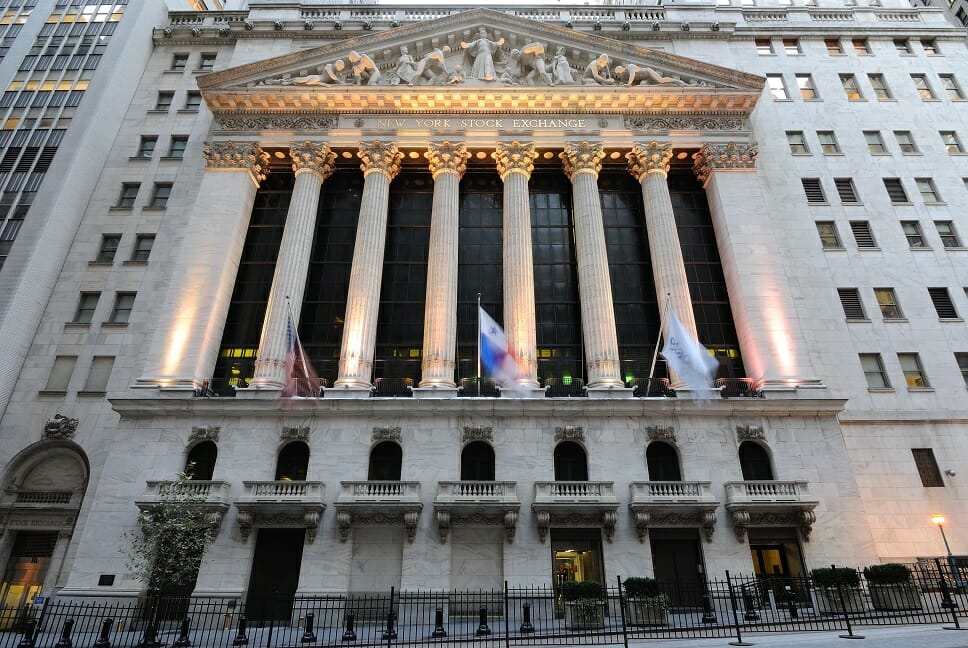
The New York Stock Exchange (NYSE) is the largest securities exchange in the world, hosting 82% of the S&P 500, as well as 70 of the biggest corporations in the world. It is a publicly-traded company that provides a platform for buying and selling over nine million corporate stocks and securities a day.
History of the New York Stock Exchange
In 1792, the NYSE was established at 68 Wall StreetWall StreetWall Street takes up eight blocks in Manhattan, New York. It runs east to west from Broadway to South Street, in the heart of the financial district. Representing the heart of capitalism, Wall Street is home to the New York Stock Exchange (NYSE), numerous banks, other financial institutions, and corporations. where 24 brokers and merchants outlined the rules for trading securities in the Buttonwood Agreement. The organization was initially named New York Stock & Exchange Board. It became the New York Stock Exchange in 1863. At that time, only male traders took part in the NYSE. It was only in 1967 when a female trader named Muriel Siebert was allowed to participate in trading.
In 1971, NYSE became a not-for-profit corporationCorporationA corporation is a legal entity created by individuals, stockholders, or shareholders, with the purpose of operating for profit. Corporations are allowed to enter into contracts, sue and be sued, own assets, remit federal and state taxes, and borrow money from financial institutions., and in 2006, a publicly-traded company. It was also during this time when traders and the public started using an electronic system to trade stocks. In 2007, NYSE merged with Euronext, and in 2008, NYSE acquired the American Stock Exchange. The Intercontinental Exchange later purchased the NYSE for $8.2 billion.
Trading on the NYSE
All trades on the New York Stock Exchange follow a continuous auction format. Brokers trade stocks as buyers and sellers auction securitiesPublic SecuritiesPublic securities, or marketable securities, are investments that are openly or easily traded in a market. The securities are either equity or debt-based. for the best price. Though famous for its trading floor, most stock transactions are now done electronically, with computers matching buyers and sellers.
Despite most transactions now happening through electronic platforms, the NYSE is still a hybrid market. This allows stockbrokers to send orders through either the electronic platform or to the trading floor where orders are carried out by floor brokers.
Opening and Closing Bells
The NYSE originally used a gavel to signal the start and end of trading, but in 1870, it switched to a Chinese gong. When it moved to its present location, the gong was replaced by a brass bell. The opening bell rings at 9:30 a.m. Eastern Time, while the closing bell can be heard at 4:00 p.m.
A significant part of the stock exchange’s brand, the opening and closing bells are also used to mark a financial-related event or celebrate an important event in New York City. It is an honor to be invited to ring the bell on the NYSE. While many who are asked to ring the bell are business executives, there are also many celebrities who’ve rung the bell. The privilege was also given to the police and fire departments of New York City who answered the call of duty during the 9/11 attacks.
The New York Stock Exchange is the busiest and most important financial market in the world. Its stocks are traded by investors worldwide.
More Resources
Thank you for reading CFI’s explanation of the New York Stock Exchange. CFI is the official provider of the global Financial Modeling & Valuation Analyst (FMVA)™Become a Certified Financial Modeling & Valuation Analyst (FMVA)®CFI's Financial Modeling and Valuation Analyst (FMVA)® certification will help you gain the confidence you need in your finance career. Enroll today! certification program, designed to help anyone become a world-class financial analyst. To keep advancing your career, the additional resources below will be useful:
- How to Read Stock ChartsHow to Read Stock ChartsIf you’re going to actively trade stocks as a stock market investor, then you need to know how to read stock charts. Even traders who primarily use fundamental analysis to select stocks to invest in still often use technical analysis of stock price movement to determine specific buy and sell, stock charting
- Investing: A Beginner’s GuideInvesting: A Beginner's GuideCFI's Investing for Beginners guide will teach you the basics of investing and how to get started. Learn about different strategies and techniques for trading
- Trading MechanismsTrading MechanismsTrading mechanisms refer to the different methods by which assets are traded. The two main types of trading mechanisms are quote driven and order driven trading mechanisms
- Types of Markets – Dealers, Brokers, ExchangesTypes of Markets - Dealers, Brokers, ExchangesMarkets include brokers, dealers, and exchange markets. Each market operates under different trading mechanisms, which affect liquidity and control. The different types of markets allow for different trading characteristics, outlined in this guide
-

SEDOL: Understanding the UK Stock Exchange Security Identifier
The stock exchange daily official list (SEDOL) is a seven-digit code used to identify all securities listed and trading on the United Kingdom securities market. Companies and issuers use SEDOL to iden
-

Understanding the Stock Market: A Beginner's Guide
The stock market refers to public markets that exist for issuing, buying, and selling stocks that trade on a stock exchange or over-the-counter. StocksStockWhat is a stock? An individual who owns stoc
invest
- American Stock Exchange (AMEX): History, Overview & Key Facts
- Hong Kong Stock Exchange (HKEX): Overview & Key Facts
- Jakarta Stock Exchange (IDX): History & Overview
- London Stock Exchange (LSE): History, Overview & Key Facts
- NYMEX Explained: A Comprehensive Guide to Commodity Futures
- NYSE Arca: A Comprehensive Overview of the Exchange
- Vancouver Stock Exchange (VSE): History & Overview | [Your Company Name]
- Understanding the Saudi Stock Exchange (Tadawul): A Comprehensive Overview
- New York Stock Exchange (NYSE): History, Overview & Key Facts
-
 NYSE Composite Index: Definition & What It Measures
The NYSE Composite Index is an index that tracks stocks traded on the New York Stock Exchange. It also measures real estate investment trustsReal Estate Investment Trust (REIT)A real estate investment...
-
 Understanding Quoted Prices: A Comprehensive Guide
The quoted price is the most recent – or last – price at which a financial assetFinancial AssetsFinancial assets refer to assets that arise from contractual agreements on future cash flows...