
NYSE Composite Index: Definition & What It Measures
The NYSE Composite Index is an index that tracks stocks traded on the New York Stock Exchange. It also measures real estate investment trustsReal Estate Investment Trust (REIT)A real estate investment trust (REIT) is an investment fund or security that invests in income-generating real estate properties. The fund is operated and owned by a company of shareholders who contribute money to invest in commercial properties, such as office and apartment buildings, warehouses, hospitals, shopping centers, student housing, hotels, American depository receipts, and foreign listings, and it excludes derivatives, ETFs, and closed-end funds.
Summary
- The NYSE Composite Index is an index that tracks all stocks traded on the New York Stock Exchange.
- The index lists over 2,000 stocks, which comprises US companies and foreign companies that are listed on the NYSE.
- The NYSE Composite Index is calculated based on the total return and price return of stocks.
The index covers over 2,000 stocks, out of which 1,600 stocks are from U.S. companies while the other stocks are foreign listings.
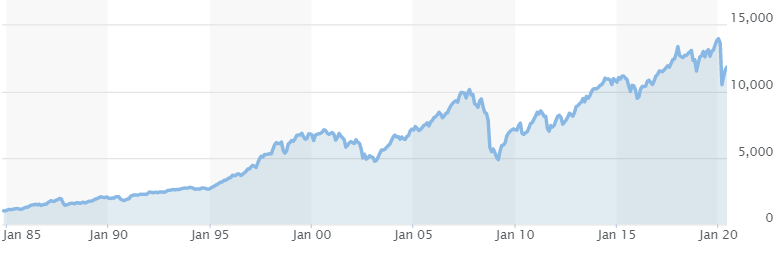
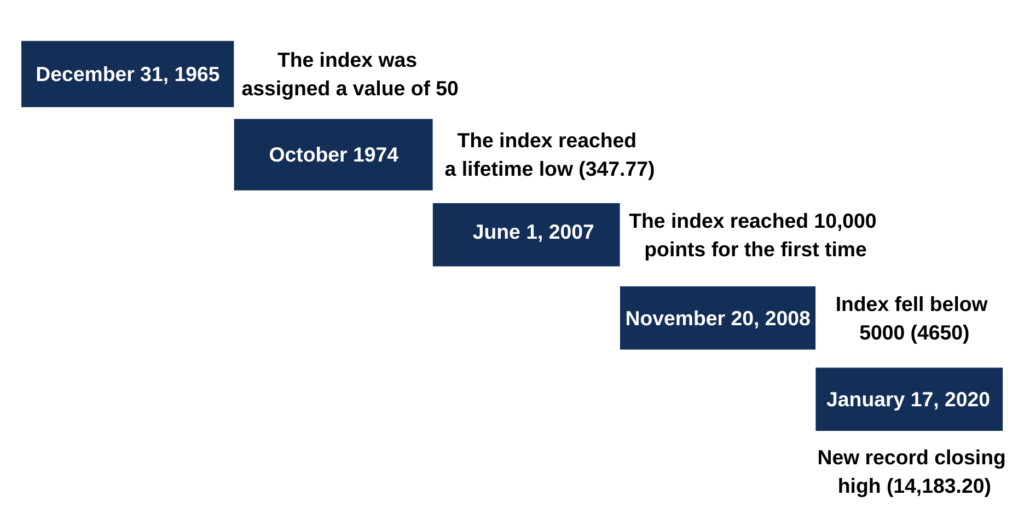
As of market closing on December 31, 1965, the NYSE Composite Index was assigned a value of 50. It is weighted based on the number of shares listed per issue. In January 2003, the index was re-introduced with a value of 5,000 points.
Understanding the NYSE Composite
The NYSE Composite Index includes separate indices for four industry categories – industrial, utility, transportation, and financial corporations. The index weights are calculated based on the price return and total return, excluding dividend amounts.
Investors in the NYSE Composite Index benefit in two ways.
The high quality of the index makes it attractive to investors. CorporationsCorporationA corporation is a legal entity created by individuals, stockholders, or shareholders, with the purpose of operating for profit. Corporations are allowed to enter into contracts, sue and be sued, own assets, remit federal and state taxes, and borrow money from financial institutions. listed on the index are required to meet stringent listing requirements, which separates potentially risky corporations from profitable corporations.
The global diversification of the NYSE Composite Index makes it attractive to investors who are looking to spread their portfolio across companies located in different geographical locations.
At least one-third of the market capitalization of the index is associated with non-U.S. companies from countries such as Japan, Mexico, Canada, China, and the United Kingdom. The foreign companies listed on the exchange operate in at least 38 different countries around the world.
How the NYSE Composite Index Works
The NYSE Composite Index was established in 1966, with a base of 50 points, which was equal to the December 1965 close. It was created to reflect the value of all stocks trading in the New York Stock Exchange, instead of a few best-performing stocks, as is the case with the Dow Jones Industrial AverageDow Jones Industrial Average (DJIA)The Dow Jones Industrial Average (DJIA), also referred to as "Dow Jones” or "the Dow", is one of the most widely-recognized stock market indices., which lists the best 330 stocks.
In 2003, the index was reintroduced with a new methodology that is applied across other popular U.S. indexes. It raised the base value from 50 points to 5,000 points, which was equal to the 2002 yearly close.
Under the current methodology, the index excludes closed-end fundsClosed-end Mutual FundsClosed-end mutual funds raise a fixed amount of capital from investors through an initial public offering and list their shares on an exchange., trust units, limited partnerships, derivatives, and preferred shares.
Milestones for the NYSE Composite Index
How Market Capitalization Works
The NYSE Composite Index uses market capitalizationMarket CapitalizationMarket Capitalization (Market Cap) is the most recent market value of a company’s outstanding shares. Market Cap is equal to the current share price multiplied by the number of shares outstanding. The investing community often uses the market capitalization value to rank companies to calculate the weights of the index constituents. Market capitalization works by multiplying the outstanding number of shares that a company owns by the market price per share.
For example, a company with 20 million outstanding shares and a current market price of $100 per share shows a market capitalization of $2 billion. Investors use the figure to determine the value of a company instead of looking at the cumulative asset or annual sales figure.
Using market capitalization tends to be more convenient for investors when making investment decisions on the stocks to invest in and diversifying stock investments across multiple companies with varying market capitalization.
Categorization of Companies Based on Market Capitalization
Investors and analysts use market capitalization to categorize companies based on their size. For example, publicly-listed companies with a market capitalization of $10 billion or more are considered large-cap companies. Such companies are usually key players in their specific industries.
While large-cap companies do not provide huge returns in the short term, such companies are considered stable and reward investors with consistent dividend payments and a gradual increase in the share value.
Mid-companies are smaller in size than large-cap companies, and their market capitalization ranges from $2 billion to $10 billion. Such companies are considered riskier than large-cap since they are not as established as the latter.
Mid-cap companies offer high growth potential since they are domiciled in industries with rapid growth. Companies in the low-tier of market capitalization are small-cap companies with a market cap of $300 million to $2 billion.
Mic-caps are usually a few years old or are serving new industries. They are considered high-risk due to their young age, and size and they are more sensitive to economic turmoil.
Additional Resources
CFI is the official provider of the Commercial Banking & Credit Analyst (CBCA)™Program Page - CBCAGet CFI's CBCA™ certification and become a Commercial Banking & Credit Analyst. Enroll and advance your career with our certification programs and courses. certification program, designed to transform anyone into a world-class financial analyst.
To keep learning and developing your knowledge of financial analysis, we highly recommend the additional resources below:
- Capitalization-Weighted IndexCapitalization-Weighted IndexThe Capitalization-Weighted Index (cap-weighted index, CWI) is a type of stock market index in which each component of the index is weighted relative to its total market capitalization. In a capitalization-weighted index, companies with larger market capitalization exert a greater impact on the index value.
- NASDAQ CompositeNASDAQ CompositeThe NASDAQ Composite is an index of more than 3,000 common equities listed on the NASDAQ stock market. The index is one of the most followed indices in the
- Price-Weighted IndexPrice-Weighted IndexA price-weighted index is a type of stock market index in which each component of the index is weighted according to its current share price. In price-weighted indices, companies with a high share price have a greater weight than those with a low share price.
- Volume of TradeVolume of TradeVolume of trade, also known as trading volume, refers to the quantity of shares or contracts that belong to a given security traded on a daily basis
-

Capitalization-Weighted Index (CWI): Explained
The Capitalization-Weighted Index (cap-weighted index, CWI) is a type of stock market index in which each component of the index is weighted relative to its total market capitalizationMarket Capitaliz
-
DMI: Understanding the Directional Movement Index for Trading
The Directional Movement Index (DMI) is an indicator that helps in determining the direction the asset price is moving and the strength of the price movement. It does so by comparing the current price
invest
- NYSE Composite Index: Definition & Performance
- EAFE Index: Understanding Developed Market Performance
- Nikkei Index: Understanding Japan's Top Stock Market Indicator
- Price-Weighted Index Explained: How It Works & Examples
- Value Line Composite Index: Definition, History & Composition
- Understanding the S&P 500: Top Holdings & Long-Term Performance
- Composite Indexes: Understanding Financial Benchmarks & Their Use
- Understanding the NYSE Composite Index: A Key Indicator for Investors
- Understanding the S&P/TSX Composite Index: A Comprehensive Guide
-
 KOSPI: Understanding South Korea's Stock Market Index
The Korean Composite Stock Price Index (KOSPI) is a group of indexes that track the stock exchange in South Korea. It was previously named the Korea Stock Exchange. Just as the NASDAQ Composite Index ...
-
Russell 2000 Index: Definition, Performance & Significance
The Russell 2000 Index tracks the performance of roughly 2,000 of the smallest publicly traded companies in the U.S. The Russell 2000 is actually a subset of the Russell 3000 Index, which is much bro...