
Notional Principal Amount: Definition & Explained
The notional principal amount refers to the predetermined dollar amount in an interest rate swapInterest Rate SwapAn interest rate swap is a derivative contract through which two counterparties agree to exchange one stream of future interest payments for another on which interest payments are based. It is the face value that is used to calculate interest payments on financial instruments.

The notional principal amount does not change hands, and therefore, no party pays or receives the amount at any time. The only transactions that change hands between the transacting parties are the interest rate payments. Essentially, the notional principal amount is the value of the asset that a person owns.
For example, if a person pays $1,000 for a bond, the notional principal amount of the bond Is equivalent to the amount paid to purchase the bond, i.e,. $1,000. The notional principal value is quoted by different financial instruments, such as swaps, optionsOptions: Calls and PutsAn option is a derivative contract that gives the holder the right, but not the obligation, to buy or sell an asset by a certain date at a specified price., and futures.
Summary
- The notional principal amount is the assumed principal amount of a financial contract on which the exchanged interest rates are based.
- It is a theoretical amount that never changes hands between the parties.
- The notional principal amount is used as the face value of a financial instrument when calculating the interest payments due.
Understanding the Notional Principal Amount
The notional principal amount is the assumed principal amount that is used as the base amount when calculating the exchanged interest amount. The principal amount is functionally separated from the transaction, and the only actual components in the transaction are the interest rate payments.
The notional principal amount is a theoretical figure employed only when calculating interest paymentsInterest ExpenseInterest expense arises out of a company that finances through debt or capital leases. Interest is found in the income statement, but can also. When making the interest payments, the parties make reference to a specified index upon the notional principal for a promise to pay similar amounts.
The interest payable is based on the notional principal amount, which can be in any denomination. Also, the notional principal amount does not need to be a cash value, and it can be equivalent to the value of equity holdings.
Practical Example
Assume that two parties, Mary and John, enter into a contractual agreement to exchange interest payments with each other. Mary holds an investment that is valued at $1 million and earns an interest of LIBOR +1% every month. Since LIBORLIBORLIBOR, which is an acronym of London Interbank Offer Rate, refers to the interest rate that UK banks charge other financial institutions for changes periodically, the interest payments that Mary receives is not constant, and it changes with fluctuations in the market rates.
John, on the other hand, owns a similar $1,000,000 investment that pays a monthly interest rate of 2%. The interest payments that John receives remain constant throughout the year. Both parties agree to enter into an interest rate swap contract to exchange interest payments between themselves. It means that Mary will get a constant payment of 2% every month, whereas John will start receiving variable interest payments every month at the rate of Libor+1%.
Since the parties only agree to exchange interest rate payments, the interest is calculated on a $1,000,000 principal amount. The amount is the notional principal amount, and it is a theoretical amount that does not change hands between the counterparties.
If the LIBOR rate is 0.5% during the month of January, Mary will receive $15,000 in interest payments ($1,000,000 x (0.5% + 1%). In the same month, John will receive $20,000 in interest payments ($1,000,000 x 2%).
Under the terms of the interest rate swap agreement, Mary will pay John $15,000, while John will pay Mary $20,000. The transactions partially offset each other, and John will owe Mary $5,000 ($20,000 – $15,000) in interest payments.
Applications of Notional Principal Amount
The following are key examples of investments where the notional principal is used:
1. Interest rate swaps
An interest rate swap occurs when two parties lend funds to each other but with different terms, i.e., repayment schedule and interest rates. It helps shift the risk or returns of an investment to another party, where one investment comes with a variable rate of return, while the other party offers a fixed rate of return.
Such a type of arrangement benefits one party, with the other party suffering a loss. The notional principal amount is the theoretical amount on which the interest payments are based. The amount can be any currency or a combination of currencies.
2. Total return swaps
A total return swap is a financial contract that transfers the credit and market risk of an underlying asset. In a total return swap, one party makes interest payments based on a fixed or variable rate that is multiplied by the notional principal amount plus depreciation.
The other party in the contract calculates interest payments based on the return of the underlying asset, i.e. income generated plus capital appreciation if any. The underlying asset can be a bond, loan, or equity index.
A total return swap is structured in a way that the parties earn interest from a reference asset without owning it. For example, if the underlying asset is a bond, Party A would pay Party B the LIBOR rate multiplied by the notional principal amount plus depreciation, while Party B would pay Party A the return of the underlying asset, including the income generated and the capital gains of the asset.
Related Readings
CFI is the official provider of the global Commercial Banking & Credit Analyst (CBCA)™Program Page - CBCAGet CFI's CBCA™ certification and become a Commercial Banking & Credit Analyst. Enroll and advance your career with our certification programs and courses. certification program, designed to help anyone become a world-class financial analyst. To keep advancing your career, the additional resources below will be useful:
- Applicable Federal Rate (AFR)Applicable Federal Rate (AFR)The applicable federal rate (AFR) is the interest rate that applies to personal loans. It is the minimum rate applicable to such loans under U.S. law.
- Interest ExpenseInterest ExpenseInterest expense arises out of a company that finances through debt or capital leases. Interest is found in the income statement, but can also
- Equity Swap ContractEquity Swap ContractAn equity swap contract is a derivative contract between two parties that involves the exchange of one stream (leg) of equity-based cash flows linked to the performance of a stock or an equity index with another stream (leg) of fixed-income cash flows.
- Compound InterestCompound InterestCompound interest refers to interest payments that are made on the sum of the original principal and the previously paid interest. An easier way to think of compound interest is that is it "interest on interest," where the amount of the interest payment is based on changes in each period, rather than being fixed at the original principal amount.
-
Effective Annual Rate (EAR): Understanding & Calculation
The Effective Annual Rate (EAR) is the rate of interestInterest ExpenseInterest expense arises out of a company that finances through debt or capital leases. Interest is found in the income statement,
-
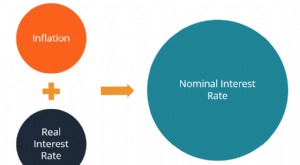
Fisher Equation Explained: Understanding Inflation & Interest Rates
The Fisher equation is a concept in economics that describes the relationship between nominal and real interest rates under the effect of inflationInflationInflation is an economic concept that refers
invest
- Compound Interest Formula: Calculate & Understand Growth
- Understanding Continuously Compounded Interest & Key Financial Ratios
- Nominal Interest Rate Explained: Definition & Implications
- Simple vs. Compound Interest: Understanding the Difference
- Swap Rate Explained: Understanding Fixed Exchange Rates in Derivatives
- Effective Interest Method Explained: Bond Amortization & Accounting
- Herrick Payoff Index: Understanding Derivative Market Trends
- Short Interest Ratio: Understanding Investor Sentiment & Market Risk
- Notional Principal Amount Explained: Interest Rate Swaps & Bonds
-
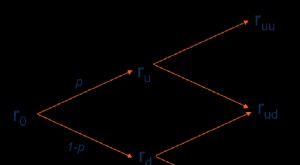 Binomial Interest Rate Tree: Definition, Uses & Applications
The binomial interest rate tree is a graphical representation of possible interest rate values at different periods of time, under the assumption that at each time period, the interest rate may either...
-
 Effective Annual Interest Rate (EAR): Understanding & Calculation
The Effective Annual Interest Rate (EAR) is the interest rate that is adjusted for compoundingCompound Growth RateThe compound growth rate is a measure used specifically in business and investing cont...