
Understanding Private Equity Funds: An Investor's Guide
Private equity funds are pools of capital to be invested in companies that represent an opportunity for a high rate of return. They come with a fixed investment horizonReturn on Investment (ROI)Return on Investment (ROI) is a performance measure used to evaluate the returns of an investment or compare efficiency of different investments., typically ranging from four to seven years, at which point the PE firm hopes to profitably exit the investment. Exit strategies include IPOsInitial Public Offering (IPO)An Initial Public Offering (IPO) is the first sale of stocks issued by a company to the public. Prior to an IPO, a company is considered a private company, usually with a small number of investors (founders, friends, family, and business investors such as venture capitalists or angel investors). Learn what an IPO is and sale of the business to another private equity firm or strategic buyer.
Institutional funds and accredited investors usually make up the primary sources of private equity funds, as they can provide substantial capital for extended periods of time. A team of investment professionals from a particular PE firm raises and manages the funds.

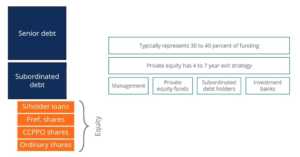
Equity
Equity can be further subdivided into four components: shareholder loans, preferred shares, CCPPO shares, and ordinary shares.
Typically, the equity proportion accounts for 30% to 40% of funding in a buyout. Private equity firms tend to invest in the equity stake with an exit plan of 4 to 7 years. Sources of equity funding include management, private equity funds, subordinated debt holders, and investment banks. In most cases, the equity fraction is comprised of a combination of all these sources.
Types of Private Equity Funds
Private equity funds generally fall into two categories: Venture Capital and Buyout or Leveraged Buyout.
1. Venture Capital (VC)
Venture capitalVenture CapitalVenture capital is a form of financing that provides funds to early stage, emerging companies with high growth potential, in exchange for equity or an ownership stake. Venture capitalists take the risk of investing in startup companies, with the hope that they will earn significant returns when the companies become a success. funds are pools of capital that typically invest in small, early stage and emerging businesses that are expected to have high growth potential but have limited access to other forms of capital. From the point of view of small start-ups with ambitious value propositions and innovations, VC funds are an essential source to raise capital as they lack access to large amounts of debt. From the point of view of an investor, although venture capital funds carry risks from investing in unconfirmed emerging businesses, they can generate extraordinary returns.
2. Buyout or Leveraged Buyout (LBO)
Contrary to VC funds, leveraged buyout funds invest in more mature businesses, usually taking a controlling interest. LBOLeveraged Buyout (LBO)A leveraged buyout (LBO) is a transaction where a business is acquired using debt as the main source of consideration. funds use extensive amounts of leverage to enhance the rate of return. Buyout finds tend to be significantly larger in size than VC funds.
Exit Considerations
There are multiple factors in play that affect the exit strategy of a private equity fund. Here are some necessary questions to ask:
- When does the exit need to take place? What is the investment horizon?
- Is the management team amenable and ready for an exit?
- What exit routes are available?
- Is the existing capital structure of the business appropriate?
- Is the business strategy appropriate?
- Who are the potential acquirers and buyers? Is it another private equity firm or a strategic buyer?
- What Internal Rate of Return (IRR)Internal Rate of Return (IRR)The Internal Rate of Return (IRR) is the discount rate that makes the net present value (NPV) of a project zero. In other words, it is the expected compound annual rate of return that will be earned on a project or investment. will be achieved?
Typical Exit Routes for PE Funds
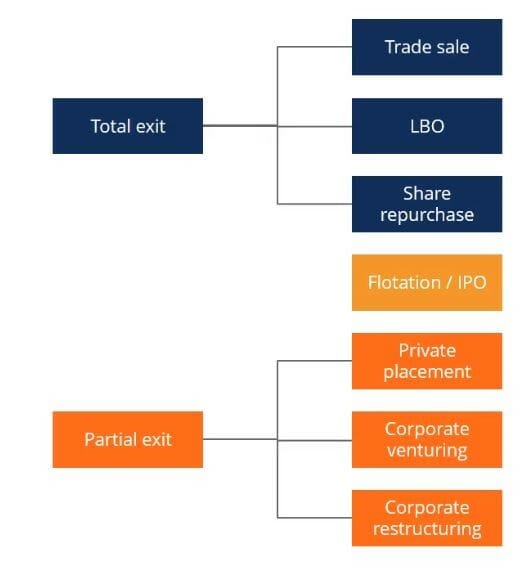
When deciding to exit, PE firms take either one of two paths: total exit or partial exit. In terms of a wholesale exit from the business, there can be a trade sale to another buyer, LBO by another private equity firm, or a share repurchase.
In terms of a partial exit, there could be a private placement, where another investor purchases a piece of the business. Another possibility is corporate restructuring, where external investors get involved and increase their position in the business by partially acquiring the private equity firm’s stake. Finally, corporate venturing could happen, in which the management increases its ownership in the business.
Lastly, a flotation or an IPO is a hybrid strategy of both total and partial exit, which involves the company being listed on a public stock exchange. Typically, only a fraction of a company is sold in an IPO, ranging from 25% to 50% of the business. When the company is listed and traded publicly, private equity firms exit the company by slowly unwinding their remaining ownership stake in the business.
Additional Resources
CFI offers the Financial Modeling & Valuation Analyst (FMVA)™Become a Certified Financial Modeling & Valuation Analyst (FMVA)®CFI's Financial Modeling and Valuation Analyst (FMVA)® certification will help you gain the confidence you need in your finance career. Enroll today! certification program for those looking to take their careers to the next level. To keep learning and advancing your career, the following resources will be helpful:
- Financial Modeling Fundamentals
- Equity Capital Market (ECM) GuideEquity Capital Market (ECM)The equity capital market is a subset of the capital market, where financial institutions and companies interact to trade financial instruments
- Career Guide to Private EquityCareer Guide to Private Equity JobsThis career guide to private equity jobs provides all the information you need to know - positions, salary, titles, skills, progression, and much more. Private equity firms are investment management companies that acquire private businesses by pooling capital provided from high net worth individuals (HNWI) and institutional investors.
- Private Equity vs. Venture CapitalPrivate Equity vs Venture Capital, Angel/Seed InvestorsCompare private equity vs venture capital vs angel and seed investors in terms of risk, stage of business, size & type of investment, metrics, management. This guide provides a detailed comparison of private equity vs venture capital vs angel and seed investors. It's easy to confuse the three classes of investors
-

Sovereign Wealth Funds (SWF): A Comprehensive Overview
Sovereign Wealth Funds (SWF) are pools of income – generally derived from staple commodities – that a country uses to invest in areas of possible growth. The majority of the countries that
-

Vanguard ETFs: A Comprehensive Guide to Index-Tracking Investments
Vanguard Exchange-Traded Funds (ETFs) are a collection of index-based traded securities managed and issued by Vanguard Group. The ETFs give investors the chance to buy and sell shares as a single secu
invest
- Mutual Funds: A Beginner's Guide to Diversified Investing
- Equity Co-Investment: Definition & How It Works
- Equity Funds: A Comprehensive Guide to Investing in Stocks
- Mutual Funds Explained: A Beginner's Guide to Investing
- Private Equity Crowdfunding: A Comprehensive Guide for Investors
- Vulture Funds Explained: Investing in Distressed Debt
- Slush Funds: Definition, Purpose, and Illicit Uses
- Segregated Funds: Understanding Insurance-Backed Investments
- Mid-Cap Equity Funds: Understanding Risk, Returns & Investment
-
 Money Market Funds: A Comprehensive Guide to Liquidity & Safety
Money market funds are open-ended fixed income mutual funds that invest in short-term debt securities, such as Treasury billsTreasury Bills (T-Bills)Treasury Bills (or T-Bills for short) are a short-t...
-
 Understanding Open-End Mutual Funds: A Comprehensive Guide
Open-end mutual funds refer to mutual funds that issue shares to investors based on the fund’s net asset value (NAV)Net Asset ValueNet asset value (NAV) is defined as the value of a fund’s...