
Money Market Funds: A Comprehensive Guide to Liquidity & Safety
Money market funds are open-ended fixed income mutual funds that invest in short-term debt securities, such as Treasury billsTreasury Bills (T-Bills)Treasury Bills (or T-Bills for short) are a short-term financial instrument issued by the US Treasury with maturity periods from a few days up to 52 weeks., municipal bills, and short-term corporate and bank debt instruments that come with low credit risk and emphasize liquidity.

Understanding Money Market Funds
Money market securities typically come with maturities under 12 months. The short-term nature of the securities is a way of reducing risk and uncertainty. The selection of money market investments is performed by a fund manager as it should relate to the type of money market fund. Money market funds are not insured by the federal government (FDIC), unlike money market accounts, which are insured.
Money market mutual fund income is usually in the form of a dividendDividendA dividend is a share of profits and retained earnings that a company pays out to its shareholders. When a company generates a profit and accumulates retained earnings, those earnings can be either reinvested in the business or paid out to shareholders as a dividend.; it can be taxed or tax-exempt depending on the nature of securities invested in the fund. The funds can be used as a cash management tool in business because of their liquidity and flexibility, hence their popularity.
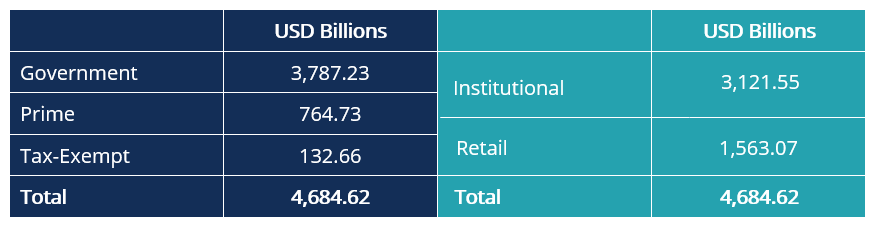
Money market funds were developed and came into use in the 1970s. They are regulated through the Securities and Exchange Commission (SEC)Securities and Exchange Commission (SEC)The US Securities and Exchange Commission, or SEC, is an independent agency of the US federal government that is responsible for implementing federal securities laws and proposing securities rules. It is also in charge of maintaining the securities industry and stock and options exchanges under the Investment Company Act of 1940 in the United States and Regulation 2017/1131 in Europe. According to the Investment Company Institute, money market funds total $4.68 trillion, as of June 17, 2020, and are distributed as follows:
Objectives of Money Market Fund Investments
Investors take part in money market funds for the following reasons:
- Short-term investment horizonInvestment HorizonInvestment horizon is a term used to identify the length of time an investor is aiming to maintain their portfolio before selling their securities for a profit. An individual’s investment horizon is affected by several different factors. However, the primary determining factor is often the amount of risk that the investor
- Low conservative risk appetite with preference to low-security volatility
- High liquidity needs
- Low returns, which is compensated by low risk
- Stability and certainty
Types of Money Market Funds
The Securities and Exchange Commission (SEC) regulations comprise three categories of money market funds based on the securities in the fund:
1. Government
The funds invest in about 99.5% in government-backed securities such as U.S. Treasury bills, collateralized U.S. Treasury securities, repurchase agreements, and Federal Home Loan securities. They also invest in government-sponsored enterprises (GSE) securities, such as Freddie Mac and Fannie Mae. Since government-backed paper is “risk-free,” the funds are considered very safe.
2. Prime
They are funds invested in short-term corporate debt instruments, such as commercial paper, corporate notes, and short-term bank securities (banker’s acceptances and certificates of deposits). They also include repurchase and reverse repurchase agreements.
3. Municipal tax-free
The money market funds are predominantly invested in securities issued by municipalities, which are federal and often state income tax-exempt securities. Other entities also issue securities with tax protection, which the money funds also participate in, such as state municipal.
Benefits of Using Money Market Funds
1. Liquidity
The redemption of a money market fund usually takes less than two business days, and it is fairly easy to settle brokerage account investment trades.
2. Risk management
Money market funds act as a risk management tool, as funds are invested in cash equivalent securities with low risk and high liquidity.
3. Short-term
The short-term nature of money market funds ensures a low interest rate, credit, and liquidity risk.
4. Security
Money market funds invest in low-risk and high-credit quality securities, ensuring high security.
5. Stability
Money market funds are low volatility investments.
6. Convenience
Easy access to funds through a checking account linked to an income-yielding money market investment fund.
7. Diversification
Money market funds usually hold a diversified portfolio of government, corporate, and tax-free debt securities.
8. Tax exemption
Municipal issues in which money market funds invest in are federal and often state income tax-exempt; hence they provide tax-efficient income.
Money Market Fund Risks
1. Credit risk
Money market securities are susceptible to volatility and are not FDIC-insured, hence the potential to not lose money, however low, is not guaranteed. There exists a probability of loss, although it is generally quite small. There is no guarantee that investors will receive $1.00 per share on the redemption of their shares.
2. Low returns
The low returns of money market funds are usually lower than other funds comprising of assets such as stocks and properties. There is a chance that money market returns may also fall below the inflation rateInflationInflation is an economic concept that refers to increases in the price level of goods over a set period of time. The rise in the price level signifies that the currency in a given economy loses purchasing power (i.e., less can be bought with the same amount of money)., providing negative real returns to investors (inflation risk). Interest rates can also go down further, reducing returns on money market investments.
3. Liquidity fees and redemption gates
It involves the imposition of high liquidity fees, i.e., fees levied on the sale of shares. Redemption gates require waiting periods before redeeming proceeds from money market funds, normally implemented to prevent a run on the fund in periods of market stress.
4. Foreign exchange exposure
This risk is borne by funds that invest in money market instruments across borders that are denominated in other currencies other than the home currency.
5. Environmental changes
Changes in economic policies and government regulations can result in an adverse impact on the price of money market securities and their issuers’ financial standing, i.e., if they affect interest rates and money supply.
Related Readings
CFI is the official provider of the global Commercial Banking & Credit Analyst (CBCA)™Program Page - CBCAGet CFI's CBCA™ certification and become a Commercial Banking & Credit Analyst. Enroll and advance your career with our certification programs and courses. certification program, designed to help anyone become a world-class financial analyst. To keep advancing your career, the additional resources below will be useful:
- Credit RiskCredit RiskCredit risk is the risk of loss that may occur from the failure of any party to abide by the terms and conditions of any financial contract, principally,
- Federal Deposit Insurance Corporation (FDIC)Federal Deposit Insurance Corporation (FDIC)The Federal Deposit Insurance Corporation (FDIC) is a government institution that provides deposit insurance against bank failure. The body was created
- Municipal Bond Credit AnalysisMunicipal Bond Credit AnalysisMunicipal bond credit analysis involves evaluating a municipal bond to determine its viability as an investment opportunity. A municipal bond is a type of
- Types of Markets – Dealers, Brokers, ExchangesTypes of Markets - Dealers, Brokers, ExchangesMarkets include brokers, dealers, and exchange markets. Each market operates under different trading mechanisms, which affect liquidity and control. The different types of markets allow for different trading characteristics, outlined in this guide
-
Index Funds Explained: A Beginner's Guide to Tracking Market Performance
Index funds are mutual fundsMutual FundsA mutual fund is a pool of money collected from many investors for the purpose of investing in stocks, bonds, or other securities. Mutual funds are owned by a g
-

Understanding Pooled Funds: A Comprehensive Guide
Pooled funds is a term used to collectively refer to a set of money from individual investors combined, i.e., “pooled” together for investment purposes. The funds are combined with the int
invest
- Understanding Distressed Securities: Risks & Opportunities
- Understanding the Money Market: Short-Term Debt & Lending
- Money Market Funds: A Comprehensive Guide to Liquidity & Safety
- Understanding Money Market Yields: A Comprehensive Guide
- Mutual Funds Explained: A Beginner's Guide to Investing
- Non-Marginable Securities: Definition & Investing Implications
- Vulture Funds Explained: Investing in Distressed Debt
- Securities Explained: A Beginner's Guide to Stocks, Bonds & More
- Understanding Market Cap Mutual Funds: A Comprehensive Guide
-
 Understanding Financial Markets: A Comprehensive Guide
Financial markets, from the name itself, are a type of marketplace that provides an avenue for the sale and purchase of assets such as bondsBondsBonds are fixed-income securities that are issued by co...
-
 Hybrid Securities: A Comprehensive Guide to Balanced Investments
Hybrid securities are investment instruments that combine the features of pure equities and pure bonds. These securities tend to offer a higher return than pure fixed income securitiesFixed Income Sec...