
Understanding Quadruple Witching: A Guide for Investors
Quadruple witching refers to a date where stock index futuresStock Index FuturesStock index futures, also referred to as equity index futures or just index futures, are futures contracts based on a stock index. Futures contracts are an, stock index options, stock options, and single stock futures expire simultaneously.
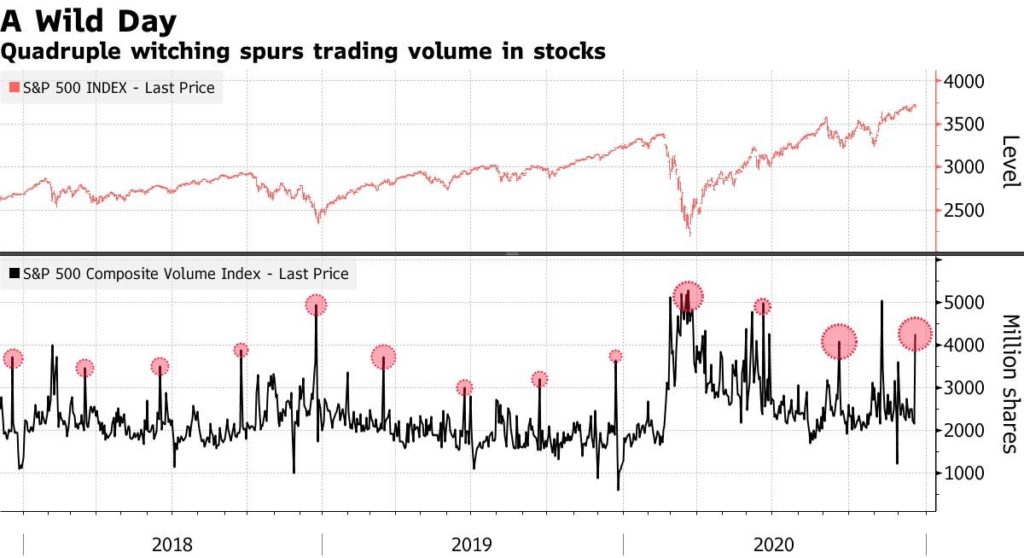
The final trading day for stock options is generally the third Friday of every month. The final trading day for index futures, stock index options, and single stock futures is generally the third Friday of each quarter. As such, there are only four dates in which stock options, stock index options, index futures, and single stock futures expire simultaneously (quadruple witching dates):
- Third Friday of March
- Third Friday of June
- Third Friday of September
- Third Friday of December
The first quadruple witching date was the third Friday of December 2002, as single stock futures commenced trading on November 8, 2002.
Summary
- Stock index futures, stock options, stock index options, and single stock futures expire simultaneously on a quadruple witching date.
- Quadruple witching dates are important to investors, as such dates are usually the most heavily traded days of the year.
- On a quadruple witching day, holders of derivatives that expire on that date close or roll over their contracts.
Understanding Quadruple Witching
Quadruple witching dates are important to investors, as such dates are usually the most heavily traded days of the year, attributable to the exercise of futures and options before expiry. As a result, there tends to be greater market volatility on quadruple witching days.
Quadruple witching days do not see significant momentum. According to Dow Jones Market Data, the average daily gain of the S&P 500 indexS&P 500 IndexThe Standard and Poor’s 500 Index, abbreviated as S&P 500 index, is an index comprising the stocks of 500 publicly traded companies in the is 0.04% since the first quadruple witching in 2002.
Derivatives Involved in Quadruple Witching
Derivatives are financial contracts primarily used to speculate on the directional movement of an underlying assetUnderlying AssetUnderlying asset is an investment term that refers to the real financial asset or security that a financial derivative is based on. Thus, the or to mitigate risk (hedge). Below, we discuss derivatives that expire on a quadruple witching date:
- Stock index futures, also known as equity index futures or index futures, are futures contracts based on a market index (such as the DJIA, S&P 500, NASDAQ, DAX, etc.). A futures contract is an agreement to buy or sell the underlying asset (in this case, a financial index) at a specific price on a specific date.
- Stock index options are options contracts based on a market index. An options contract gives the buyer the right (not the obligation) to buy or sell the underlying asset (in this case, a financial index) at a specified price at any date before the expiration date (in the case of an American-style optionAmerican vs European vs Bermudan OptionsThere are different types of options that differ in terms of their exercise restrictions. Let’s explore American vs European vs Bermudan options to find out) or at the expiration date (in the case of a European-style option).
- Single stock futures (“SSF”) are futures contracts based on a single stock (such as Facebook, Amazon, Tesla, Microsoft, etc.) and are an agreement to buy or sell a single stock at a specific price on a specific date. SSF only began trading in the United States in November 2002 after then-President Bill Clinton signed the Commodity Futures Modernization Act of 2000.
- Stock options are options contracts based on a stock. A stock option contract gives the buyer the right, but not the obligation, to buy or sell a stock at a specified price at any date before the expiration date (American-style option) or at the expiration date (European-style option).
What Happens to Derivatives on a Quadruple Witching Date?
On a quadruple witching day, holders of derivatives that expire on that date close or roll over their contracts. Rolling over a contract involves closing the existing contract and initiating a similar contract but with a later expiry date.
Quadruple Witching in September 2020
On September 18, 2020, a quadruple witching day, equity transactions surged – 14 billion shares changed hands, representing approximately 40% above the three-month volume average. Furthermore, volatilityVolatilityVolatility is a measure of the rate of fluctuations in the price of a security over time. It indicates the level of risk associated with the price changes of a security. Investors and traders calculate the volatility of a security to assess past variations in the prices increased on that day, as investors closed out profitable trades.
Related Readings
CFI is the official provider of the Capital Markets & Securities Analyst (CMSA)®Program Page - CMSAEnroll in CFI's CMSA® program and become a certified Capital Markets &Securities Analyst. Advance your career with our certification programs and courses. certification program, designed to transform anyone into a world-class financial analyst.
To keep learning and developing your knowledge of financial analysis, we highly recommend the additional resources below:
- Exchange-Traded DerivativesExchange-Traded DerivativesExchange-traded derivatives consist mostly of options and futures traded on public exchanges, with a standardized contract, which increases liquidity and market depth.
- Options: Calls and PutsOptions: Calls and PutsAn option is a derivative contract that gives the holder the right, but not the obligation, to buy or sell an asset by a certain date at a specified price.
- Expiration DateExpiration Date (Derivatives)The expiration date refers to the date in which options or futures contracts expire. It is the last day of the validity of the derivatives contract.
- Volume of TradeVolume of TradeVolume of trade, also known as trading volume, refers to the quantity of shares or contracts that belong to a given security traded on a daily basis
-

Understanding Stock Performance: A Guide for Investors
Brokers, investors and day traders are particularly sensitive to the performance of stocks on markets such as the New York Stock Exchange. The performance of stocks vary depending on the industry, pri
-
All-Ordinaries Index (XAO): Your Guide to Australian Equities
What Is the All-Ordinaries Stock Index? The All-Ordinaries ( or Kangaroos for slang) is a stock index comprised of common shares from the Australian Stock Exchange (ASX). The All-Ordinaries Ind
invest
- Quadruple Witching Explained: Understanding Market Liquidity Events
- Understanding Quadruple Witching: A Guide for Investors
- DAX Index: Your Guide to Germany's Top 30 Companies
- Understanding Downtrends: Definition, Identification & Reversal
- Understanding High Beta Indexes: Risk & Investment Opportunities
- High-Low Index: Understanding 52-Week Highs & Lows | [Your Brand]
- Stock Indexes Explained: A Beginner's Guide to Market Benchmarks
- Understanding Stock Index Futures: A Comprehensive Guide
- Stock Market Indexes: A Comprehensive Guide to Understanding
-
Composite Indexes: Understanding Financial Benchmarks & Their Use
A composite index is a combination of securities into a group so as to provide some type of financial indicator about the group as a whole. Composite indices are commonly used by financial organ...
-
Phantom Stock: Definition, Benefits & How It Works
Many companies today are looking for creative ways to reward their senior managers and key executives for outstanding performance. One strategy is to provide these employees with what’s commonly refer...