
Quantitative Funds: A Deep Dive into Algorithmic Investing
A quant fund (short for quantitative fund) is an investment fund that uses mathematical and statistical techniques together with automated algorithms and advanced quantitative models to make investment decisions and execute trades. There is no human intellect and judgment involved in investment selection and related decisions.
Quant funds operate using computer-based models, which mitigate risks and losses related to human fund management. The funds are often considered to be a form of alternative investments because they are non-traditional by nature. Just like any other investment fund, quant funds aim to outperform the market by placing funds with liquid and publicly traded assets in a superior way. In financial terms, the goal is to generate alphaAlphaAlpha is a measure of the performance of an investment relative to a suitable benchmark index such as the S&P 500. An alpha of one (the baseline value is zero) shows that the return on the investment during a specified time frame outperformed the overall market average by 1%. (excess return).
Quantitative theory, which is the backbone of quant funds, was originally applied to finance by Robert Merton. Quantitative finance combined with mathematics (calculus) led to developments such as the modern portfolio theory, the Black-Scholes option pricing modelEmbedded OptionAn embedded option is a provision in a financial security (typically in bonds) that provides an issuer or holder of the security a certain right but not an obligation to perform some actions at some point in the future. The embedded options exist only as a component of financial security, and other strategies.
The quantitative models used by quant funds are designed to detect investment opportunities in the market. Hence, competition between quant developers is to create a more superior model. The complex mathematical models carry out the buy/sell decisions without human intervention.
Understanding Quant Funds
Quant funds use algorithmic investment strategies that are systematically programmed to manage a fund and make investment decisions. There is no direct intervention of human fund managers with their judgments, experience, opinions, and emotions.
Quant funds use quantitative analysisQuantitative AnalysisQuantitative analysis is the process of collecting and evaluating measurable and verifiable data to understand the behavior and performance of a business. compared to traditional funds that use fundamental analysis. Quant strategies are often called Black Box due to the level of secrecy surrounding their algorithms. Quant models also work best when they are back-tested, and they are said to perform better in bull markets but perform like other generic strategies in bear markets.
The substantial growth of quant funds in recent years can be attributed to several factors, including big data solutions and greater access to a wider range of market data. Quant fund models are more efficient and effective with more data than less, which made the big data age an opportune period to complement their growth.
The advancements and innovation in technology and automation also positively impacted the growth of quant funds by augmenting the data that they could work with. It enabled quant funds to receive strong feeds for a comprehensive analysis of scenarios and sensitivities. Quants use proprietary models to increase their chance of beating the market. There are also off-the-shelf programs that can be obtained for funds that require simplicity.
Quantitative Investment Process
A quant fund is a hybrid of passive index funds and actively managed funds as it carries characteristics of both in terms of management. In a passive fund, the fund manager decides the timing of entry and exit of an investment. In quant funds, the timing decisions are made by the computer programs.
The quantitative investment process is usually broken down into three essential stages, i.e., input system, forecasting engine, and portfolio construction.
Step 1: Input System
This stage is where all the necessary inputs are provided. They include market data, rules, and company data. Market data includes interest rates, inflationInflationInflation is an economic concept that refers to increases in the price level of goods over a set period of time. The rise in the price level signifies that the currency in a given economy loses purchasing power (i.e., less can be bought with the same amount of money)., GDP growth rate, etc. Company data includes revenue growth, earnings growth, cost of capital, dividend yield, price-earnings, etc.
At the input stage, stocks with undesirable factors such as high volatility, huge debt burden, inefficient capital allocation, and other related factors are removed from the quantitative model. This is an initial screening mechanism used to remove the undesirable elements beforehand and leave companies that are more likely to generate alpha. The model rules are also defined at this juncture.
Step 2: Forecasting Engine
The forecasting stage is where estimations for expected return, price, risk parameters, and other factors are generated. The evaluation of stocks is also done at this stage.
Step 3: Portfolio Construction
The portfolio composition and construction occur at this stage. The composition is done using optimizers or heuristics-based systems. An optimum portfolio is constructed by the quantitative model by assigning an appropriate weight for each stock to generate desired returns and reduce risk at acceptable levels.
Quant Fund Strategies
Quant strategies are formulated to identify and target the underlying factors responsible for the outperformance of certain assets over others or the market. The quant model describes the underlying factors and back-test models to show factors that are viable for analysis.
The model is then implemented based on a set of defined rules that assist in screening assets to be included in a portfolio. Hence, quants will aim to identify the factors and design strategies that best extract them in a process called factor investing. The chief objective is to pursue alpha.
Factors are characteristics inherent in groups of financial assets which describe the different risk/return metrics from the market. Popular factors targeted by quants include low volatility, value, low size, quality, high yield, liquidityLiquidityIn financial markets, liquidity refers to how quickly an investment can be sold without negatively impacting its price. The more liquid an investment is, the more quickly it can be sold (and vice versa), and the easier it is to sell it for fair value. All else being equal, more liquid assets trade at a premium and illiquid assets trade at a discount., and momentum. The factors are found across sectors and asset classes, historically earning a long-term risk premium. They can be explained by the table below:
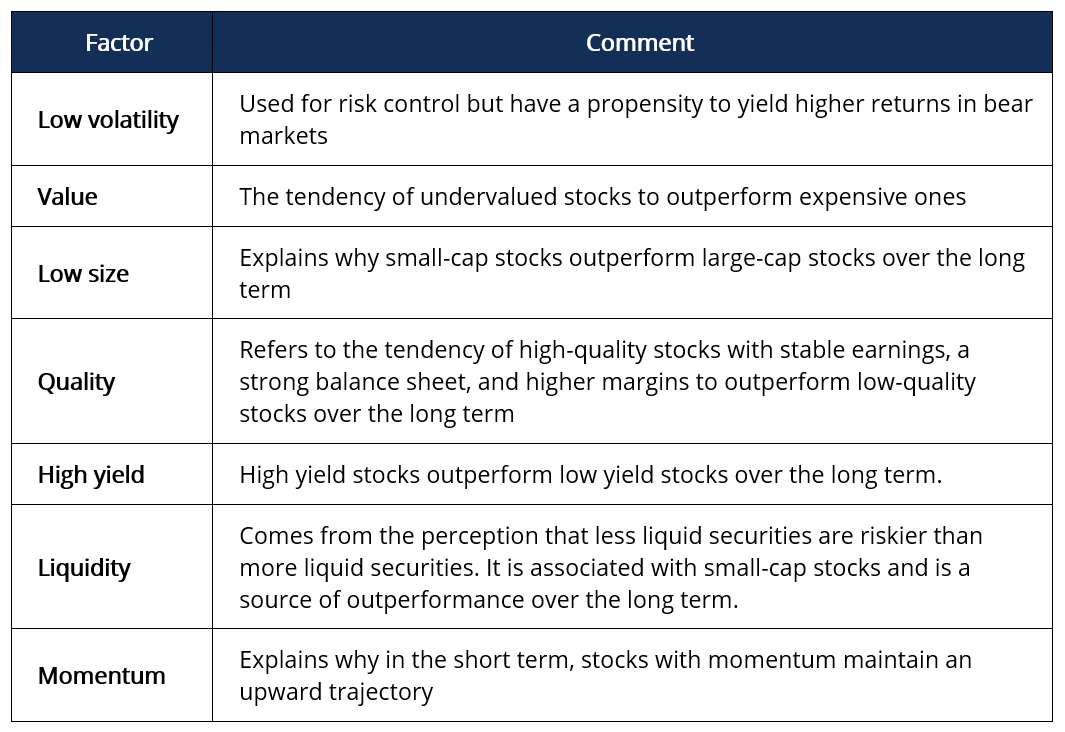
Investors can target single-factor models or construct multi-factor portfolios. Quant funds have started allocating assets across factors as opposed to allocation across asset classes as in traditional portfolios. This is because of the observation that asset classes are showing more correlation with each other in contrast to factors that show a high degree of uncorrelation.
The most common quant strategies are smart-beta and risk premia, which are explained below:
1. Smart-Beta Strategies
Smart-beta refers to investment in portfolios that use a combination of both passive and active investing. The smart-beta approach is similar to an intersection between traditional value investing and the efficient markets hypothesisEfficient Markets HypothesisThe Efficient Markets Hypothesis is an investment theory primarily derived from concepts attributed to Eugene Fama's research work..
It is a long-only strategy using alternatively constructed indices to exploit market inefficiencies and underlying risk factors. It is factor-driven and can tilt towards one or more factors through reweighting benchmark indices to tilt them towards low volatility stocks which can generate improved risk-adjusted returns that surpass the benchmark. Benchmark indices include S&P 500 Index or MSCI Index, which weighs stocks by market capitalization and is a proxy for broad market exposure. They also passively show the equity risk premium.
Smart-beta funds are also known as custom indices and can also be constructed using high-yielding quality assets where stocks are selected according to the strategy rules transparently. Smart-beta funds include a strong beta element, indicating that they are closely correlated to the market.
2. Risk Premia Strategies
The risk premia strategy targets factors through long-short trades with the sole purpose to generate absolute returns. The strategy sheds off much of the beta element to deliver positive returns even during bear markets.
Risk premia strategies also employ leverage and derivatives to amplify returns or hedge against risks. A model long-short value strategy involves a long position on undervalued stocks and, at the same time, short-selling the expensive stocks in a portfolio on a price-to-book value basis.
Risk premia strategies offer a higher chance of capturing alpha through a long position on undervalued stocks and short-selling of overvalued stocks, thereby capturing the risk premium from both sides. They are arguably a better strategy than a smart beta strategy.
A risk premia fund can, to a greater extent eliminate risks associated with market exposure. However, some costs are incurred when short-selling as it involves borrowing assets. The longer the short position, the riskier and costly the position can become. It is even more costly shorting small-cap stocks, which results in the portfolio losing benefits of the size factor.
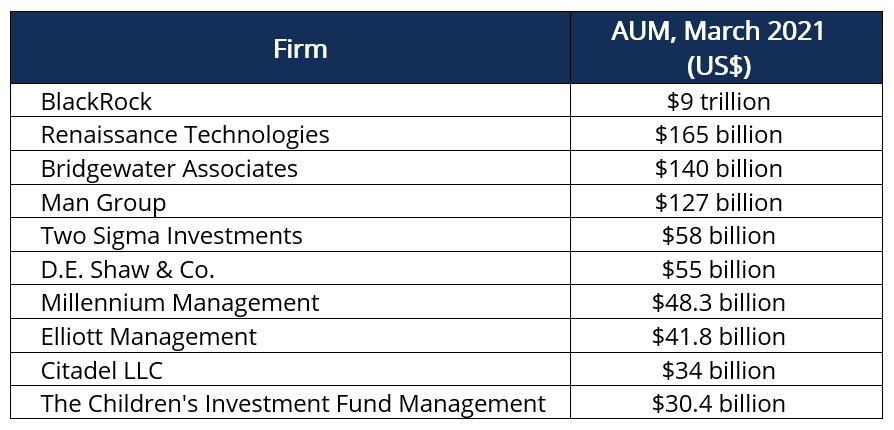
Top Quant Funds in 2021
Advantages of Quant Funds
- Quant funds eliminate human judgment, take on a neutral bias, and remove prejudice.
- Quant funds charge lower management fees, making them cost-effective due to their passive and consistent strategy.
- Risk control is superior due to a consistent investment model regardless of changing market conditions.
- Fast decision making due to automation of a model that can place orders quickly and exploit gains from thin price differentials more effectively.
- The occurrence of errors is not rampant as in traditional investing.
- Quant funds make use of superior algorithms and the best minds in quantitative analysis to exploit market inefficiencies and achieve alpha.
- Machine learning capabilities of quant models draw insights by analyzing large amounts of data in real-time.
Disadvantages of Quant Funds
- Quant funds use historical data, but sometimes history does not repeat itself.
- Quant models need rigorous and continuous back-testing to ensure they continue working as expected.
- Some models do not factor in unexpected circumstances, which can result in undesirable results in the event of a catastrophic event, e.g., a pandemic.
- Too many assumptions are inputted into the model. Some assumptions may not hold if the environment changes, resulting in undesirable buy/sell orders.
- The use of Artificial Intelligence (AI)Artificial Intelligence (AI)Artificial Intelligence (AI) is a broad branch of computer science that is focused on a machine's capability to produce rational behavior from external can lead to different quantitative models to make the same decisions in unison, which can bring about contagion issues in financial markets.
Related Readings
CFI is the official provider of the global Capital Markets & Securities Analyst (CMSA)®Program Page - CMSAEnroll in CFI's CMSA® program and become a certified Capital Markets &Securities Analyst. Advance your career with our certification programs and courses. certification program, designed to help anyone become a world-class financial analyst. To keep advancing your career, the additional CFI resources below will be useful:
- AlgorithmsAlgorithms (Algos)Algorithms (Algos) are a set of instructions that are introduced to perform a task. They automate trading to generate profits at a frequency impossible to a human trader.
- Equity Risk PremiumEquity Risk PremiumEquity risk premium is the difference between returns on equity/individual stock and the risk-free rate of return. It is the compensation to the investor for taking a higher level of risk and investing in equity rather than risk-free securities.
- How to Become a Quant?How to Become a Quant?A quant refers to a person specializing in the implementation of statistical and mathematical methods in order to understand and forecast the
- Modern Portfolio Theory (MPT)Modern Portfolio Theory (MPT)The Modern Portfolio Theory (MPT) refers to an investment theory that allows investors to assemble a portfolio of assets that maximizes expected return for
-

Understanding Vice Funds: A Guide to Controversial Investments
A vice fund is a type of mutual fund that takes the opposite approach to socially responsible investing. With this type of fund, fund managers invest in a variety of stocks from companies that a
-
Fund of Funds (FoF): A Comprehensive Guide
Ever hear of a turducken? It's a deboned chicken that is stuffed into a deboned duck, then further stuffed inside a turkey and then roasted into a delicious abomination. A fund of funds is a litt
invest
- Hedge Funds Explained: A Comprehensive Guide for Investors
- Interval Funds: Understanding Illiquidity & High Yields
- Quant Funds: Understanding Quantitative Investment Strategies
- Equity Funds: A Comprehensive Guide to Investing in Stocks
- Understanding Foreign Funds: Investing in Global Markets
- Fund of Funds (FOF): A Comprehensive Guide for Investors
- Income Funds: A Comprehensive Guide to Current Income Investments
- Quantitative Funds (Quant Funds): An In-Depth Explanation
- Understanding Credit Risk Funds: A Guide for Investors
-
 NFO Explained: Understanding New Fund Offers & Investment
An NFO (new fund offer) is a call for investors made by an asset management company (AMC) to invest money into a new fund. An AMC is an enterprise that collects money from different clients and places...
-
 No-Load Funds: Understanding Commission-Free Mutual Funds
A no-load fund is a type of mutual fund where shares are bought and sold without commission charges for the purchase or the sale being taken out of the investor’s funds. The sales charges are ca...