
Understanding Risk Tolerance: A Guide for Investors
Risk tolerance refers to the amount of loss an investor is prepared to handle while making an investment decision. Several factors determine the level of risk an investor can afford to take.

Knowing the risk tolerance level helps investors plan their entire portfolio and will drive how they invest. For example, if an individual’s risk tolerance is low, investments will be made conservatively and will include more low-risk investments and less high-risk investments.
Summary
- Risk tolerance refers to the amount of loss an investor is prepared to handle while making an investment decision.
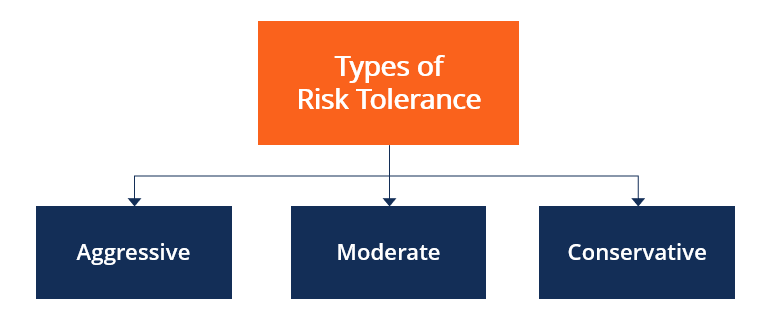
- Investors are usually classified into three main categories based on how much risk they can tolerate. They include aggressive, moderate, and conservative.
- Knowing the risk tolerance level helps investors plan their entire portfolio and will drive how they invest.
Factors that influence Risk Tolerance
1. Timeline
Each investor will adopt a different time horizon based on their investment plansInvestment HorizonInvestment horizon is a term used to identify the length of time an investor is aiming to maintain their portfolio before selling their securities for a profit. An individual’s investment horizon is affected by several different factors. However, the primary determining factor is often the amount of risk that the investor. Generally, more risk can be taken if there is more time. An individual who needs a certain sum of money at the end of fifteen years can take more risk than an individual who needs the same amount by the end of five years. It is due to the fact that the market has shown an upward trend over the years. However, there are constant lows in the short term.
2. Goals
Financial goals differ from individual to individual. To accumulate the highest amount of money possible is not the sole purpose of financial planning for many. The amount required to achieve certain goals is calculated, and an investment strategy to deliver such returnsRate of ReturnThe Rate of Return (ROR) is the gain or loss of an investment over a period of time copmared to the initial cost of the investment expressed as a percentage. This guide teaches the most common formulas is usually pursued. Therefore, each individual will take on a different risk tolerance based on goals.
3. Age
Usually, young individuals should be able to take more risks than older individuals. Young individuals have the capability to make more money working and have more time on their hands to handle market fluctuations.
4. Portfolio size
The larger the portfolio, the more tolerant to risk. An investor with a $50 million portfolio will be able to take more risk than an investor with a $5 million portfolio. If value drop, the percentage loss is much less in a larger portfolio when compared to a smaller portfolio.
5. Investor comfort level
Each investor handles risk differently. Some investors are naturally more comfortable with taking risks than others. On the contrary, market volatility can be extremely stressful for some investors. Risk tolerance is, therefore, directly related to how comfortable an investor is while taking risks.
Types of Risk Tolerance
Investors are usually classified into three main categories based on how much risk they can tolerate. The categories are based on many factors, few of which have been discussed above. The three categories are:
1. Aggressive
Aggressive risk investors are well versed with the market and take huge risks. Such types of investors are used to seeing large upward and downward movements in their portfolio. Aggressive investors are known to be wealthy, experienced, and usually have a broad portfolio.
They prefer asset classes with a dynamic price movement, such as equitiesPublic SecuritiesPublic securities, or marketable securities, are investments that are openly or easily traded in a market. The securities are either equity or debt-based.. Due to the amount of risk they take, they reap superior returns when the market is doing well and naturally face huge losses when the market performs poorly. However, they do not panic sell at times of crisis in the market as they are used to fluctuations on a daily basis.
2. Moderate
Moderate risk investors are relatively less risk-tolerant when compared to aggressive risk investors. They take on some risk and usually set a percentage of losses they can handle. They balance their investments between risky and safe asset classesAsset ClassAn asset class is a group of similar investment vehicles. They are typically traded in the same financial markets and subject to the same rules and regulations.. With the moderate approach, they earn lesser than aggressive investors when the market does well but does not suffer huge losses when the market falls.
3. Conservative
Conservative investors take the least risk in the market. They do not indulge in risky investments at all and go for the options they feel are safest. They prioritize avoiding losses above making gains. The asset classes they invest in are limited to a few, such as FD and PPF, where their capital is protected.
Ignoring Risk Tolerance
Investing without considering risk tolerance can prove to be fatal. An investor must know how to react when the value of investments falls. Many investors flee the market and sell low in the process. At the same time, a market decline can be a great time to buy. Therefore, ascertaining risk tolerance helps in making informed decisions and not make hasty, wrongful decisions.
Additional Resources
CFI is the official provider of the global Commercial Banking & Credit Analyst (CBCA)™Program Page - CBCAGet CFI's CBCA™ certification and become a Commercial Banking & Credit Analyst. Enroll and advance your career with our certification programs and courses. certification program, designed to help anyone become a world-class financial analyst. To keep advancing your career, the additional CFI resources below will be useful:
- Asset AllocationAsset AllocationAsset allocation refers to a strategy in which individuals divide their investment portfolio between different diverse categories
- Risk AversionRisk AversionRisk aversion refers to the tendency of an economic agent to strictly prefer certainty to uncertainty. An economic agent exhibiting risk aversion is said to be risk averse. Formally, a risk averse agent strictly prefers the expected value of a gamble to the gamble itself.
- Expected ReturnExpected ReturnThe expected return on an investment is the expected value of the probability distribution of possible returns it can provide to investors. The return on the investment is an unknown variable that has different values associated with different probabilities.
- Investing: A Beginner’s GuideInvesting: A Beginner's GuideCFI's Investing for Beginners guide will teach you the basics of investing and how to get started. Learn about different strategies and techniques for trading
-

Understanding Deviation Risk Measures: A Financial Risk Assessment
Deviation risk measure is a function that is used to measure financial risk, and it differs from general risk measurements. Risk measurement is primarily used in the finance industry to measure the mo
-

Overconfidence Bias: Understanding Its Impact & How to Mitigate It
Overconfidence bias is a tendency to hold a false and misleading assessment of our skills, intellect, or talent. In short, it’s an egotistical belief that we’re better than we actually are
invest
- Understanding Risk Grades: An Investor's Guide
- Understanding Risk Preference: A Comprehensive Guide
- Understanding Currency Risk: A Comprehensive Guide
- Understanding Downside Risk: Protecting Your Investments
- Understanding Market Risk: A Comprehensive Guide
- Understanding Risk Tolerance: Definition & Importance for Investors
- Value at Risk (VaR): Understanding Investment Risk
- Understanding Risk Aversion in Investing: A Beginner's Guide
- Understanding Investment Risk Tolerance: A Comprehensive Guide
-
 Basis Risk Explained: Understanding and Managing Hedging Risk
Basis risk is defined as the inherent risk a traderThe Winning Mindset of a TraderBeing a master trader is not just about formulating better strategies and analysis but is also about developing a...
-
 Understanding Call Risk in Bonds: A Comprehensive Guide
Call risk is the risk for a bond buyer that exists in purchasing a callable bondCallable BondA callable bond (redeemable bond) is a type of bond that provides the issuer of the bond with the right, bu...