
Understanding Call Risk in Bonds: A Comprehensive Guide
Call risk is the risk for a bond buyer that exists in purchasing a callable bondCallable BondA callable bond (redeemable bond) is a type of bond that provides the issuer of the bond with the right, but not the obligation, to redeem the bond before its maturity date. The callable bond is a bond with an embedded call option. These bonds generally come with certain restrictions on the call option.. The chance that the bond may be redeemed (i.e., called) before its scheduled maturity date represents an investment risk for the buyer, as it can result in them earning less from their bond purchase investment than they expected.
Call risk is essentially the same as reinvestment risk, as will be explained below.

Summary
- Call risk is the risk for a bond buyer that exists in purchasing a callable bond – one that may be redeemed by the issuer before maturity.
- Call risk is essentially reinvestment risk.
- Callable bonds typically offer a premium over principal repayment in the event that the bond is called – it represents compensation to the bond investor for assuming the call risk.
Callable Bonds
Some corporate and municipal bondsMunicipal BondA municipal bond refers to a bond or fixed income security that is issued by a government municipality, township, or state to finance its governmental may be called – that is, redeemed early, before their stated maturity date – by the issuer. Such a call feature exists as an embedded option – an option but not an obligation – in the bond indenture, the bond’s purchase agreement that lays out all the terms regarding the bond.
The terms include things such as the bond’s par value, the stated coupon rateCoupon RateA coupon rate is the amount of annual interest income paid to a bondholder, based on the face value of the bond., the frequency and schedule of coupon payments, the bond’s maturity date, and the terms of any call provision that exists with the bond.
The right of the issuer to redeem the bond prior to maturity is commonly time-limited. Typically, there is a period of time following the initial issuance of bonds during which the issuer may not exercise its early redemption option.
For example, for a bond with a stated maturity of five years, the bond indenture may state that the issuer cannot redeem the bond prior to two years from the original bond issue date. Such a limitation provides investors with some protection against the bond’s call risk, guaranteeing that – unless the issuer defaults on its debt obligations – they will at least receive coupon payments for a period of two years.
Why Bonds are Called
To understand why bonds may be called, you need to understand the point of view of the bond’s issuer. When a company or a municipality issues bonds, it usually does so by offering interest rates comparable to the prevailing market rates. However, interest rates fluctuate over time. If an issuer sells bonds with a stated maturity date of 10 years, there is a significant likelihood that prevailing market interest rates will rise or fall during the life of the bond.
If interest rates should rise over the bond’s life, then the issuer would benefit, as it is paying less interest on its borrowed money than the current market rate. However, if interest rates decline during the bond’s term, then the issuer finds itself paying a higher rate of interest than the rate it would need to pay if it borrowed money at the current prevailing interest rates.
If the fall in interest rates is substantial enough, for example, a decline from 7% to 4%, then the issuer may want to redeem its outstanding 7% coupon rate bonds and issue new bonds that only require the issuer pay a 4% coupon rate. In short, by redeeming a bond issue early, the issuer has an opportunity to lower its borrowing cost.
To learn more about bond-related risks, check out CFI’s Fixed Income Fundamentals course!
Call Risk – Time and Interest
The risk that a buyer of a callable bond faces is the potential lost investment return if their bond is redeemed early, thus depriving them of the full amount of interest that they had expected to receive over the full life of the bond. Call risk is often referred to as reinvestment risk. The following example shows how reinvestment risk works:
Assume that you buy a 10-year bond with a stated coupon rate of 8%. The bond is callable after three years from issue. Three years into the life of the bond, prevailing interest rates have fallen to 4%. The bond issuer exercises its call optionCall OptionA call option, commonly referred to as a "call," is a form of a derivatives contract that gives the call option buyer the right, but not the obligation, to buy a stock or other financial instrument at a specific price - the strike price of the option - within a specified time frame. and redeems the bond early. Thus, you have only received three years’ worth of 8% interest on your bond, rather than the 10 years of 8% interest payments that you were expecting.
You have received your principal back, the money you paid for the bond, but if you go looking to purchase a new bond, you will most likely only find bonds offering the prevailing market interest rate of 4%. Thus, reinvesting in new bonds effectively costs you seven years’ worth of 4% more interest (8% – 4% = 4%) that you would have earned had your prior bond not been redeemed early.
Because a call provision exposes a bond investor to reinvestment risk, most call provisions specify a call price – the price the issuer must pay an investor to redeem the bond early – that represents a premium to the bond’s original face value. The premium is compensation to the investor for assuming the call risk when they buy a bond.
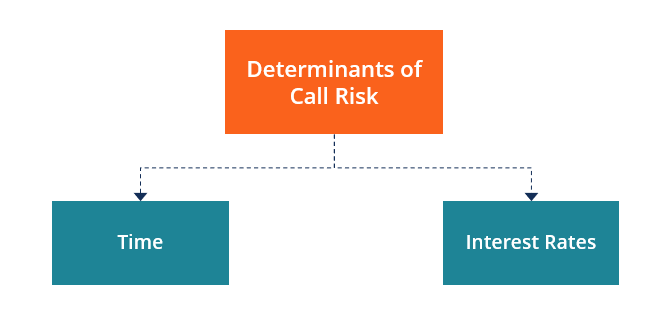
The primary determinants of call risk are interest rates and time. If prevailing interest rates are in a downtrend, then there is a greater likelihood that rates will fall substantially during the life of a bond and that the issuer may, therefore, call the bond.
The greater the amount of time until the bond’s maturity also represents a higher call risk, as a significant decline in interest rates is more likely to occur over a long span of time rather than within a relatively short period. Thus, for example, there is a higher call risk with a 20-year callable bond than with a five-year callable bond.
More Resources
CFI is the official provider of the Capital Markets & Securities Analyst (CMSA)™Program Page - CMSAEnroll in CFI's CMSA® program and become a certified Capital Markets &Securities Analyst. Advance your career with our certification programs and courses. certification program, designed to transform anyone into a world-class financial analyst.
In order to help you become a world-class financial analyst and advance your career to your fullest potential, these additional resources will be very helpful:
- Call PriceCall PriceA call price refers to the price that a preferred stock or bond issuer would pay to buyers if they chose to redeem the callable security
- DurationDurationDuration is one of the fundamental characteristics of a fixed-income security (e.g., a bond) alongside maturity, yield, coupon, and call features.
- Embedded OptionEmbedded OptionAn embedded option is a provision in a financial security (typically in bonds) that provides an issuer or holder of the security a certain right but not an obligation to perform some actions at some point in the future. The embedded options exist only as a component of financial security
- Fixed Income RisksFixed Income RisksFixed income risks occur based on the volatility of the bond market environment. Risks impact the market value of the security when it is sold, cash flow from the security while it is held, and additional income made by reinvesting cash flows.
-

Personal Bond Explained: Release from Jail Without Bail
A personal bond, which is also called personal recognizance and own recognizance, is a written contract in which a person who has been arrested agrees to appear at all required court dates and promise
-
Understanding Bonds: A Comprehensive Guide for Investors
At its essence, a bond is a formalized IOU. It’s a loan agreement between a borrower (the bond issuer) and a lender (the bondholders). A bond issuer is looking to borrow money to spend on any number o
invest
- Understanding Call Dates: What You Need to Know
- Call Premium Explained: Understanding Issuer Redemptions & Option Pricing
- Understanding Call Prices: Callable Bonds & Preferred Stocks
- Understanding Call Protection in Bonds: Investor Protection Explained
- Understanding Call Provisions in Bonds: A Comprehensive Guide
- Coupon Bonds: Understanding Fixed Income & Interest Payments
- Understanding Currency Risk: A Comprehensive Guide
- Understanding Hard Call Protection in Callable Bonds
- Make-Whole Call Provisions: Understanding Early Bond Redemption
-
Value at Risk (VaR): Understanding Investment Risk
Value at risk is a method that is used to determine the possible risk of loss for a particular type of investment. This is a strategy that attempts to determine what the worst-case scenario is f...
-
Understanding Risk Aversion in Investing: A Beginner's Guide
The term risk aversion is often applied to certain types of investors. Here are the basics of risk aversion and what it means to investors. Risk Aversion The term risk aversion basically means t...