
Basis Risk Explained: Understanding and Managing Hedging Risk
Basis risk is defined as the inherent risk a traderThe Winning Mindset of a TraderBeing a master trader is not just about formulating better strategies and analysis but is also about developing a winning mindset. takes when hedging a position by taking a contrary position in a derivative of the asset, such as a futures contract. Basis risk is accepted in an attempt to hedge away price risk.
As an example, if the current spot price of gold is $1190 and the price of gold in the June gold futures contract is $1195, then the basis, the differential, is $5.00. Basis risk is the risk that the futures price might not move in normal, steady correlation with the price of the underlying assetTypes of AssetsCommon types of assets include current, non-current, physical, intangible, operating, and non-operating. Correctly identifying and, and that this fluctuation in the basis may negate the effectiveness of a hedging strategy employed to minimize a trader’s exposure to potential loss. The price spread (difference) between the cash price and the futures price may either widen or narrow.

Hedging Strategies
A hedgingHedging ArrangementHedging arrangement refers to an investment whose aim is to reduce the level of future risks in the event of an adverse price movement of an asset. Hedging provides a sort of insurance cover to protect against losses from an investment. strategy is one where a trader adopts a second market position for the purpose of minimizing the risk exposure in the initial market position. The strategy may involve taking a futures position contrary to one’s market position in the underlying asset. For example, a trader might sell futures short to offset a long, buy position in the underlying asset. The idea behind the strategy is that at least part of any potential loss in the underlying asset position will be offset by profits in the hedge futures position.
When large investments are involved, basis risk can have a significant effect on eventual profits or losses realized. Even a modest change in the basis can make the difference between bagging a profit and suffering a loss. The inherently imperfect correlation between cash and futures prices means there is potential for both excess gains and excess losses. This risk that is specifically associated with a futures hedging strategy is the basis risk.
Components of Basis Risk
Risk can never be altogether eliminated in investments. However, risk can be at least somewhat mitigated. Thus, when a trader enters into a futures contract to hedge against possible price fluctuations, they are at least partly changing the inherent “price risk” into another form of risk, known as “basis risk”. Basis risk is considered a systematic, or market, risk. Systematic risk is the risk arising from the inherent uncertainty of the markets. Unsystematic, or non-systematic, risk, which is the risk associated with a specific investment. The risk of a general economic turndown, or depression, is an example of systematic riskSystematic RiskSystematic risk is that part of the total risk that is caused by factors beyond the control of a specific company or individual. Systematic risk is caused by factors that are external to the organization. All investments or securities are subject to systematic risk and therefore, it is a non-diversifiable risk.. The risk that Apple may lose market share to a competitor is unsystematic risk.
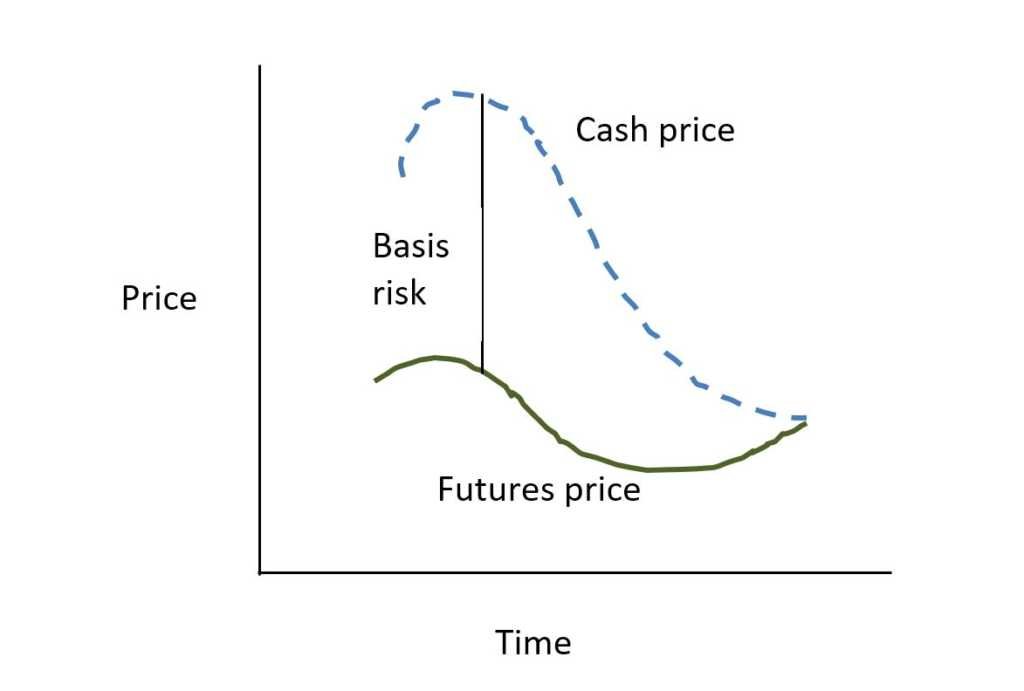
Between the time a futures position is initiated and closed out, the spread between the futures price and the spot price may widen or narrow. As the visual representation below shows, the normal tendency is for the basis spread to narrow. As the futures contract nears expiration, the futures price usually converges toward the spot price. This logically happens as the futures contract becomes less and less “future” in nature. However, this common narrowing of the basis spread is not guaranteed to occur.
Hedging with Futures Contracts
Suppose a rice farmer wants to hedge against possible price fluctuations in the market. For example, in December, he decides to enter into a short-sell position in a futures contract in order to limit his exposure to a possible decline in the cash price prior to the time when he will sell his crop in the cash market. Assume that the spot price of rice is $50 and the futures price for a March futures contract is $55. The basis, then, is $5.00 (the futures price minus the spot price). In this situation the market is in contango,Contango vs BackwardationContango vs backwardation are terms used to describe the shape of the futures curve for commodity markets. The futures curve has two dimensions, plotting time across the horizontal axis and delivery price of the commodity across the vertical axis. i.e., the spot price is less than the futures price.
Suppose the farmer decides to lift the hedge in February, due to falling prices. At the time he decides to close out his market positions, the spot price is $47 and the March futures price is $49. He sells his rice crop at $47 per unit and lifts his hedge by buying futures to close out his short sell position at $49. In this case, his $3 per unit loss in the cash market is more than offset by his $6 gain from short selling futures ($55 – $49). Therefore, his net sales revenueSales RevenueSales revenue is the income received by a company from its sales of goods or the provision of services. In accounting, the terms "sales" and becomes $53 ($47 cash price + $6 futures profit). The farmer has enjoyed extra profits as a result of the basis narrowing from $5 to $2.
If the basis remained constant, then the farmer would not gain any extra profit, nor incur any additional loss. His $3.00 profit in futures would have exactly offset the $3.00 loss in the cash market. It’s important to note, however, that while his short sell hedge in futures didn’t generate any additional profit, it did successfully protect him from the price decline in the cash market. If he had not taken the futures position, then he would have suffered a $3.00 per unit loss.
The other possible scenario would be where the cash market price declined while the futures price increased. Suppose when the farmer closed out his short sell futures hedge, the cash price was $47 but the futures price was $57. Then he would have lost $3.00 per unit in the cash market and lost an additional $2.00 in his short futures trade ($57 – $55). His net sales revenue would be only $45 per unit. Why the extra loss? Because in this instance the basis widened, as opposed to narrowing or remaining constant. It was the opposite of the basis pattern the farmer was looking for to successfully hedge his cash crop. In this case, the farmer took the basis risk and lost.
It’s also worth noting that a buyer of rice, looking to hedge against a possible cash market increase in the price of rice, would have bought futures as a hedge. That hedger would realize maximum profit from the third scenario, where the basis widened from $5.00 to $10.00.
Different Types of Basis Risk
Different types include:
- Price basis risk: The risk that occurs when the prices of the asset and its futures contract do not move in tandem with each other.
- Location basis risk: The risk that arises when the underlying asset is in a different location from the where the futures contract is traded. For example, the basis between actual crude oil sold in Mumbai and crude oil futures traded on a Dubai futures exchange may differ from the basis between Mumbai crude oil and Mumbai-traded crude oil futures.
- Calendar basis risk: The selling date of the spot market position may be different from the expiry date of a futures market contract.
- Product quality basis risk: When the properties or qualities of the asset are different from that of the asset as represented by the futures contract.
Main Takeaways
Basis risk is the risk that is inherent whenever a trader attempts to hedge a market position in an asset by adopting a contrary position in a derivative of the asset, such as a futures contract. Basis risk is accepted in an attempt to hedge away price risk. If the basis remains constant until the trader closes out both of his positions, then he will have successfully hedged his market position. If the basis has changed significantly, then he will likely experience extra profits or increased losses. Producers looking to hedge their market position will profit from a narrowing basis spread, while buyers will profit from a widening basis.
More Resources
Thank you for reading this CFI guide to basis risk. CFI is the official provider of the Financial Modeling & Valuation Analyst (FMVA)™ certificationBecome a Certified Financial Modeling & Valuation Analyst (FMVA)®CFI's Financial Modeling and Valuation Analyst (FMVA)® certification will help you gain the confidence you need in your finance career. Enroll today!. To prepare for the FMVA curriculum, these additional resources will be helpful:
- Contango vs. BackwardationContango vs BackwardationContango vs backwardation are terms used to describe the shape of the futures curve for commodity markets. The futures curve has two dimensions, plotting time across the horizontal axis and delivery price of the commodity across the vertical axis.
- How to read stock chartsHow to Read Stock ChartsIf you’re going to actively trade stocks as a stock market investor, then you need to know how to read stock charts. Even traders who primarily use fundamental analysis to select stocks to invest in still often use technical analysis of stock price movement to determine specific buy and sell, stock charting
- Hedge fund strategiesHedge Fund StrategiesA hedge fund is an investment fund created by accredited individuals and institutional investors for the purpose of maximizing returns and
- Risk AverseRisk Averse DefinitionSomeone who is risk averse has the characteristic or trait of preferring avoiding loss over making a gain. This characteristic is usually attached to investors or market participants who prefer investments with lower returns and relatively known risks over investments with potentially higher returns but also with higher uncertainty and more risk.
-

Managed Futures: A Comprehensive Guide for Diversified Investing
Managed futures is a subclass of alternative investment strategies used by large funds and institutional investors to achieve both portfolio and market diversification. With the ability to take both l
-

Understanding Risk and Return in Investing
In investing, risk and return are highly correlated. Increased potential returns on investment usually go hand-in-hand with increased risk. Different types of risks include project-specific
invest
- Understanding Risk Grades: An Investor's Guide
- Understanding Risk Preference: A Comprehensive Guide
- Understanding Operating Risk: A Key Component of Business Risk
- Understanding Financial Risk: A Comprehensive Guide
- Understanding Currency Risk: A Comprehensive Guide
- Understanding Downside Risk: Protecting Your Investments
- Understanding Market Risk: A Comprehensive Guide
- Value at Risk (VaR): Understanding Investment Risk
- Understanding Risk Aversion in Investing: A Beginner's Guide
-
 Understanding Deviation Risk Measures: A Financial Risk Assessment
Deviation risk measure is a function that is used to measure financial risk, and it differs from general risk measurements. Risk measurement is primarily used in the finance industry to measure the mo...
-
 Equity Futures Contracts: Definition, Types & Uses
An equity futures contract is a financial arrangement between two counterparties to buy or sell equity at a specified date, amount, and price. They are regulated on derivative exchanges and used for s...