
Understanding Rolling LEAP Options: A Comprehensive Guide
Rolling LEAP options refers to extending the trading duration of stock optionsOption Pricing ModelsOption Pricing Models are mathematical models that use certain variables to calculate the theoretical value of an option. The theoretical value of an to the next trading period. Investors rollover options to manage a winning or losing position. In a losing position, they extend the time to hopefully prevent losses before they close the position. However, they must possess sufficient and reliable data to support their decision. Otherwise, they stand to incur larger losses.
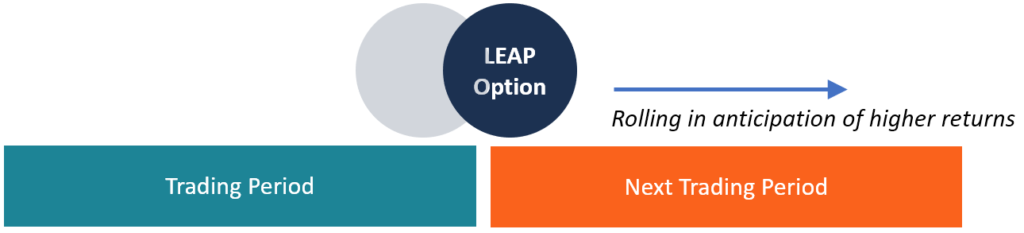
If there is a sign of continuous improvement, there is no need to close the position. The prudent action will be to extend the trade. The ideal scenario might be one where the price is quite close to where the investor wants it to be. So, by extending the duration, the investor might make a higher gain or avoid a loss.
LEAP Options vs. Shares
LEAP options are long-term (expiration more than one year ahead) options on stocksStockWhat is a stock? An individual who owns stock in a company is called a shareholder and is eligible to claim part of the company’s residual assets and earnings (should the company ever be dissolved). The terms "stock", "shares", and "equity" are used interchangeably.. With the introduction of LEAP options, investors can now leverage long-term option opportunities as a buy-and-hold investment. Because of this, investors don’t need to make a large capital outlay. By rolling LEAP options, they can extend their market position further into the future. LEAP stands for “Long-term Equity Anticipation”.
Understanding the Rolling Over Options Process
Rolling LEAP options involves simultaneously closing the existing position and opening a new position at a different strike priceStrike PriceThe strike price is the price at which the holder of the option can exercise the option to buy or sell an underlying security, depending on, or with a different expiration, or both. One LEAP option contract can replace another LEAP option contract by extending the expiration date. If the option has low volatility, the investor stands to maintain higher leverage with minimal transaction costs.
Example
Let’s say Joe is investing in LEAP option trading. In the stock market, the price of Company X’s stock is $25 per share. Joe decides to purchase at-the-money LEAP options on the stock. Since he is trading options, he pays a premium price of $2.05 per share. He buys 100 LEAP options contracts with a strike price of $25 and a hold period of 1 year. Each contract, in this case, contains 100 shares. So, in total, he has optioned 10,000 shares (100 contracts x 100 shares/contract).
The total value of the shares is $250,000 ($25 per share x 10,000 shares). However, since he is trading option contracts, he only needs to pay a premium fee of $20,500 ($2.05 premium price x 10,000 shares). For Joe to break even, the stock must trade at $27.05 ($25 strike price + $2.05 premium price). Therefore, for him to make a profit, Company X stocks must trade above $27.05.
Let’s say that the stock is trading at $26.50 when the expiration period has just a few weeks to go. He might decide to roll his LEAP options to the next trading period in anticipation of an increase in share price. This is a reasonable decision because the price is near where he wants it to be and has moved in the direction he anticipated. It may only require a little more time to make him a profit.
When is the right time to roll an option?
Rolling LEAP options is entirely a subjective decision. There is no definitive guide regarding the right time to roll them. However, there are a few important considerations to factor into the decision.
1. What were the investor’s initial assumptions?
The investor should consider whether his original assumptions about the investment are still valid. If his viewpoint is now negative, based on either price changes or company news, then he/she might decide to against rolling over his LEAP option.
2. Whether holding the option is the best use of capital
Even if rolling over their LEAP option may be profitable, if the investor speculates they will, at best, enjoy minimal gains, then they might consider closing out their position and using the money elsewhere where there is a better opportunity.
Rolling LEAP options is a simple way for an investor to maintain a low-cost position in a stock over a longer time frame. The rollover may be done in hopes of avoiding a loss or with a view to making a greater profit.
More resources
Thank you for reading CFI’s explanation of rolling LEAP options. CFI is a provider of the Financial Modeling & Valuation Analyst (FMVA)™Become a Certified Financial Modeling & Valuation Analyst (FMVA)®CFI's Financial Modeling and Valuation Analyst (FMVA)® certification will help you gain the confidence you need in your finance career. Enroll today! certification program and financial analyst training. To keep advancing your career, the additional resources below will be useful:
- Long and Short PositionsLong and Short PositionsIn investing, long and short positions represent directional bets by investors that a security will either go up (when long) or down (when short). In the trading of assets, an investor can take two types of positions: long and short. An investor can either buy an asset (going long), or sell it (going short).
- Daily Trading LimitDaily Trading LimitThe daily trading limit refers to the maximum amount by which the price of a stock or other exchange-traded security can rise or fall during a trading session. The limits are decided by the exchange in an attempt to avoid extreme volatility or manipulation in the markets.
- Trade Order TimingTrade Order Timing - TradingTrade order timing refers to the shelf-life of a specific trade order. The most common types of trade order timing are market orders, GTC orders,
- Triangle Patterns – Technical AnalysisTriangle Patterns - Technical AnalysisThe triangle patterns are common chart patterns every trader should know. Triangle patterns are important because they help indicate the continuation of a bullish or bearish market. They can also assist a trader in spotting a market reversal.
-
Call Ratio Back Spread: A Bullish Options Strategy Explained
A call ratio back spread is a bullish options trading strategy that involves both buying and selling call options. The strategy is designed to maximally profit from a significant upward movement in th
-

Stock Options Explained: A Beginner's Guide to Understanding Equity Contracts
Have you ever wondered, “what are stock options?” Understanding this method of stock trading is essential to any investor who’s looking to make the most of the public mark
invest
- Understanding Early Exercise of Options Contracts
- Understanding Exotic Options: A Comprehensive Guide
- Understanding Options Expiration Time: Key Dates & Deadlines
- Understanding Index Options: A Comprehensive Guide
- Understanding Non-Equity Options: A Comprehensive Guide
- Rho (Finance): Understanding Interest Rate Sensitivity of Options
- Volatility Smile Explained: Understanding Implied Volatility Patterns
- Rolling Forecasts: A Comprehensive Guide to Continuous Financial Planning
- Options Trading Explained: Risks & Rewards for Investors
-
 Understanding Synthetic Options: A Comprehensive Guide
Synthetic options are portfolios or tradingTrading & InvestingCFIs trading & investing guides are designed as self-study resources to learn to trade at your own pace. Browse hundreds of articl...
-
Understanding Binary Options: A Comprehensive Guide
There are two primary types of binary options available: cash-or-nothing and asset-or-nothing options. Both types of options provide a fixed payout amount to the owner in the event that a certai...