
Rolling Forecasts: A Comprehensive Guide to Continuous Financial Planning
A rolling forecast is a type of financial modelTypes of Financial ModelsThe most common types of financial models include: 3 statement model, DCF model, M&A model, LBO model, budget model. Discover the top 10 types that predicts the future performance of a business over a continuous period, based on historical data. Unlike static budgets that forecast the future for a fixed time frame, e.g., January to December, a rolling forecast is regularly updated throughout the year to reflect any changes.
That is, it relies on an add/drop approach to forecasting that drops a month/period as it passes and adds a new month/period automatically. This enables companies to project future performance based on the most recent numbers and time frame, which offers an advantage when operating in a fluid and ever-changing business environment.
Learn more in CFI’s Rolling Cash Flow Forecast Course.
Rolling Forecasts vs. Static Budgets
While most traditional businesses use static budgets to assess past performance, a rolling forecast is used to try to predict future performance. With static budgets, the budget remains fixed and does not change as the business evolves. As a result, even if revenuesSales RevenueSales revenue is the income received by a company from its sales of goods or the provision of services. In accounting, the terms "sales" and exceed budget estimates, the static budget will remain unchanged until the predetermined time frame has expired.
With rolling forecasts, businesses establish a set of periods after which to update the forecast. For example, if the company sets the period to a month, the budget is automatically updated one month after every month is complete. This allows businesses to be more efficiently responsive by regularly adapting their budgets to reflect recent trends and changes in the marketplace.
Steps in Creating Rolling Forecasts
The process of creating a rolling forecast should be done in a sequential order to avoid missing some steps. The process to create forecasts is as follows:
1. Identify the objectives.
The team tasked with creating the rolling forecast should keep the end goal in mind when building the projections. Setting the objectives also involves identifying the usability of the forecasts and the persons who will rely on the forecasts to make decisions. Failure to set clear goals from the start will inhibit the effectiveness of creating rolling forecasts.
2. Consider the time frame.
A business must keep the time frame of rolling forecasts in mind to help in planning. This involves deciding on how far into the future the forecast will go. The business should determine the forecast increments in advance.
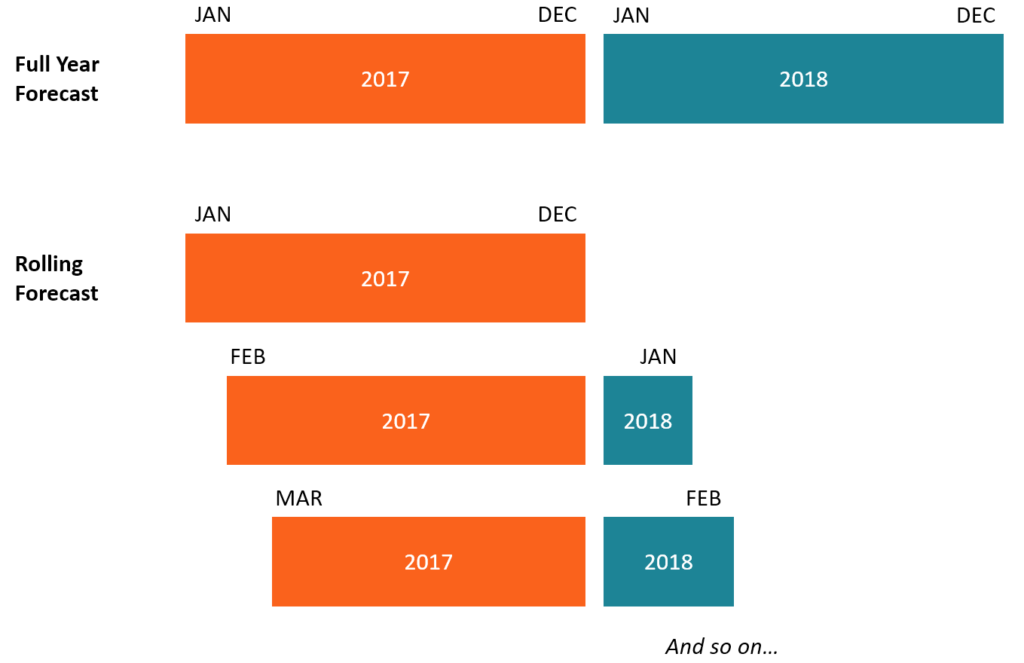
For example, a company may choose the increment period to be weekly, monthly, or quarterly. If management chooses monthly increments for 12 months, after one month expires, it drops out of the forecast and an extra month is added to the end of the forecast. This means that the business is continually forecasting 12 monthly periods into the future, as shown in Figure 1 below.

3. Determine the level of detail.
The length of the forecast period may partially determine how much detail should be included in the forecast. Longer forecasts will typically be less detailed. Also, in a situation where the consequences of a bad decision are potentially very substantial, the creators of the rolling forecast should spend more time and effort to increase the accuracy of the forecasts.
4. Identify the contributors to the process.
A company must identify the key contributors to the process of creating rolling forecasts. The participants need to be persons who are objective, unbiased, and insightful in order to make meaningful contributions to the process. They should be rewarded when the company achieves set targets and held accountable when the company fails to meet targeted performance.
5. Identify value drivers.
Rather than focus on all aspects of the business, the company should identify the value drivers most likely to contribute to achieving success. Focusing on too many goals may obstruct the company from achieving the objectives that are most important to its success. The value drivers may be identified from past company successes and from the industry in which the business operates.
6. Verify the source of data.
The data that the company relies on when creating the rolling forecasts should be reliable and credible to give objective targets. Management must verify that the quality of data is above par and that the source of the data is trustworthy.
7. Create scenarios and sensitivities.
An essential step in creating rolling forecasts is assessing possible financial outcomes using certain assumptions and drivers. This gives the company a glimpse of the possible scenarios that it may have to adapt to, depending on the drivers that the company uses.
As new information becomes available or new trends appear, the forecast can be updated and new possible outcomes ascertained. Having advanced knowledge of possible or likely scenarios or outcomes helps company management make better decisions.
8. Measure actual and estimated forecasts.
Once the rolling forecast has been implemented, it should be tracked to see if there are any variances between the actual performance and the set targets. If there are any variances, the participants in the process should find out what led to the variances and plan courses of action to remedy the situation.
Learn more in CFI’s Rolling Forecast Modeling Course.
Benefits of Using a Rolling Forecast
A company that uses a rolling forecast as opposed to a static budget enjoys the following benefits:
1. Improved risk analysis
Businesses operate in an ever-changing environment, which translates to increased risks. By using a rolling forecast, a business can continually adapt to changing economic and industry conditions, which helps reduce the amount of risk exposure. Additionally, the company can identify areas that need more attention and allocate more time and resources to them.
2. Increased accuracy in financial planning
When preparing annual budgets, large businesses often need to consider a number of variables that keep on changing from day to day or month to month. For example, the implementation of a government policy that directly affects the business will require the company to adjust its financials to accommodate and reflect the changes.
If the business relies on a static budget, it will need to wait until the next budgetingBudgetingBudgeting is the tactical implementation of a business plan. To achieve the goals in a business’s strategic plan, we need some type of budget that finances the business plan and sets measures and indicators of performance. period to reflect the changes. However, the practice of using a rolling forecast enables a company to respond more quickly to such marketplace changes.
Other Resources
CFI is the global provider of the Financial Modeling & Valuation Analyst (FMVA)Become a Certified Financial Modeling & Valuation Analyst (FMVA)®CFI's Financial Modeling and Valuation Analyst (FMVA)® certification will help you gain the confidence you need in your finance career. Enroll today!®Become a Certified Financial Modeling & Valuation Analyst (FMVA)®CFI's Financial Modeling and Valuation Analyst (FMVA)® certification will help you gain the confidence you need in your finance career. Enroll today! certification program for finance professionals around the world. To learn more and advance your career, explore the additional relevant CFI resources below:
- CalendarizationCalendarizationThe process of standardizing financial statements is called calendarization. To make comparable companies “equal,” the financial data of each company
- Year to Date (YTD)Year to Date (YTD)Year to date (YTD) refers to the period from the beginning of the current year to a specified date. Year to date is based on the number of days from the beginning of the calendar year (or fiscal year). It is commonly used in accounting and finance for financial reporting purposes.
- Projecting Income Statement Line ItemsProjecting Income Statement Line ItemsWe discuss the different methods of projecting income statement line items. Projecting income statement line items begins with sales revenue, then cost
- Projecting Balance Sheet Line ItemsProjecting Balance Sheet Line ItemsProjecting balance sheet line items involves analyzing working capital, PP&E, debt share capital and net income. This guide breaks down how to calculate
-
Understanding Accounting Income: A Key Financial Metric
Accounting income is the profit a company retains after paying off all relevant expenses from sales revenue earned. It is synonymous with net incomeNet IncomeNet Income is a key line item, not only in
-

Understanding Accounting Methods: Cash vs. Accrual
An accounting method refers to a set of rules that a company adheres to when keeping its financial records and reporting financial transactions. The transactions are recorded in a manner that accurate
Accounting
- PC Banking: A Comprehensive Guide to Online Banking Security & Features
- IRA CDs: Secure Retirement Savings with FDIC Insurance
- Understanding the DU: Your Mortgage Approval Explained
- Decentralized Finance (DeFi): A Comprehensive Overview
- Understanding Rolling Hedges: A Risk Management Strategy
- Jumbo CDs: Higher Rates & Deposits Explained
- Understanding Yield Curve Rollover: A Fixed Income Strategy
- Understanding Rolling LEAP Options: A Comprehensive Guide
- Rolling Forecasts: A Comprehensive Guide to Continuous Financial Planning
-
 Accounts Payable (AP): Definition, Function & Importance
A company’s accounts payable represents its short-term liabilities—invoices owed to suppliers, for example. AP departments are responsible for processing expense...
-
 Accounting Explained: Understanding Financial Records & Reporting
Accounting is a term that describes the process of consolidating financial information to make it clear and understandable for all stakeholders and shareholdersShareholderA shareholder can be a person...