
Short Call Options: Strategy, Risks & How It Works
A short call is an options strategy where an investor writes (sells) a call option on a stock because he expects that stock’s price to decrease in the future.

Understanding the Short Call Strategy
The short call strategy creates a contract between the option writer (seller) and the option buyer (holder). The contract provides the holder with the right to buy the underlying asset for a pre-specified price (strike priceStrike PriceThe strike price is the price at which the holder of the option can exercise the option to buy or sell an underlying security, depending on) by a pre-specified date (expiration date). However, no obligation is created for the holder, who is not forced to buy the underlying asset (exercising the option) by the expiration date.
If the stock price of the underlying asset is greater than the strike price at the expiration date, the holder will exercise his option. This obligates the writer to sell the asset to the buyer at the pre-specified price, which will be at a price below the market price. This results in a loss for the writer and an equivalent profit for the holder (net of the price paid by the holder and received by the writer for the call option).
If the stock price of the underlying assetUnderlying AssetUnderlying asset is an investment term that refers to the real financial asset or security that a financial derivative is based on. Thus, the is lower than or equal to the strike price at the expiration date, the holder will not exercise his option. It will expire as worthless. It results in a profit for the writer and an equivalent loss for the holder (equal to the price received by the writer and paid by the holder for the call option).
Profits from Short Calls
The writer of the call option receives a fee (premium) for selling the call option. It is the only profit the writer can receive from the transaction.
Assume that:
- p = Profit
- K = Strike price
- S = Stock price
- c = Call price
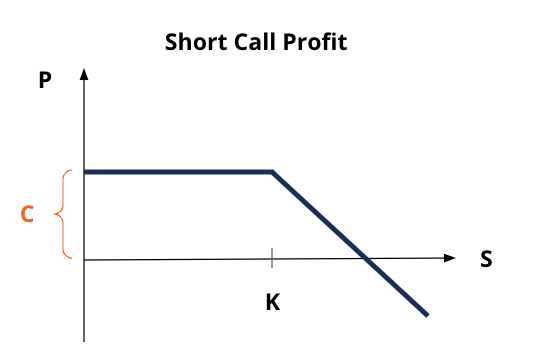
If the underlying asset’s price is lower than or equal to the strike price at the expiration dateExpiration Date (Derivatives)The expiration date refers to the date in which options or futures contracts expire. It is the last day of the validity of the derivatives contract., the holder does not exercise his option. The writer’s profit is equal to the price he received for selling the call option.
If S ≤ K, p = c
If the underlying asset’s price is greater than the strike price at the expiration date, the holder will exercise his option. The writer’s loss is equal to the loss he assumes because of the difference between the stock price and the strike price, net of the price received for selling the call option.
If S > K, p = – (S – K) + c
Advantage of Short Calls
The main advantage of a short call strategy is its flexibility. An investor may set the strike price of the call option as high as he wishes, increasing the probability that the holder will not exercise the option.
Disadvantages of Short Calls
- The maximum profit of the strategy is limited to the price received for selling the call optionCall OptionA call option, commonly referred to as a "call," is a form of a derivatives contract that gives the call option buyer the right, but not the obligation, to buy a stock or other financial instrument at a specific price - the strike price of the option - within a specified time frame..
- The maximum loss is unlimited because the price of the underlying stock may rise indefinitely.
The short call strategy can be thought of as involving unlimited risk, with only a limited potential for reward. The fact is especially true since most stocks increase in value over the long term.
Additional Info
To avoid some of the risks associated with short calls, an investor may choose to employ a strategy known as the covered call. The covered call strategy involves the investor owning the underlying stock for which he is writing a call option.
Assume that:
- p = Profit
- K = Strike price
- c = Call price
- S0 = Stock price when investor buys the stock
- ST = Stock price at expiration date
- A = Maximum loss = –S0 + c
- B = Maximum profit = –S0 + k + c

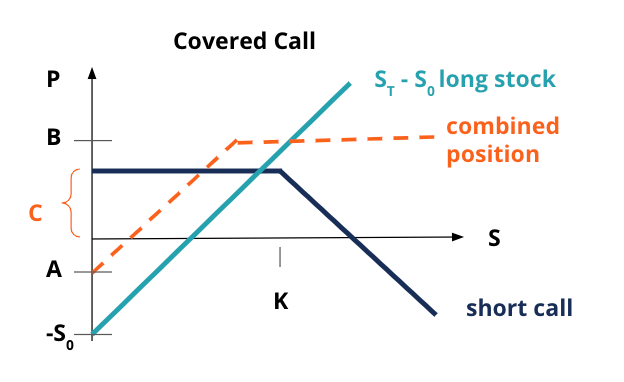
The investor limits his possible losses, as he will simply have to give up his shares at the strike price when the holder exercises his option. Note that the combined position is essentially a short put.
Additional Resources
CFI is the official provider of the global Capital Markets & Securities Analyst (CMSA)®Program Page - CMSAEnroll in CFI's CMSA® program and become a certified Capital Markets &Securities Analyst. Advance your career with our certification programs and courses. certification program, designed to help anyone become a world-class financial analyst. To keep advancing your career, the additional CFI resources below will be useful:
- Hard Call ProtectionHard Call ProtectionHard call protection, also known as absolute call protection, is a requirement in a callable bond where the issuer does not have the ability
- Long and Short PositionsLong and Short PositionsIn investing, long and short positions represent directional bets by investors that a security will either go up (when long) or down (when short). In the trading of assets, an investor can take two types of positions: long and short. An investor can either buy an asset (going long), or sell it (going short).
- Options Case StudyOptions Case Study – Long CallTo study the complex nature and interactions between options and the underlying asset, we present an options case study. It's much easier to
- Short PutShort PutA short put is just the sale of a put option. When you sell a put option, you are said to short the put. A trader, when shorting a put option,
-

What is Price Fixing?
Price fixing refers to an agreement between market participants to collectively raise, lower, or stabilize prizes to control supply and demandSupply and DemandThe laws of supply and demand are microec
-

Price Skimming: Definition, Strategy & When to Use It
Price skimming, also known as skim pricing, is a pricing strategy in which a firm charges a high initial price and then gradually lowers the price to attract more price-sensitive customers. The pricin
invest
- Short Call Options Strategy: A Comprehensive Guide
- Call Options: A Comprehensive Guide for Investors
- Call Premium Explained: Understanding Issuer Redemptions & Option Pricing
- Understanding Call Prices: Callable Bonds & Preferred Stocks
- Call Warrants: Understanding Rights & Investment Potential
- Covered Calls: A Comprehensive Guide for Investors
- Short Put Options: A Comprehensive Guide for Investors
- Short Selling Explained: A Beginner's Guide to Profiting from Declining Stocks
- Understanding Short Squeezes: A Guide for Investors
-
 Understanding Short Certificates: Estate Administration Explained
Called "short" because it is usually printed on a half-sheet of paper, a short certificate is issued to the person appointed to handle a decedent's estate. It is a legal document that is...
-
 Price Discrimination Explained: Types, Examples & Strategies
Price discrimination refers to a pricing strategy that charges consumers different prices for identical goods or services. Different Types of Price Discrimination 1. First Degree Price...