
Price Skimming: Definition, Strategy & When to Use It
Price skimming, also known as skim pricing, is a pricing strategy in which a firm charges a high initial price and then gradually lowers the price to attract more price-sensitive customers. The pricing strategy is usually used by a first moverFirst Mover AdvantageThe first mover advantage refers to an advantage gained by a company that first introduces a product or service to the market. The first mover advantage who faces little to no competition. Price skimming is not a viable long-term pricing strategy, as competitors eventually launch rival products and put pricing pressure on the first company.
Rationale Behind Price Skimming
Price skimming is used to maximize profits when a new product or service is deployed. Therefore, the pricing strategy is largely effective with a breakthrough product, where the firm is the first to enter the marketplace. In such a strategy, the goal is to generate the maximum profit in the shortest time possible, rather than to generate maximum sales. This enables a firm to quickly recover its sunk costsSunk CostA sunk cost is a cost that has already occurred and cannot be recovered by any means. Sunk costs are independent of any event and should not before increased competition and pricing pressure arise.
Consider the diffusion of innovation, a theory that explains the rate at which a product spreads throughout a social system. Innovators are those who want to be the first to get a new product or service. They are risk-takers and price insensitive. A price skimming strategy tries to get the highest possible profit from innovators and early adopters. As the demand from these two consumer segments fills up, the price of the product is reduced, to target more price-sensitive customers such as early majorities and late majorities.
Illustration and Example of Price Skimming
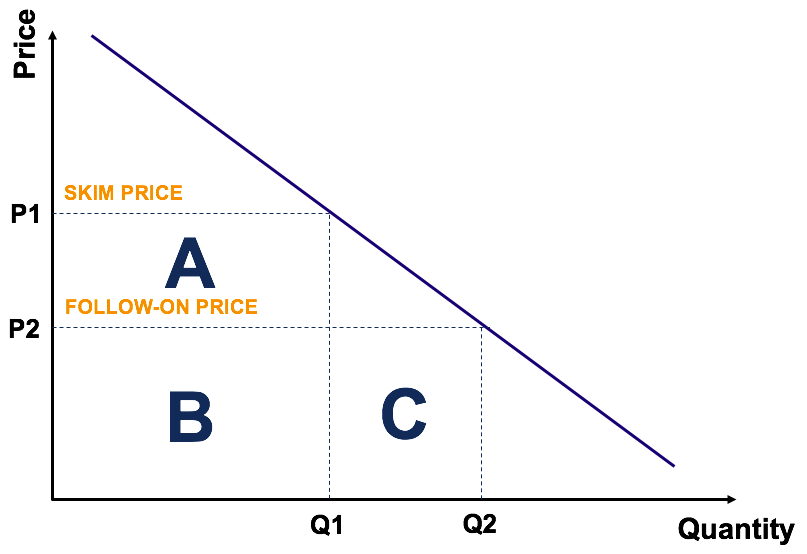
Company A is a phone manufacturing company that recently developed a new proprietary technologyIntangible AssetsAccording to the IFRS, intangible assets are identifiable, non-monetary assets without physical substance. Like all assets, intangible assets for its phones. Company A follows a price skimming strategy and sets a skim price at P1 to recover its research and development cost. After satisfying demand at P1, the company sets a follow-on price at P2 to capture price-sensitive customers and to put pricing pressure on competitors that enter the market.
In the price skimming strategy above, Company A generates revenue = A + B with sales of Q1. With their follow-on pricing, the company generates additional revenue = C with sales of Q2-Q1. The company generates total revenue of A + B + C, with total sales of Q2.
Advantages of Price Skimming
- Perceived quality: Price skimming helps build a high-quality image and perception of the product.
- Cost recuperation: It helps a firm quickly recover its costs of development.
- High profitability: It generates a high profit margin for the company.
- Vertical supply chain benefits: It helps distributors earn a higher percentage. The markup on a $500 product is far more substantial than on a $5 item.
Disadvantages
- Deterrence: If the firm is unable to justify its high price, then consumers may not be willing to purchase the product.
- Limitation of sales volume: A firm may not be able to utilize economies of scaleEconomies of ScaleEconomies of scale refer to the cost advantage experienced by a firm when it increases its level of output.The advantage arises due to the if a skim price generates too few sales.
- Inefficient long-term strategy: Price skimming is not a viable long-term pricing strategy, as competitors will eventually enter the market with rival products and exert downward pricing pressure.
- Consumer loyalty: If a product that costs $1,000 at launch has a follow-on price of $200 in a couple of months, innovators and early adopters may feel ripped off. Therefore, if the firm has a history of price skimming, consumers may wait a couple of months before purchasing the product.
Additional Resources
CFI is the official provider of the global Financial Modeling & Valuation Analyst (FMVA)™Become a Certified Financial Modeling & Valuation Analyst (FMVA)®CFI's Financial Modeling and Valuation Analyst (FMVA)® certification will help you gain the confidence you need in your finance career. Enroll today! certification program, designed to help anyone become a world-class financial analyst. To keep advancing your career, the additional CFI resources below will be useful:
- Competitive AdvantageCompetitive AdvantageA competitive advantage is an attribute that enables a company to outperform its competitors. It allows a company to achieve superior margins
- DemographicsDemographicsDemographics refer to the socio-economic characteristics of a population that businesses use to identify the product preferences and
- Inelastic DemandInelastic DemandInelastic demand is when the buyer’s demand does not change as much as the price changes. When price increases by 20% and demand decreases by
- Price LeaderPrice LeaderA price leader is a company that exercises control in determining the price of goods and services in a market. The price leader’s actions
-

Covered Calls: A Comprehensive Guide for Investors
A covered call is a risk management and an options strategy that involves holding a long position in the underlying asset (e.g., stockStockWhat is a stock? An individual who owns stock in a company is
-
Understanding Dealer Markets: How Market Makers Function
A dealer market is a financial market where dealers post prices they would be willing to buy and sell specific securitiesTrading SecuritiesTrading securities are securities purchased by a company for
Business strategy
- Understanding Divergence in Technical Analysis: A Guide
- Understanding Forward Prices: Definition & How They Work
- Understanding Hedging Strategies: A Comprehensive Guide
- Understanding Slippage in Trading: Causes & Impact
- Understanding Strangle Options: A Comprehensive Guide
- Understanding Volatility: A Key Indicator of Investment Risk
- Price Discrimination Explained: Types, Examples & Strategies
- What is Price Fixing?
- Understanding Clearing Prices in Stock Trading: A Comprehensive Guide
-
 Call Warrants: Understanding Rights & Investment Potential
A call warrant gives the holder of the investment the right, not the obligation, to purchase the underlying financial securities at a specific price on or before a certain date.If the holder does not ...
-
 Commodity Valuation: Understanding Intrinsic Value & Market Pricing
Commodity valuation is the process of deriving the intrinsic value of a commodity under optimal market conditions. In a perfectly competitive free market, the price of a commodity reflects the intrins...