
Price Discrimination Explained: Types, Examples & Strategies
Price discrimination refers to a pricing strategy that charges consumers different prices for identical goods or services.
Different Types of Price Discrimination
1. First Degree Price Discrimination
Also known as perfect price discrimination, first-degree price discrimination involves charging consumersBuyer TypesBuyer types is a set of categories that describe spending habits of consumers. Consumer behavior reveals how to appeal to people with different habits the maximum price that they are willing to pay for a good or service. Here, consumer surplus is entirely captured by the firm. In practice, a consumer’s maximum willingness to pay is difficult to determine. Therefore, such a pricing strategy is rarely employed.
2. Second Degree Price Discrimination
Second-degree price discrimination involves charging consumers a different price for the amount or quantity consumed. Examples include:
- A phone plan that charges a higher rate after a determined amount of minutes are used
- Reward cards that provide frequent shoppers with a discount on future products
- Quantity discounts for consumers that purchase a specified number of more of a certain good
3. Third Degree Price Discrimination
Also known as group price discrimination, third-degree price discrimination involves charging different prices depending on a particular market segmentDemographicsDemographics refer to the socio-economic characteristics of a population that businesses use to identify the product preferences and or consumer group. It is commonly seen in the entertainment industry.
For example, when an individual wants to see a movie, prices for the same screening are different depending on if you are a minor, adult, or senior.
Primary Requirements for a Successful Price Discrimination
For a firm to employ this pricing strategy, there are certain conditions that must be met:
#1 Imperfect competition
The firm must be a price makerPrice LeaderA price leader is a company that exercises control in determining the price of goods and services in a market. The price leader’s actions (i.e., operate in a market with imperfect competition). There must be a degree of monopoly power to be able to employ price discrimination. If the company is operating in a market with perfect competition, this pricing strategy would not be possible, as there would not be sufficient ability to influence prices.
#2 Prevention of resale
The firm must be able to prevent resale. In other words, consumers who already purchased a good or service at a lower price must not be able to re-sell it to other consumers who would’ve otherwise paid a higher price for the same good or service.
#3 Elasticity of demand
Consumer groups must demonstrate varying elasticities of demandPrice ElasticityPrice Elasticity measures how the quantity demanded or supplied of a good changes when its price changes. Learn more in this resource by CFI. (i.e., low-income individuals being more elastic to airplane tickets compared to business travelers). If consumers all show the same elasticity of demand, this pricing strategy will not work.
Example of Price Discrimination: Cineplex
The Canadian entertainment company, Cineplex, is a classic example of a firm using the price discrimination strategy. Depending on the age demographic, tickets for the same movie are sold at different prices. In addition, Cineplex charges different prices on different days (Tuesday being the cheapest and weekends being the most expensive). The following is a diagram from Cineplex for a movie screening on a Monday.
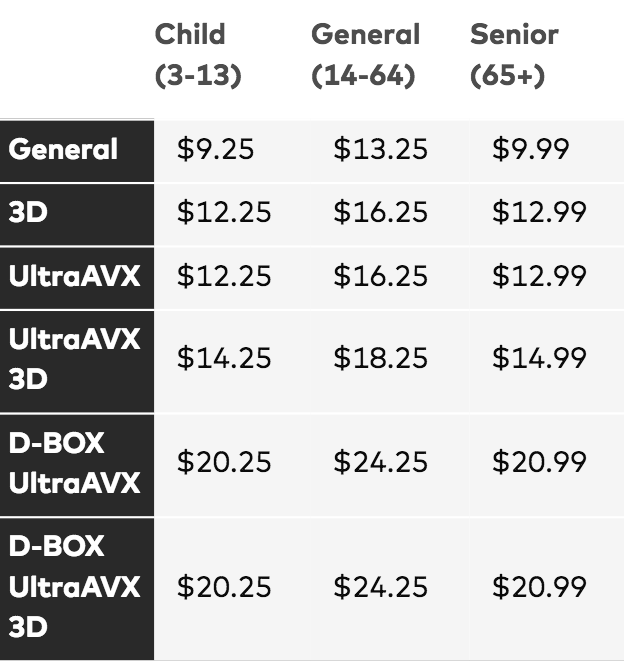
As indicated in the diagram above, different age demographics face different prices for the same screening. This is an example of third-degree price discrimination.
Price Discrimination in Increasing a Firm’s Profitability
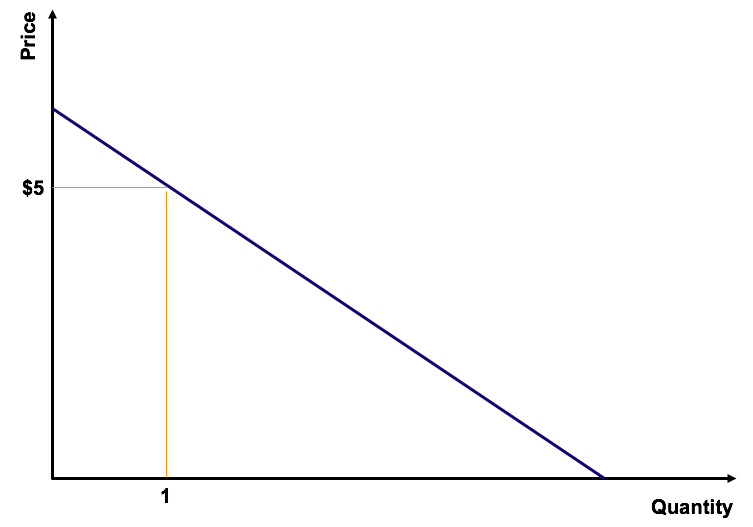
Consider a firm that charges a single price for an apple: $5. In such a case, it would lead to one sale and total revenue of $5:
Now, consider a firm that is able to charge a different price to each customer. For example:
- $5 for the first consumer
- $4 for the second consumer
- $3 for the third consumer, and so on.
In such a situation, the firm is able to increase its revenues by selling to customers who were originally not going to purchase, by offering price = each customer’s willingness to pay. This leads to five sales and total revenue of $5+$4+$3+$2+1 = $15.
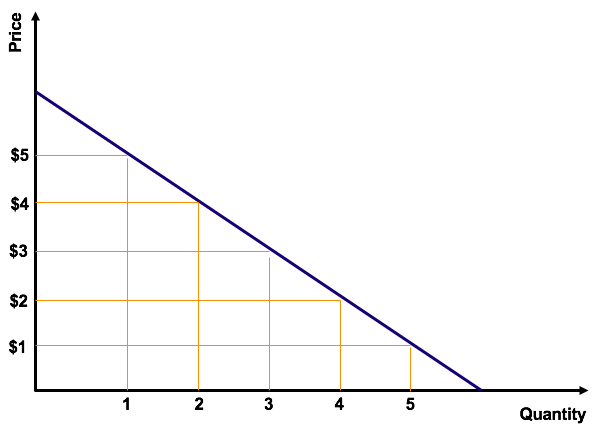
As indicated above, price discrimination allows a firm to reap additional profits and convert consumer surplus into producer surplus.
Advantages of Price Discrimination
Advantages of this pricing strategy can be viewed from the perspective of both the firm and the consumer:
The Firm
- Profit maximization: The firm is able to turn consumer surplus into producer surplus. In a first-degree price discrimination strategy, all consumer surplus is turned into producer surplus. It also ties into survivability, as smaller firms are able to better survive if they are able to offer different prices in times of greater and lower demand.
- Economies of scale: By charging different prices, sales volume is likely to increase. As a result, firms can benefit from increasing their production towards capacity and utilizing economies of scale.Economies of ScaleEconomies of scale refer to the cost advantage experienced by a firm when it increases its level of output.The advantage arises due to the
The Consumer
- Lower prices: Although not all consumers are winners, consumers that are highly elastic may gain consumer surplus from the lower prices, due to price discrimination. For example, at a movie theatre, tickets for seniors and children are typically priced at a discount to adult tickets.
Disadvantages of Price Discrimination
- Higher prices: As indicated above, some consumers will face lower prices while others will face higher prices. Consumers that face higher prices (i.e., consumers who purchase airline tickets during peak season) are disadvantaged.
- Reduction in consumer surplus: The pricing strategy reduces consumer surplus and transfers money from consumers to producers, leading to inequality.
Related Readings
CFI offers the Financial Modeling & Valuation Analyst (FMVA)®Become a Certified Financial Modeling & Valuation Analyst (FMVA)®CFI's Financial Modeling and Valuation Analyst (FMVA)® certification will help you gain the confidence you need in your finance career. Enroll today! certification program for those looking to take their careers to the next level. To keep learning and advancing your career, the following CFI resources will be helpful:
- Brand EquityBrand EquityIn marketing, brand equity refers to the value of a brand and is determined by the consumer’s perception of the brand. Brand equity can be positive or
- Beachhead StrategyBeachhead StrategyThe beachhead strategy refers to focusing resources on a small market area to turn it into a stronghold before entering the broader market
- Cost of Goods SoldCost of Goods Sold (COGS)Cost of Goods Sold (COGS) measures the “direct cost” incurred in the production of any goods or services. It includes material cost, direct
- Economies of ScopeEconomies of ScopeEconomies of scope is an economic concept that refers to the decrease in the total cost of production when a range of products are produced together rather than separately.
-

Covered Calls: A Comprehensive Guide for Investors
A covered call is a risk management and an options strategy that involves holding a long position in the underlying asset (e.g., stockStockWhat is a stock? An individual who owns stock in a company is
-
Understanding Dealer Markets: How Market Makers Function
A dealer market is a financial market where dealers post prices they would be willing to buy and sell specific securitiesTrading SecuritiesTrading securities are securities purchased by a company for
Business strategy
- Understanding Divergence in Technical Analysis: A Guide
- Understanding Forward Prices: Definition & How They Work
- Understanding Hedging Strategies: A Comprehensive Guide
- Understanding Slippage in Trading: Causes & Impact
- Understanding Strangle Options: A Comprehensive Guide
- Understanding Volatility: A Key Indicator of Investment Risk
- What is Price Fixing?
- Price Skimming: Definition, Strategy & When to Use It
- Understanding Clearing Prices in Stock Trading: A Comprehensive Guide
-
 Call Warrants: Understanding Rights & Investment Potential
A call warrant gives the holder of the investment the right, not the obligation, to purchase the underlying financial securities at a specific price on or before a certain date.If the holder does not ...
-
 Commodity Valuation: Understanding Intrinsic Value & Market Pricing
Commodity valuation is the process of deriving the intrinsic value of a commodity under optimal market conditions. In a perfectly competitive free market, the price of a commodity reflects the intrins...