
Solar Energy ETFs: Investing in the Future of Clean Power
Solar energy ETFs are exchange-traded funds that provide investors access to investments in the solar power industry. As of May 2020, there is only one ETF strictly devoted to solar energy – the Invesco Solar ETF (TAN). However, solar energy equities are part of the holdings of several renewable energy, or clean energy, ETFs.

Some investors in renewable energy ETFs are motivated by the desire to engage in socially responsible investing (SRI), while others are simply seeking profitable investmentsReturn on Investment (ROI)Return on Investment (ROI) is a performance measure used to evaluate the returns of an investment or compare efficiency of different investments. in what they perceive to be a sector offering stocks with high growth potential.
The majority of the potential profits for alternative energy companies stems from the fact that individual states, and the United States overall, are adopting increasingly stringent clean energy standards. Legislation and regulations require that renewable energy sources be used to provide an ever-increasing percentage of the overall energy mix offered to consumers. In short, solar, wind, and other renewable energy companies are supported and bolstered by the government in the U.S. and other countries.
Summary
- There is only one strictly solar energy ETF – the Invesco Solar Energy ETF. However, many solar energy equities are contained in the portfolios of broader-based renewable energy ETFs.
- Enphase Energy and First Solar Inc. are popular solar energy stocks held in the portfolios of many clean energy ETFs.
- The renewable energy sector is strongly supported by government legislation and regulations in most developed nations.
Top Solar Energy ETFs
As noted, as of mid-2020, there is only one ETF – the Invesco Solar ETF – that is invested solely in solar energy companies. Investors can also gain exposure to solar energy companies by investing in more general clean energy ETFs that include investments in water and wind power companies. The following is information on three of the top solar energy ETFs – the detailed makeup of the ETFs is as of May 2020.
Invesco Solar ETF (TAN)
This ETF, created by Invesco in 2008, aims to mirror the MAC Global Solar Energy Index. The index is comprised of a variety of companies engaged in the solar power industry, including companies that manufacture parts for solar power equipment, companies engaged in the installation or infrastructure of providing solar energy, and companies that market solar energy to power companies and the public.
Being concentrated only on the solar energy industry, the Invesco Solar ETF typically includes 25-35 holdings only in its portfolio, and much of the portfolio is concentrated on the top three or four holdings. The fund’s top four holdings are:
1. Solar Edge Technologies Inc. (SEDG:NASDAQ)
2. Enphase Energy Inc. (ENPH:NASDAQ)
3. First Solar Inc. (FSLR:NASDAQ)
4. Scatec Solar ASA (STECF:OTC)
Together, they make up approximately 35% of the fund’s portfolio. The fund’s expense ratio of 0.71% is slightly higher than the sector average of 0.63%. Its year-to-date performance in 2020 is 9.61%. It is the second most-widely-held ETF in the renewable energy sector, with more than $550 million in total assets under managementAssets Under Management (AUM)Assets under management (AUM) is the total market value of the securities a financial institution owns or manages on behalf of its clients..
iShares Global Clean Energy ETF (ICLN)
The Global Clean Energy ETF from Blackrock’s iShares, also created in 2008, is the most-widely-held ETF in the alternative energy sector, with approximately $625 million in assets under management. It tracks the S&P Global Clean Energy Index, which is made up of companies involved in wind power, solar power, biofuels, geothermal power, and hydroelectric power.
Of the fund’s 30 holdings, the top three mirror the top holdings of the Invesco Solar Energy ETF:
1. Solar Edge Technologies Inc.
2. Enphase Energy Inc.
3. First Solar Inc.
Much of the rest of the portfolio is dedicated to holdings in companies that provide other sources of alternative energy. The iShares Global Clean Energy ETF carries an expense ratioExpense RatioAn expense ratio is a fee charged by an investment company to manage the shareholders' funds. Investment companies such as mutual funds often incur various operating expenses when managing investors’ funds, and they charge a small percentage on the funds under management to cover the expenses. of only 0.46, which is well below the sector average. Its year-to-date performance is 1.45%, indicating that solar energy equities are performing better than alternative energy equities overall.
Invesco WilderHill Clean Energy ETF (PBW)
The third most-widely-held ETF in the alternative energy sector is another offering from Invesco – Invesco WilderHill Clean Energy ETF – created in 2005. The ETF is considered to offer a broader base of exposure to the sector by including companies that, while not directly involved in the renewable energy industry, provide technology that is used in the industry or that are otherwise related to the industry. It tracks the WilderHill Clean Energy Index.
The Invesco WilderHill Clean Energy ETF comprises approximately 40 holdings, each of which makes up 2%-3% of the total portfolio. The top three holdings are:
1. Enphase Energy Inc.
2. Tesla Inc. (TSLA:NASDAQ)
3. NIO Inc. (NIO:NYSE)
At 0.70%, the expense ratio for the ETF is on par with that of the Invesco Solar Energy ETF. Year-to-date in 2020, the fund is up 2.28%.
Related Readings
CFI is the official provider of the global Commercial Banking & Credit Analyst (CBCA)™Program Page - CBCAGet CFI's CBCA™ certification and become a Commercial Banking & Credit Analyst. Enroll and advance your career with our certification programs and courses. certification program, designed to help anyone become a world-class financial analyst. To keep learning and advancing your career, see the following CFI resources:
- Corporate Social Responsibility (CSR)Corporate Social Responsibility (CSR)Corporate social responsibility (CSR) refers to strategies that companies put into action as part of corporate governance that are designed to
- New York Stock Exchange (NYSE)New York Stock Exchange (NYSE)The New York Stock Exchange (NYSE) is the largest securities exchange in the world, hosting 82% of the S&P 500, as well as 70 of the biggest
- Non-Renewable SourceNon-Renewable ResourceA non-renewable resource refers to a natural resource that is found beneath the earth, which when consumed, does not replenish at the same speed at which it
- Renewable Energy – Solar Financial Modeling Course
-
Understanding Junk Bonds: Risks, Rewards, and Investment Strategies
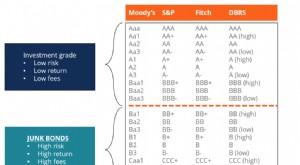
Junk bonds, also known as high-yield bonds, are bonds that are rated below investment grade by the big three rating agencies (see image below). Junk bonds carry a higher risk of defaultMarket Ri
-

Managed Futures: A Comprehensive Guide for Diversified Investing
Managed futures is a subclass of alternative investment strategies used by large funds and institutional investors to achieve both portfolio and market diversification. With the ability to take both l
invest
- Baby Bonds: A Comprehensive Guide to Investing in Children's Futures
- Understanding Bonds: A Comprehensive Guide for Investors
- Understanding Commodities: A Beginner's Guide to Investing
- Defensive Industries: Stability in Economic Uncertainty | [Your Company Name]
- Understanding Financial Derivatives: A Comprehensive Guide
- Vanguard ETFs: A Comprehensive Guide to Index-Tracking Investments
- ETFs Explained: A Beginner's Guide to Exchange-Traded Funds
- ETFs Explained: A Beginner's Guide to Exchange-Traded Funds
- Leveraged ETFs Explained: How They Work & Risks
-
 Income Stocks: A Guide to Dividend Investing
Income stocks are equity financial securities that pay regular and predictable dividendsDividendA dividend is a share of profits and retained earnings that a company pays out to its shareholders. When...
-
 Investment-Grade Bonds: Understanding Credit Risk & Ratings
An investment-grade bond is a bond classification used to denote bonds that carry a relatively low credit riskCredit RiskCredit risk is the risk of loss that may occur from the failure of any party to...