
Understanding Trade Order Timing: A Comprehensive Guide
Trade order timing allows investors to set the amount of time a trade orderTrade Orders - TradingTrade orders refer to the different types of orders that can be placed on trading exchanges for financial assets, such as stocks or futures contracts. is good for. The different types of trade order timing each have different advantages and disadvantages that play along with the different strategies an investor may have or wish to use. The following are the most common types of trade order timing:
- Market Order (Immediate)
- Good Until Canceled (GTC)
- Good Until … Specified Time or Date
- Good Today (sometimes known as Good Until Close or Day Order)
- Fill or Kill
The following is the same list, but reordered in terms of how soon trades will execute under that trade order timing:
- Market Order (Immediate)
- Fill or Kill
- Good Today
- Good Until … Specified Time
- Good Until Canceled
Trade Order Timing: Market Order
The market orderTrading MechanismsTrading mechanisms refer to the different methods by which assets are traded. The two main types of trading mechanisms are quote driven and order driven trading mechanisms is technically not a timing order, but rather a type of trade order. The nature of the market order, however, dictates that these orders will be executed immediately, at the best available price.
If, for example, a trader wishes to purchase BitcoinBitcoinBitcoin is the forerunner of the cryptocurrency market. Operating on blockchain technology, Bitcoin is set to disrupt the currency market. Invented in 2008 in a market order and the market price is at $2,200 per bitcoin, that is the price the trader will receive. The order will complete immediately, up to the specified volume stated in the market order.
This type of order provides the highest liquidity to the trader, but the lowest amount of control. The best available price in our Bitcoin example, in a rapidly moving market, could be far from the trader’s ideal price where he hopes to enter the market.
Trade Order Timing: Fill or Kill
A fill or kill (FOK) order is intuitively named. By definition, FOK orders will either execute immediately or are canceled if conditions are not met. Usually, fill or kills require the whole order volume to be met at a specified price, otherwise, the order is canceled. However, some trades can be set in such a way that partial order volume can be completed, and the
In our previous example, let’s say the Bitcoin trader wants to purchase 5 BTC in a fill or kill order. Only 2 BTC is available at his specified price, so the order is not filled. Thus, it is canceled entirely.
In an immediate or cancel order, however, the order is filled up to 2 BTC. The remaining 3 BTC on order is canceled.
This type of order provides a good amount of liquidity and control for the trader, depending on the specified price. If the trader is willing to forego a better price for a higher chance at completing the trade, she will be met with higher liquidity. However, if the trader is strictly looking for a specific price, the order may be killed if no seller on the market is willing to trade at that level.
Trade Order Timing: Good Today
A good today, or day order, is exactly as the name implies. Such types of orders are only good for the day they are set and are canceled when the market closes if not met. Again, like an FOK order, most orders need to be filled in full. However, day orders can also be set to fill partially, with the unfilled balance canceled on market close.
Day orders provide a decent amount of control to the trader. A day order is typically not long enough to move the market entirely, therefore it wouldn’t change the strategyForex Trading - How to Trade the Forex MarketForex trading allows users to capitalize on appreciation and depreciation of different currencies. Forex trading involves buying and selling currency pairs based on each currency's relative value to the other currency that makes up the pair. of the trader. In other words, it’s much easier to manage market expectations for a day than it is for an entire week.
Trade Order Timing: Good Until Specified
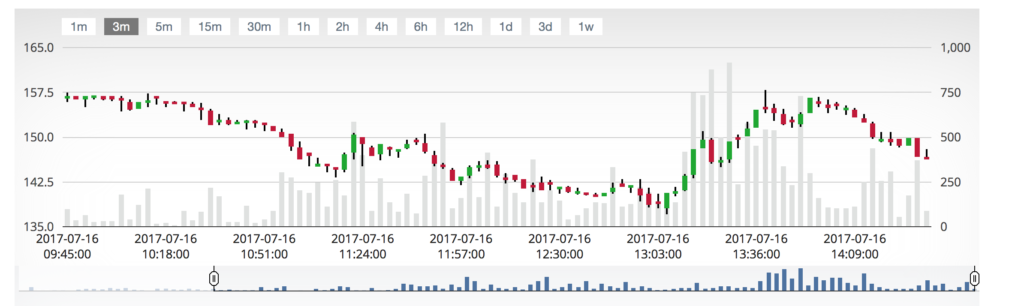
In a good until specified trade order timing, the trader specifies when the order is canceled, if not filled. This type of trade order stays open for the duration of the trade order timing. A longer time period will provide the trader a better chance of the trade being executed, but also exposes the investor to a higher risk of sudden spikes or trend changesTriangle Patterns - Technical AnalysisThe triangle patterns are common chart patterns every trader should know. Triangle patterns are important because they help indicate the continuation of a bullish or bearish market. They can also assist a trader in spotting a market reversal..
(Courtesy of CEX.io)
Trade Order Timing: Good Until Canceled (GTC)
Finally, the GTC order. Again, its name follows the pattern of the other types of trade order timing and is self-explanatory. The order will be active until canceled by the trader. It works well for diligent traders that are actively managing their orders and can adjust to any changes in the market, canceling the order if needed.
A GTC trade order timing may not work well, however, for traders who wish to set their orders and leave them until completed. The danger is that a trader may forget about the order after a period of time, but it may be filled at a much later date when the trader would no longer wish to enter the market at the price and direction (buy or sell) specified in the order.
We take the example of a bondFixed Income TradingFixed income trading involves investing in bonds or other debt security instruments. Fixed income securities have several unique attributes and factors that exchange where two traders are managing their portfolios. Both traders want to purchase a 10% 2-Year A-rated bond from Company X. The current market price is $1,543, but the traders wish to purchase it at $1,500, knowing the bond is slightly over-traded. They both set GTC orders for 100 bonds at $1,500.
In the following week, the company is supposedly undergoing financial hardship, in addition to their creditworthiness dropping. As a result, there is the expectation that the bonds will trade even lower once the market opens. One trader cancels his GTC order entirely. The other trader has forgotten his GTC order.
On market open, 100 bonds are purchased for his order at $1,500, whereafter the market stabilizes around $1,357. This trader is now in the market at a loss, while the trader who canceled their order can put in a new order to purchase the bonds at a more favorable price.
Learn More
CFI is the official provider of the global Capital Markets & Securities Analyst (CMSA)®Program Page - CMSAEnroll in CFI's CMSA® program and become a certified Capital Markets &Securities Analyst. Advance your career with our certification programs and courses. certification program, designed to help anyone become a world-class financial analyst. To keep advancing your career, the additional CFI resources below will be useful:
- Technical AnalysisTechnical Analysis - A Beginner's GuideTechnical analysis is a form of investment valuation that analyses past prices to predict future price action. Technical analysts believe that the collective actions of all the participants in the market accurately reflect all relevant information, and therefore, continually assign a fair market value to securities.
- How to Read Stock ChartsHow to Read Stock ChartsIf you’re going to actively trade stocks as a stock market investor, then you need to know how to read stock charts. Even traders who primarily use fundamental analysis to select stocks to invest in still often use technical analysis of stock price movement to determine specific buy and sell, stock charting
- ADX IndicatorADX Indicator - Technical AnalysisADX stands for average directional movement index. The ADX indicator is an indicator of trend strength, commonly used in futures trading. However, it has since been widely applied by technical analysts to virtually every other tradeable investment, from stocks to forex to ETFs.
- CryptocurrencyCryptocurrencyCryptocurrency is a form of digital currency that is based on blockchain networking. Cryptocurrency like Bitcoin and Ethereum are becoming widely accepted.
-

Understanding Market Manipulation: Definition, Tactics & SEC Role
Market manipulation refers to artificial inflation or deflation of the price of a security. Also known as price manipulation or stock manipulation, it involves the literal manipulation of a financial
-

Understanding Market Risk: A Comprehensive Guide
The term market risk, also known as systematic risk, refers to the uncertainty associated with any investment decision. Price volatility often arises due to unanticipated fluctuations in factors that
invest
- Understanding Auction Markets: How Prices Are Determined
- Doji Candlestick Pattern: Meaning & Trading Signals
- Market Orders: A Comprehensive Guide for Investors
- Market Timing: Strategies & How It Works | [Your Company Name]
- Understanding Order Books: A Guide for Traders
- Understanding Trade Execution: A Comprehensive Guide
- Understanding Trade Orders: A Comprehensive Guide
- Understanding Trade Orders: A Comprehensive Guide
- Market Timing Strategies: A Comprehensive Guide
-
 Understanding Market Indexes: A Comprehensive Guide
Market index refers to a portfolio of securities that represent a particular section of the stock marketStock MarketThe stock market refers to public markets that exist for issuing, buying and selling...
-
 Understanding Market Makers: How They Fuel Liquidity
Market maker refers to a firm or an individual that engages in two-sided markets of a given security. It means that it provides bids and asks in tandem with the market size of each security. A market ...