
Market Timing: Strategies & How It Works | [Your Company Name]
Market timing refers to an investing strategy through which a market participant makes buying or selling decisions by predicting the price movements of a financial asset in the future. Investors following the strategy aim to outperform the market by taking a long position (buying) at market bottoms and a short position (selling) at market tops.
![Market Timing: Strategies & How It Works | [Your Company Name]](https://www.etffin.com/Article/UploadFiles/202110/2021100815253643.jpeg)
The market timing strategy can be used to enter or exit markets or to choose between different assets or asset classesAsset ClassAn asset class is a group of similar investment vehicles. They are typically traded in the same financial markets and subject to the same rules and regulations. while making trading decisions.
Summary
- Market timing refers to an investing strategy through which a market participant makes buying or selling decisions by predicting the price movements of the financial asset in the future.
- It includes the timely buying and selling of financial assets based on expected price fluctuations.
- Traders use technical and fundamental analysis techniques to supplement the strategy.
When is Market Timing Strategy Used?
It can be very difficult to regularly and effectively execute a market timing strategy. Despite the fact, it appeals to investors primarily because of its potential to amass a fortune overnight as compared to the long time horizon required by most other approaches of value investing or formula acquisition.
Market timing’s provided success for professional day traders, portfolio managersPortfolio ManagerPortfolio managers manage investment portfolios using a six-step portfolio management process. Learn exactly what does a portfolio manager do in this guide. Portfolio managers are professionals who manage investment portfolios, with the goal of achieving their clients’ investment objectives. and other financial professionals who can devote considerable time to analyze economic forecasts and effectively predict market shifts with such consistency. For the average investor, however, following the market daily is rather inconvenient, and it is more profitable for them to focus on investing in the long term.
How does Market Timing Strategy Work?
Market timing includes the timely buying and selling of financial assets based on expected price fluctuations. The strategy can be applied to both long-term and short-term time horizons, as per the risk and return preferences of the investor.
Usually, the trader would buy stocks when the markets are bullish and sell them off at the onset of a bear market. It involves recognizing when there would be a change in the trajectory of the price movements.
To do it, the investor must speculate how the price shall increase or decrease in the future, rather than examining the value of the financial product. An active allocation strategyDynamic Asset AllocationDynamic asset allocation is an investment strategy that involves the frequent adjustment of the weights in a portfolio based on the overall market performance or the performance of certain securities., the market timing strategy aims at reaping the maximum benefits out of price inequities prevailing in the markets.
Analysis for Market Timing
Under the market timing strategy, any buying or selling decisions are based on either of the following two analysis techniques:
1. Fundamental analysis
While performing fundamental analysis, an analyst takes into account certain assumptions regarding variables that affect buying and selling decisions. Market timing is the mathematical function of such variables. It is important to find out the most accurate timing to make the decision. Fundamental analysis is used for a mid-term to a long-term time horizon.
2. Technical analysis
In technical analysis, market timing becomes a function of the historical performance of the stock and the history of investor behavior. Technical analysis is generally used for a short-term to mid-term investment horizon.
Advantages of Using Market Timing Strategy
The benefits of market timing strategy are as follows:
- Market timing is used to maximize profits and offset the associated risks with high gains. It is the classic risk-return tradeoff that exists with respect to investment – the higher the risk, the higher the return.
- It enables traders to curtail the effects of market volatility.
- It enables traders to reap the benefits of short-term price movements.
Disadvantages of Using Market Timing Strategy
Empirical research and real-life incidents show that the costs associated with the market timing strategy greatly surpass the potential benefits given that:
- It requires a trader to consistently follow up on market movements and trends.
- It entails higher transaction costs and commissions and includes a substantial opportunity costOpportunity CostOpportunity cost is one of the key concepts in the study of economics and is prevalent throughout various decision-making processes. The. Market timers exit the market during periods of high volatility. Since most market upswings occur under volatile conditions, active investors miss out on the opportunities and ultimately earn less returns than buy-and-hold investors.
- An investor who succeeds in buying low and selling high must incur tax consequences on their gain. In case the security was held for less than a year, which is mostly true for market timers, the profit is taxed at the short-term capital gains rate, which is higher than the long-term capital gains rate.
- Precisely timing market entries and exits may be difficult.
Additional Resources
CFI is the official provider of the global Commercial Banking & Credit Analyst (CBCA)™Program Page - CBCAGet CFI's CBCA™ certification and become a Commercial Banking & Credit Analyst. Enroll and advance your career with our certification programs and courses. certification program, designed to help anyone become a world-class financial analyst. To keep advancing your career, the additional CFI resources below will be useful:
- Bullish and BearishBullish and BearishProfessionals in corporate finance regularly refer to markets as being bullish and bearish based on positive or negative price movements. A bear market is typically considered to exist when there has been a price decline of 20% or more from the peak, and a bull market is considered to be a 20% recovery from a market bottom.
- Investment HorizonInvestment HorizonInvestment horizon is a term used to identify the length of time an investor is aiming to maintain their portfolio before selling their securities for a profit. An individual’s investment horizon is affected by several different factors. However, the primary determining factor is often the amount of risk that the investor
- Long and Short PositionsLong and Short PositionsIn investing, long and short positions represent directional bets by investors that a security will either go up (when long) or down (when short). In the trading of assets, an investor can take two types of positions: long and short. An investor can either buy an asset (going long), or sell it (going short).
- Market SentimentMarket SentimentThe term market sentiment, also known as investor sentiment, refers to the general outlook or attitude of investors toward a particular security or the
-
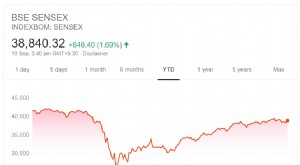
Sensex Explained: Understanding India's Key Stock Market Index
Sensex, also known as the S&P BSE Sensex Index, is the benchmark index that tracks India’s Bombay Stock Exchange (BSE). The Sensex is composed of the 30 largest and most-traded stocks within
-

Understanding Algorithmic Trading Spoofing: Definition & Impact
Spoofing is a disruptive algorithmic trading practice that involves placing bids to buy or offers to sell futures contractsFutures ContractA futures contract is an agreement to buy or sell an underlyi
invest
- Understanding Auction Markets: How Prices Are Determined
- Doji Candlestick Pattern: Meaning & Trading Signals
- Understanding Frothy Markets: Risks & Opportunities
- Understanding Inefficient Markets: Causes & Implications
- Understanding Market Cycles: Trends & Economic Environments
- Understanding Market Depth: A Guide for Traders
- Understanding Market Exposure: Risk & Portfolio Allocation
- Understanding Trade Order Timing: A Comprehensive Guide
- Market Timing Strategies: A Comprehensive Guide
-
 Understanding Stock Rallies: Definition & What Causes Them
A rally refers to a period of continuous increase in the prices of stocks, indexes or bondsBondsBonds are fixed-income securities that are issued by corporations and governments to raise capital. The ...
-
 Understanding Secular Markets: Long-Term Trends & Investment Strategies
A secular market is predominantly driven and impacted by elements or forces that are likely to be present in the foreseeable future. The forces can impact the price or value of a financial assetFinanc...