
Trading Accounts: Your Gateway to Investing & Trading
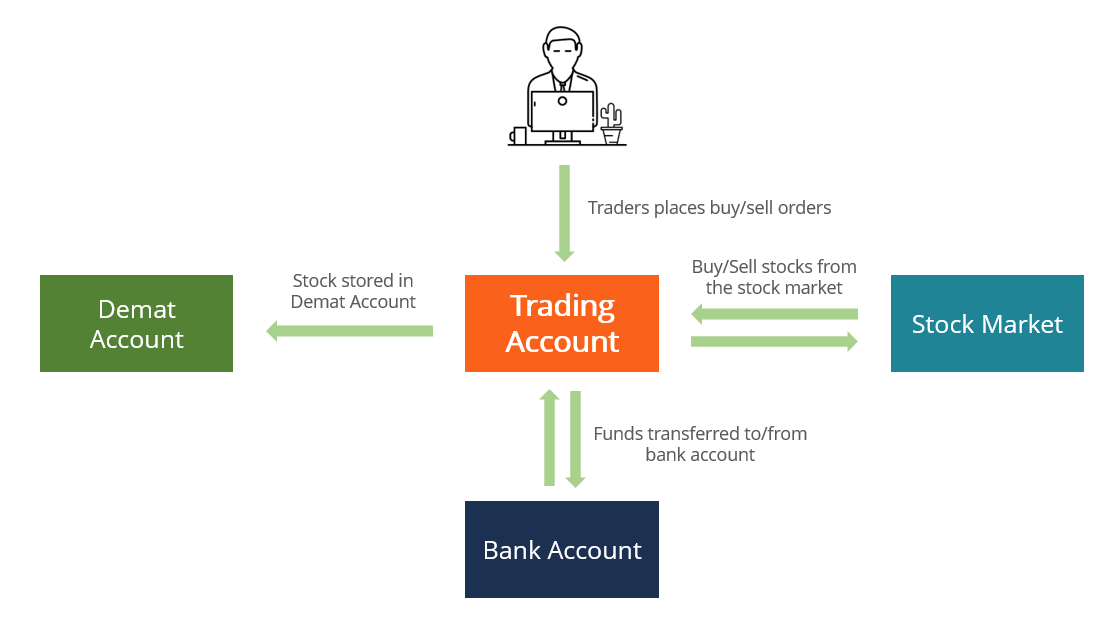
A trading account is an online investment account that traders use to purchase securities and monitor trades. It allows investors to buy and sell securities such as shares, commoditiesCommoditiesCommodities are another class of assets just like stocks and bonds. Most commodities are products that come from the earth that possess, foreign exchange, etc., in the public market.
A trading account may also refer to a primary account for a day trader. Day traders buy and sell securities daily, often within regular trading hours, and as a result, their accounts are subject to special regulatory requirements.

Before trading accounts were introduced, traders were required to be physically present on the trading floor of stock exchanges to buy or sell securities. The system was known as open outcryOpen OutcryOpen outcry is a trading method used in futures pits and stock exchanges where traders use verbal and nonverbal signals to communicate. Before the advent of electronic trading, nearly all financial trading was conducted via open outcry., and traders needed to verbally communicate with other parties on the trading floor when buying or selling securities.
However, with the introduction of electronic trading, the open outcry system was replaced by trading accounts, which traders can use to buy and sell securities electronically without being physically present on the trading floor. The securities are held in their electronic form instead of holding physical certificates.
Summary
- A trading account is an account with holdings such as cash or securities that are used for the purpose of buying and selling assets.
- Trading accounts operate under the Financial Industry Regulatory Authority (FINRA), where account activities are operated within a single day for five business days.
- FINRA rules require pattern day traders to meet an eligibility criterion before opening a trading account.
Understanding Trading Accounts
Traders use trading accounts to hold financial assets such as stocks, bonds, foreign exchange, and other investment vehicles. Typically, a trading account allows the buying and selling of securities, otherwise known as day trading. According to the rules set by the Financial Industry Regulatory Authority (FINRA)Financial Industry Regulatory Authority (FINRA)The Financial Industry Regulatory Authority (FINRA) acts as a self-regulatory organization for securities firms operating in the United States., day trading is a form of trading where assets in a margin account are purchased and sold within a single day. FINRA rules require pattern day traders to satisfy the following rules when trading:
- Traders who execute at least four-day trades within a five-day week
- Traders whose trading activities constitute more than 6% of the full trading activity during the week
Opening a Trading Account
Broker-dealer firms may also designate clients as pattern day traders based on a reasonable conclusion that they will engage in pattern day trading. Although brokerage firms allow customers to open cash or margin accounts, day traders must choose a margin for their trading accounts.
Subsequently, FINRA enforces a special margin requirement for traders who are considered pattern day traders. Thus, a trader must meet certain margin requirements before opening a trading account.
Some of the information that investors must provide when opening a trading account includes personal details, contact details, physical address, and social security number. Traders may be required to provide additional information, depending on their jurisdiction.
Margin Requirements for Trading Accounts
The following are some of the margin requirements for trading accounts:
1. Maintenance requirements
Generally, trading accounts come with higher equity requirements compared to non-pattern trading accounts. Regulation T of the Federal Research Board sets out the margin requirements for margin investors. Additional rules for day traders are provided in FINRA’s Rule 4210.
Day traders are required to maintain a base equity margin of $25,000 or 25% of the value of a security, whichever is higher. The equity amount must be deposited before starting any trading activity and be maintained at all times.
2. Day trading buying power
Day traders can purchase up to four times the excess over the minimum requirements set by FINRA. Traders who do not meet such requirements receive a margin call from their broker-dealers, requiring them to deposit more funds into their account or sell part of the assets in their portfolios.
If the call is not covered within five days, traders will be temporarily restricted to two times any excess of maintenance margin. Failure to cover the call within the five days, trading will be limited to trading only cash available for three months or until the call is met.
A point to note is that a brokerage firm may impose a higher minimum maintenance requirement and limit pattern day trade to less than four times excess of maintenance marginMaintenance MarginMaintenance margin is the total amount of capital that must remain in an investment account in order to hold an investment or trading position and avoid a.
Why Traders Need a Trading Account
Although trading accounts facilitate the buying and selling of securities in a stock exchange, there are various benefits that traders stand to gain:
1. Trading in multiple stock exchanges
With an online trading account, traders do not need to be physically present on the trading floor of a stock exchange. Instead, they can access multiple stock exchanges from any location around the world. A trading account allows traders to deposit and withdraw funds to and from their account, place orders, and monitor their trades from a single platform.
2. Access to research reports and business news
Trading accounts give traders access to the latest business news as they happen. They also get access to financial and research reports of top companies, which helps evaluate their financial performance and the expected trend in the future.
Traders can also use the information to make a decision on the potential stocks that will help them achieve their financial goals.
Learn More
CFI is the official provider of the global Capital Markets & Securities Analyst (CMSA)®Program Page - CMSAEnroll in CFI's CMSA® program and become a certified Capital Markets &Securities Analyst. Advance your career with our certification programs and courses. certification program, designed to help anyone become a world-class financial analyst. To keep advancing your career, the additional resources below will be useful:
- Day TraderDay TraderA day trader is an individual who opens and closes all of his or her trades before the end of the trading day; no open positions are
- Margin TradingMargin TradingMargin trading is the act of borrowing funds from a broker with the aim of investing in financial securities. The purchased stock serves as collateral for the loan. The primary reason behind borrowing money is to gain more capital to invest
- Six Essential Skills of Master TradersSix Essential Skills of Master TradersJust about anyone can become a trader, but to be one of the master traders takes more than investment capital and a three-piece suit. Keep in mind: there is a sea of individuals looking to join the ranks of master traders and bring home the kind of money that goes with that title.
- Trade OrdersTrade Orders - TradingTrade orders refer to the different types of orders that can be placed on trading exchanges for financial assets, such as stocks or futures contracts.
-

UTMA Account: A Comprehensive Guide for Custodians
What Is a UTMA Account? A Uniform Transfer to Minors Account, or UTMA account, is a way to open an investment account for a child. Since minors can't legally own assets, a UTMA holds asse
-
Margin Calls & Margin Trading: A Comprehensive Guide
When you are buying on margin, you borrow money from a broker to purchase stock. Margin trading occurs when you use your broker’s money to purchase shares, and it can al
invest
- CFD Trading Explained: A Comprehensive Guide for Investors
- Day Trading Explained: Strategies, Risks & How It Works
- Margin Accounts: Borrowing to Invest & Increase Buying Power
- Proprietary Trading: A Comprehensive Guide for Investors
- Quantitative Trading: A Deep Dive into Models & Analysis
- Swing Trading Explained: A Beginner's Guide to Profiting from Trends
- The Trader's Mindset: Key to Successful Trading
- Understanding Trading Floors: A Comprehensive Guide
- Understanding Trading Accounts: A Comprehensive Guide
-
 Wash Trading: Definition, Risks & How It Impacts Markets
Wash trading – also referred to as round trip trading – is an illegal practice where investors buy and sell the same financial instrumentsMarketable SecuritiesMarketable securities are unr...
-
 Wrap Accounts: A Comprehensive Guide for Investors
A wrap account refers to an investment account that is managed by a broker for a flat annual fee. The flat annual fee, which ranges from 1% to 3% of assets under management (AUM)Assets Under Managemen...