
Understanding Triangle Patterns in Technical Analysis
Triangle patterns are a commonly-used technical analysis tool. It is important for every traderEquity TraderAn equity trader is someone who participates in the buying and selling of company shares on the equity market. Similar to someone who would invest in the debt capital markets, an equity trader invests in the equity capital markets and exchanges their money for company stocks instead of bonds. Bank careers are high-paying to recognize patterns as they form in the marketEquity Capital Market (ECM)The equity capital market is a subset of the capital market, where financial institutions and companies interact to trade financial instruments. Patterns are vital in a trader’s quest to spot trends and predict future outcomes so that they can trade more successfully and profitably. Triangle patterns are important because they help indicate the continuation of a bullish or bearishBullish and BearishProfessionals in corporate finance regularly refer to markets as being bullish and bearish based on positive or negative price movements. A bear market is typically considered to exist when there has been a price decline of 20% or more from the peak, and a bull market is considered to be a 20% recovery from a market bottom. market. They can also assist a trader in spotting a market reversal.
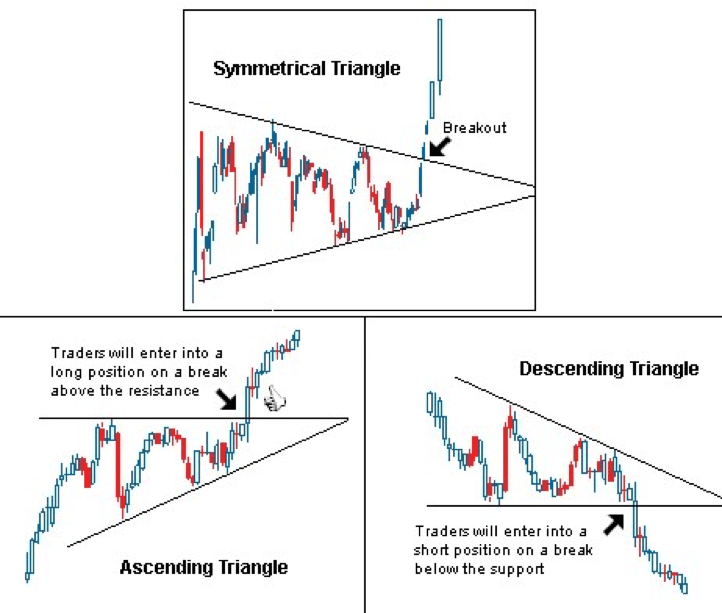
There are three types of triangle patterns: ascending, descending, and symmetrical. The picture below depicts all three. As you read the breakdown for each pattern, you can use this picture as a point of reference, a helpful visualization tool you can use to get a mental picture of what each pattern might look like. And here is the short version of triangle patterns:
- Ascending triangles are a bullish formation that anticipates an upside breakout.
- Descending triangles are a bearish formation that anticipates a downside breakout.
- Symmetrical triangles, where price action grows increasingly narrow, may be followed by a breakout to either side—up or down.
Ascending Triangle Patterns
Ascending triangle patterns are bullish, meaning that they indicate that a security’sPublic SecuritiesPublic securities, or marketable securities, are investments that are openly or easily traded in a market. The securities are either equity or debt-based. price is likely to climb higher as the pattern completes itself. This pattern is created with two trendlines. The first trendline is flat along the top of the triangle and acts as a resistance point which—after price successfully breaks above it—signals the resumption or beginning of an uptrend. The second trendline—the bottom line of the triangle that shows price support—is a line of ascension formed by a series of higher lows. It is this configuration formed by higher lows that forms the triangle and gives it a bullish characterization. The basic interpretation is that the pattern reveals that each time sellers attempt to push prices lower, they are increasingly less successful.
The ascending triangle pattern forms as a security’s price bounces back and forth between the two lines. Prices move to a high, which inevitably meets resistance that leads to a drop in price as securities are sold. Although the price may fail to overcome the resistance several times, this does not lead to increased power for sellers, as evidenced by the fact that each sell-off after meeting resistance stops at a higher level than the previous sell-off attempt.
Eventually, price breaks through the upside resistance and continues in an uptrend. In many cases, the price is already in an overall uptrend and the ascending triangle pattern is viewed as a consolidation and continuation pattern. In the event that an ascending triangle pattern forms during an overall downtrend in the market, it is typically seen as a possible indication of an impending market reversal to the upside.
Indications and Using the Ascending Triangle Pattern
Because the ascending triangle is a bullish pattern, it’s important to pay close attention to the supporting ascension line because it indicates that bears are gradually exiting the market. Bulls (or buyers) are then capable of pushing security prices past the resistance level indicated by the flat top line of the triangle.
As a trader, it’s wise to be cautious about making trade entries before prices break above the resistance line because the pattern may fail to fully form or be violated by a move to the downside. There is less risk involved by waiting for the confirming breakout. Buyers can then reasonably place stop-loss orders below the low of the triangle pattern.
Using Descending Triangle Patterns
Based on its name, it should come as no surprise that a descending triangle pattern is the exact opposite of the pattern we’ve just discussed. This triangle pattern offers traders a bearish signal, indicating that the price will continue to lower as the pattern completes itself. Again, two trendlines form the pattern, but in this case, the supporting bottom line is flat, while the top resistance line slopes downward.
Just as an ascending triangle is often a continuation pattern that forms in an overall uptrend, likewise a descending triangle is a common continuation pattern that forms in a downtrend. If it appears during a long-term uptrend, it is usually taken as a signal of a possible market reversal and trend change. This pattern develops when a security’s price falls but then bounces off the supporting line and rises. However, each attempt to push prices higher is less successful than the one before, and eventually, sellers take control of the market and push prices below the supporting bottom line of the triangle. This action confirms the descending triangle pattern’s indication that prices are headed lower. Traders can sell short at the time of the downside breakout, with a stop-loss order placed a bit above the highest price reached during the formation of the triangle.
Using Symmetrical Triangle Patterns
Traders and market analysts commonly view symmetrical triangles as consolidation patterns which may forecast either the continuation of the existing trend or a trend reversal. This triangle pattern is formed as gradually ascending support lines and descending resistance lines meet up as a security’s trading range becomes increasingly smaller. Typically, a security’s price will bounce back and forth between the two trendlines, moving toward the apex of the triangle, eventually breaking out in one direction or the other and forming a sustained trend.
If a symmetrical triangle follows a bullish trend, watch carefully for a breakout below the ascending support line, which would indicate a market reversal to a downtrend. Conversely, a symmetrical triangle following a sustained bearish trend should be monitored for an upside breakout indication of a bullish market reversal.
Regardless of whether a symmetrical triangle breakout goes in the direction of continuing the existing trend or in the direction of a trend reversal, the momentum that is generated when price breaks out of the triangle is usually sufficient to propel the market price a significant distance. Thus, the breakout from a symmetrical triangle is usually considered a strong signal of future trend direction which traders can follow with some confidence. Again, the triangle formation offers easy identification of reasonable stop-loss order levels—below the low of the triangle when buying, or above the triangle high if selling short.
The Bottom Line
In the end, as with any technical indicator, successfully using triangle patterns really comes down to patience and due diligence. While these three triangle patterns tend toward certain signals and indications, it’s important to stay vigilant and remember that the market is not known for being predictable and can change directions quickly. This is why judicious traders eyeing what looks like a triangle pattern shaping up will wait for the breakout confirmation by price action before adopting a new position in the market.
Read more
- Aroon IndicatorAroon Indicator - Technical AnalysisThe aroon indicator uses the aroon-up and aroon-down calculations to identify the beginning of a new trend, or a changing trend in the market.
- Head and Shoulders PatternHead and Shoulders Pattern – Technical AnalysisThe head and shoulders is a pattern commonly seen in trading charts. The head and shoulders pattern is a predicting chart formation that usually indicates a reversal in trend where the market makes a shift from bullish to bearish, or vice-versa.
- McClellan OscillatorMcClellan Oscillator - Technical AnalysisThe McClellan Oscillator is a type of momentum oscillator. The McClellan Oscillator is calculated using exponential moving averages, and is designed to indicate the strength or weakness of price movement, rather than its direction.
- MACD OscillatorMACD Oscillator - Technical AnalysisThe MACD Oscillator is used to examine short-term moving average convergence and divergence. The MACD Oscillator is a double-edged technical indicator in that it offers traders and analysts the ability to follow trends in the market, as well as gauge the momentum of price changes.
-
Doji Candlestick Pattern: Meaning & Trading Signals
A Doji is a unique pattern in a candlestick chart, a common chart type for trading. It is characterized by having a small length, which indicates a small trading range. The small length means that the
-

Understanding Frothy Markets: Risks & Opportunities
A frothy market, a common Wall Street jargon, refers to a market condition where asset prices are notably detached from their true intrinsic valueIntrinsic ValueThe intrinsic value of a business (or a
invest
- Market Basket: Understanding Market Basket Analysis & Index Funds
- Understanding Yo-Yo Markets: Volatility and Investment Strategies
- Understanding Bull Markets: A Comprehensive Guide
- Descending Triangle Chart Pattern: Definition & Analysis
- Understanding Market Liquidity: A Guide for Investors
- Money Market Accounts vs. CDs: Which is Right for You?
- Understanding the Bullion Market: Gold & Silver Trading
- Primary Market: Definition, Function & How It Works
- Understanding Bear Markets: Causes, Characteristics & Impact
-
 Understanding Auction Markets: How Prices Are Determined
An auction market is a market where the price is determined by the highest price the buyer is willing to pay (bids), and the lowest price the seller is willing to take (offers). Bids and offers are ma...
-
 Understanding Liquid Markets: Definition & Key Characteristics
What Is a Liquid Market? A liquid market a one with many available buyers and sellers and comparatively low transaction costs. The details of what makes a market liquid may vary depending on th...