
Value at Risk (VaR): Understanding Investment Risk
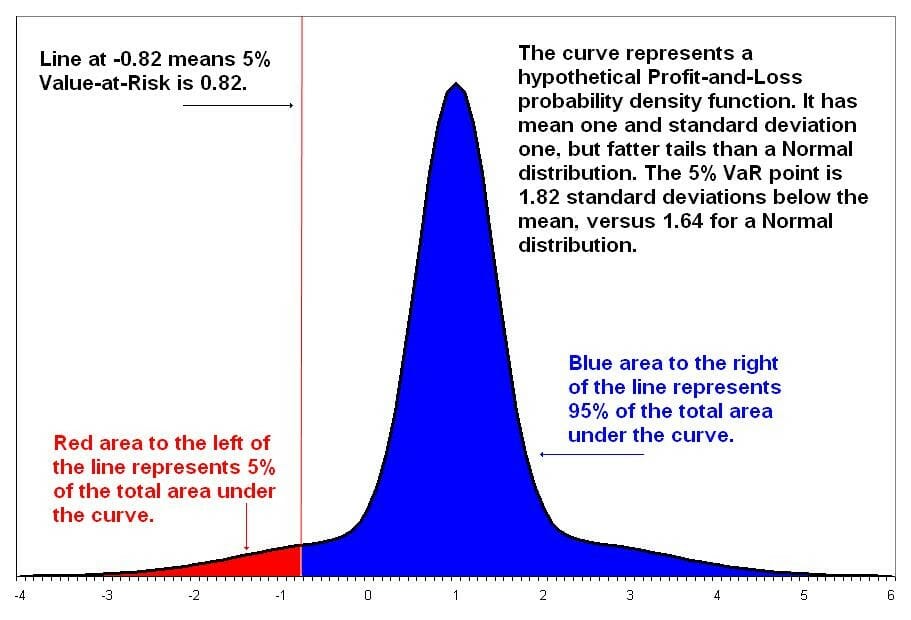
Value at Risk (VaR) is a financial metric that estimates the risk of an investment. More specifically, VaR is a statistical technique used to measure the amount of potential loss that could happen in an investment portfolio over a specified period of time. Value at Risk gives the probability of losing more than a given amount in a given portfolio.
Advantages of Value at Risk (VaR)
1. Easy to understand
Value at Risk is a single number that indicates the extent of risk in a given portfolio. Value at Risk is measured in either price units or as a percentage. This makes the interpretation and understanding of VaR relatively simple.
2. Applicability
Value at Risk is applicable to all types of assets – bondsBondsBonds are fixed-income securities that are issued by corporations and governments to raise capital. The bond issuer borrows capital from the bondholder and makes fixed payments to them at a fixed (or variable) interest rate for a specified period., shares, derivatives, currencies, etc. Thus, VaR can be easily used by different banks and financial institutions to assess the profitability and risk of different investments, and allocate risk based on VaR.
3. Universal
The Value at Risk figure is widely used, so it is an accepted standard in buying, selling, or recommending assets.
Limitations of Value at Risk
1. Large portfolios
Calculation of Value at Risk for a portfolio not only requires one to calculate the risk and return of each asset but also the correlations between them. Thus, the greater the number or diversity of assets in a portfolio, the more difficult it is to calculate VaR.
2. Difference in methods
Different approaches to calculating VaR can lead to different results for the same portfolio.
3. Assumptions
Calculation of VaR requires one to make some assumptions and use them as inputs. If the assumptions are not valid, then neither is the VaR figure.
Key Elements of Value at Risk
- Specified amount of loss in value or percentage
- Time period over which the risk is assessed
- Confidence interval
Example VaR Assessment Question
If we have a 95% confidence interval, what is the maximum loss that can occur from this investment over a period of one month?
Methods Used for Calculating VaR
1. Historical Method
The historical method is the simplest method for calculating Value at Risk. Market data for the last 250 days is taken to calculate the percentage change for each risk factor on each day. Each percentage change is then calculated with current market values to present 250 scenarios for future value.
For each of the scenarios, the portfolio is valued using full, non-linear pricing models. The third worst day selected is assumed to be 99% VaR.
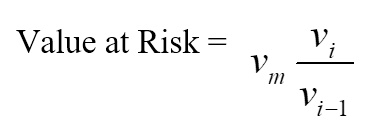
Where:
- vi is the number of variables on day i
- m is the number of days from which historical data is taken
2. Parametric Method
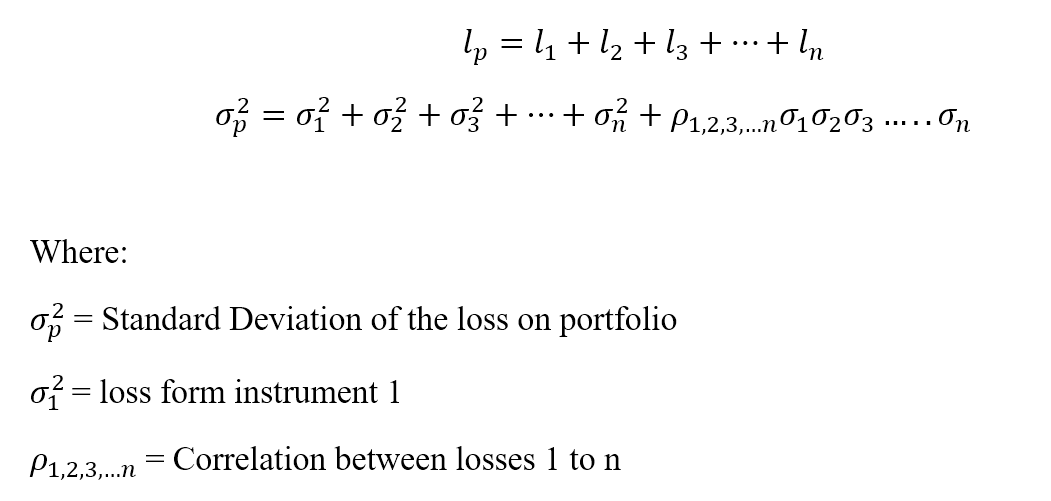
The parametric method is also known as the variance-covariance method. It assumes a normal distribution in returns. Two factors are to be estimated – an expected return and a standard deviation.
The parametric method is best suited to risk measurement problems where the distributions are known and reliably estimated. The method is unreliable when the sample size is very small.
Let loss be ‘l’ for a portfolio ‘p’ with ‘n’ number of instruments.
3. Monte Carlo Method
Under the Monte Carlo method, Value at Risk is calculated by randomly creating a number of scenarios for future rates using non-linear pricing models to estimate the change in value for each scenario, and then calculating the VaR according to the worst losses.
The Monte Carlo method is suitable for a great range of risk measurement problems, especially when dealing with complicated factors. It assumes that there is a known probability distribution for risk factors.
Marginal Value at Risk (MVaR)
The marginal value at risk (MVaR) method is the amount of additional risk that is added by a new investment in the portfolio. MVaR helps fund managers to understand the change in a portfolio due to the subtraction or addition of a particular investment.
An investment may individually have a high Value at Risk, but if it is negatively correlated with the portfolio, it may contribute a relatively much lower amount of risk to the portfolio than its standalone risk.
Incremental Value at Risk
Incremental VaR is the amount of uncertainty added to, or subtracted from, a portfolio due to buying or selling of an investment. Incremental VaR is calculated by taking into consideration the portfolio’s standard deviation and rate of return, and the individual investment’s rate of return and portfolio share. (The portfolio share refers to what percentage of the portfolio the individual investment represents.)
Conditional Value at Risk (CVaR)
This is also known as the expected shortfall, average value at risk, tail VaR, mean excess loss, or mean shortfall. CVaR is an extension of VaR. CVaR helps to calculate the average of the losses that occur beyond the Value at Risk point in a distribution. The smaller the CVaR, the better.
Related Readings
We hope you’ve enjoyed reading CFI’s guide to Value at Risk. CFI offers the Capital Markets & Securities Analyst (CMSA)®Program Page - CMSAEnroll in CFI's CMSA® program and become a certified Capital Markets &Securities Analyst. Advance your career with our certification programs and courses. certification program for those looking to take their careers to the next level.
To keep learning and advance your career, the following resources will be helpful:
- Equity Risk PremiumEquity Risk PremiumEquity risk premium is the difference between returns on equity/individual stock and the risk-free rate of return. It is the compensation to the investor for taking a higher level of risk and investing in equity rather than risk-free securities.
- Fixed Income TradingFixed Income TradingFixed income trading involves investing in bonds or other debt security instruments. Fixed income securities have several unique attributes and factors that
- Risk AverseRisk Averse DefinitionSomeone who is risk averse has the characteristic or trait of preferring avoiding loss over making a gain. This characteristic is usually attached to investors or market participants who prefer investments with lower returns and relatively known risks over investments with potentially higher returns but also with higher uncertainty and more risk.
- Investing: A Beginner’s GuideInvesting: A Beginner's GuideCFI's Investing for Beginners guide will teach you the basics of investing and how to get started. Learn about different strategies and techniques for trading
-

Risk Shifting: Definition, Examples & Implications
Risk shifting is a risk strategy that involves transferring the responsibility for risk or liability to another party. The risk can be transferred in full or partially, and it ensures that the third p
-
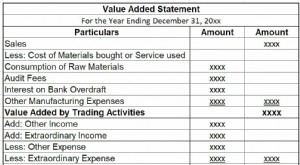
Understanding Value Added: Definition & Business Applications
Value added is the extra value created over and above the original value of something. It can apply to products, services, companies, management, and other areas of business. In other word
invest
- Understanding Risk Grades: An Investor's Guide
- Understanding Value at Risk (VaR): A Comprehensive Guide
- Understanding Currency Risk: A Comprehensive Guide
- Understanding Downside Risk: Protecting Your Investments
- Ex-Post Analysis: Understanding Outcomes After Events
- Understanding Market Risk: A Comprehensive Guide
- Value at Risk (VaR): Understanding Investment Risk
- Understanding Risk Aversion in Investing: A Beginner's Guide
- Value Investing: A Comprehensive Guide to Finding Undervalued Investments
-
 Understanding Operating Risk: A Key Component of Business Risk
Operating risk is the risk related to a company’s cost structure. More specifically, it is the risk the company faces due to the level of fixed costs in its operations. Together with sales ...
-
 Understanding Financial Risk: A Comprehensive Guide
In finance, risk is the probability that actual results will differ from expected results. In the Capital Asset Pricing Model (CAPM)Capital Asset Pricing Model (CAPM)The Capital Asset Pricing Model (C...