
Understanding Wash Sales: IRS Rules and Implications
A wash sale is categorized when an investor sells a stockStockWhat is a stock? An individual who owns stock in a company is called a shareholder and is eligible to claim part of the company’s residual assets and earnings (should the company ever be dissolved). The terms "stock", "shares", and "equity" are used interchangeably. or security and repurchases the same or a substantially identical security within 30 days of the sale. The US Internal Revenue Service (IRS)How to Use the IRS.gov WebsiteIRS.gov is the official website of the Internal Revenue Service (IRS), the United States’ tax collection agency. The website is used by businesses and introduced the 61-day wash sale rule to prevent investors who hold unrealized losses from benefiting from a tax deduction.
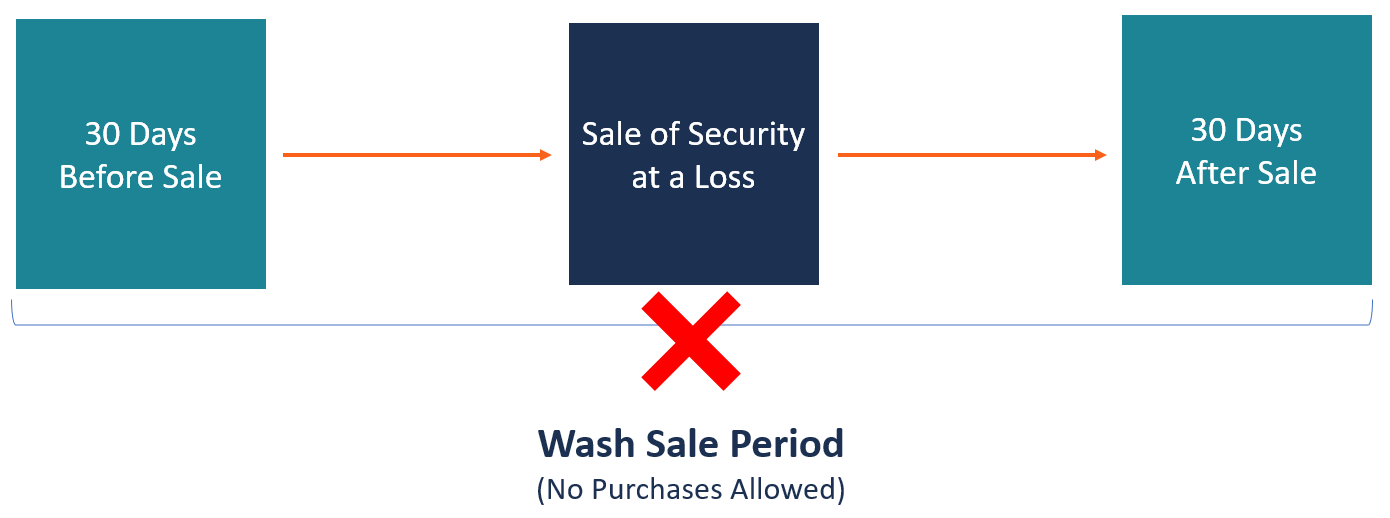
In a wash sale, the investor repurchases the security within 30 days with the hope of regaining the value of the security. The 61-day wash sale rule comprises 30 days before and after the date of sale.
Wash Sale Rule Explained
A wash sale comprises two transactions, i.e., the sale of a security at a loss and the repurchase of the security within 30 days. The purchase may include any of the following options:
- Purchase of another substantially identical security for an individual retirement account
- Purchase of the same or a substantially identical security
- Purchase of an option or contract to buy a substantially identical security
- Purchase of a substantially identical security in a fully taxable transaction
If an investor purchases the same or a substantially identical security within the 61-day time frame, the IRS effectively ignores the transaction, and the amount of loss is added to the cost of the replacement security. It defers the loss until a future time when the replacement security is sold. The 61-day holding period also applies to the replacement security. The “substantially identical security” is also referred to as the “replacement security” for the original security.
What Constitutes a Wash Sale
There several things that the IRS considers when deciding whether a certain transaction qualifies as a wash sale transaction. First, securities in different classes are not considered substantially identical to each other. For example, bonds and preferred stockPreferred SharesPreferred shares (preferred stock, preference shares) are the class of stock ownership in a corporation that has a priority claim on the company’s assets over common stock shares. The shares are more senior than common stock but are more junior relative to debt, such as bonds. are considered to be different from common stock. The only exception to this provision is when preferred stock can be converted to common stock without any restriction.
With these provisions, investors can use certain methods to keep trading until the wash sale period has lapsed. One way that investors can achieve this is to sell one security at a loss and buy a different security in the same industry. They can then wait until the 61-day period has expired and repurchase the original security.
For example, an investor can sell 1,000 stocks of ABC Company, a manufacturing company, at a loss. They can use the funds to buy a mutual fund in the manufacturing sector during the wash sale period. After the period has expired, the investor can sell the mutual fund shares and repurchase the stock of ABC Company. Repurchasing ABC’s shares after the wash sale period allows the investor to claim losses and realize tax deductions.

Practical Example: Wash Sale
Assume that Jay purchased 100 shares of ABC Company for $30 per share and sold them for $27 per share on July 20. He then repurchased the shares on August 10 when the shares were trading at $33 per share. Since the transaction occurred within the 30-day wash sale period, the $300 loss is a wash sale and would be disallowed by the IRS.
[takeaways]The adjusted basis for the replacement shares is $3,600, which is the addition of the $3,300 ($33 x 100) and the $300 loss that was disallowed. Therefore, taxes on any future sale will be figured as though Jay had retained the original shares.
[/takeaways]
Same Stocks vs. or Substantially Identical Stocks
When determining the transactions that are counted as wash sales, the IRS uses the terms “same stocks” or “substantially identical stocks” to determine if investors are claiming artificial losses. Two securities are identified as the same if they are exactly identical or if they share most of their characteristics.
A company’s bonds and preferred stock are considered different from the same company’s common stock. Also, the securities of one company, e.g., ABC Company, are not identical to the stocks of another company, e.g., XYZ Company.
Additional Resources
CFI is the official provider of the global Financial Modeling & Valuation Analyst (FMVA)™Become a Certified Financial Modeling & Valuation Analyst (FMVA)®CFI's Financial Modeling and Valuation Analyst (FMVA)® certification will help you gain the confidence you need in your finance career. Enroll today! certification program, designed to help anyone become a world-class financial analyst. To keep advancing your career, the additional resources below will be useful:
- Long and Short PositionsLong and Short PositionsIn investing, long and short positions represent directional bets by investors that a security will either go up (when long) or down (when short). In the trading of assets, an investor can take two types of positions: long and short. An investor can either buy an asset (going long), or sell it (going short).
- Momentum InvestingMomentum InvestingMomentum investing is an investment strategy aimed at purchasing securities that have been showing an upward price trend or short-selling securities that
- Swing TradingSwing TradingSwing trading is a trading technique that traders use to buy and sell stocks when indicators point to an upward (positive) or downward (negative) trend
- Trade Order TimingTrade Order Timing - TradingTrade order timing refers to the shelf-life of a specific trade order. The most common types of trade order timing are market orders, GTC orders,
-

Understanding Social Security Benefits: A Comprehensive Guide
Social Security Benefits Defined Social Security is an income replacement program in the U.S. During your career, you will pay Social Security taxes which contribute to this fund and benefits ar
-

ChexSystems Security Freeze: Understanding Your Banking Report
If you’re not familiar with the consumer report agency ChexSystems, consider yourself lucky. The consumer reporting agency tracks information on your banking habits, like overdrafts, bounced checks, s
invest
- Understanding Security Deposits: What You Need to Know
- Understanding Wash Sales: Tax Implications & Avoidance
- Margin Calls Explained: Understanding and Avoiding Them
- Understanding Non-Marketable Securities: Definition & Examples
- Understanding Security Quality: A Guide to Investment Risk
- Securities Lending: Definition, Process & Benefits
- Understanding Technical Decline in Securities: Causes & Factors
- Wash Trading: Definition, Risks & How It Impacts Markets
- Wash Sale Rule: Understanding Tax Implications and Strategies
-
 Understanding Non-Covered Securities: Definition & SEC Role
The term non-covered security refers to a legal definition of securities, the details of which may not necessarily be disclosed to the Internal Revenue Service (IRS). The competent authority that make...
-
 Understanding Installment Sales: A Comprehensive Guide
An installment sale is a financing arrangement in which the seller allows the buyer to make payments over an extended period of time. In an installment sale, the buyer receives the goods at the beginn...