
Understanding Installment Sales: A Comprehensive Guide
An installment sale is a financing arrangement in which the seller allows the buyer to make payments over an extended period of time. In an installment sale, the buyer receives the goods at the beginning of the installment period and makes payments over an installment period. RevenueSales RevenueSales revenue is the income received by a company from its sales of goods or the provision of services. In accounting, the terms "sales" and and expenseAccrued ExpensesAccrued expenses are expenses that are recognized even though cash has not been paid. They are usually paired up against revenue via the matching principle are recognized at the time of cash collection and not at the time of sale.

Summary
- An installment sale allows the buyer to make payments over an extended period of time.
- Revenue recognition recognizes revenue and expense at the time of cash collection and not at the time of sale.
- Used when ownership is not fully transferred at the point of sale.
- Used when there is a degree of uncertainty in the collection of cash.
Installment Sales Method of Revenue Recognition
The installment sales method of revenue recognitionRevenue Recognition PrincipleThe revenue recognition principle dictates the process and timing by which revenue is recorded and recognized as an item in a company's defers revenue recognition until cash from the sale is received. Therefore, the installment sales method is a conservative method of revenue recognition as revenue is not immediately recognized at the point of sale.
The installment sales method is only applied in situations where ownership is not fully transferred at the time of sale. In addition, the method is used when there is a degree of uncertainty over the amount that will be collected (therefore, it would be inappropriate to recognize all revenue at the time of sale).
Journal Entries
The journal entries for installment sales are as follows:
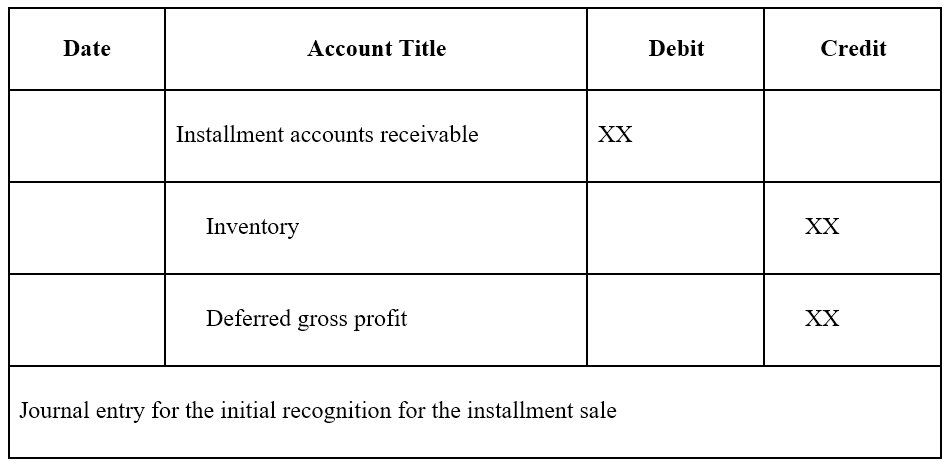
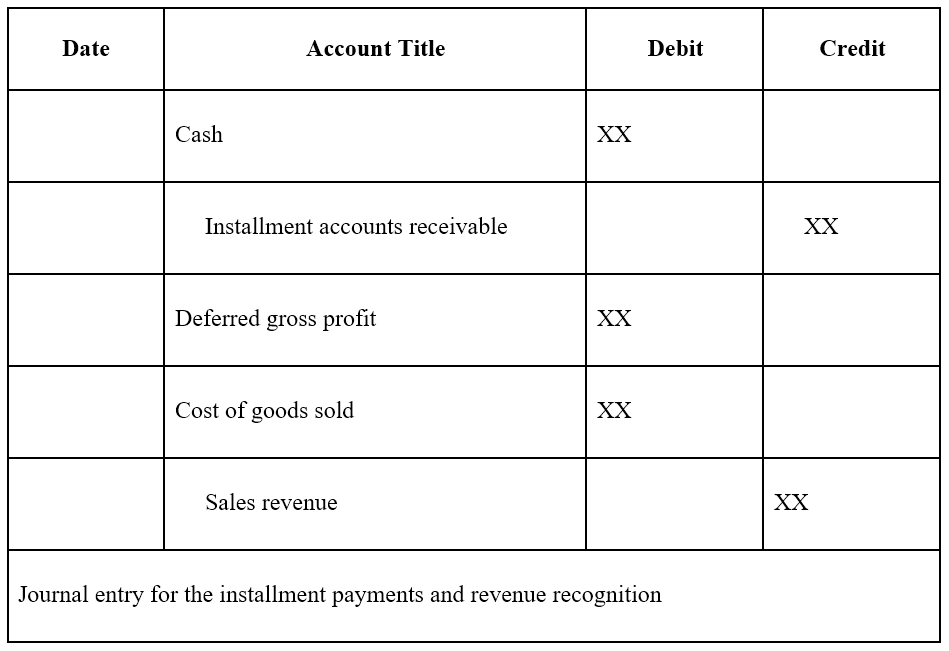
Example of Installment Sales Method
Company A is a furniture company and makes a sale for a piece of furniture with a retail price of $10,000 at the end of January. The cost of the furniture to the company is $4,000. Therefore, the gross margin for the good is 60%.
The company strikes a deal with the customer in which the customer is required to make installment payments of $2,500 each month for the furniture until the full amount is paid ($10,000).

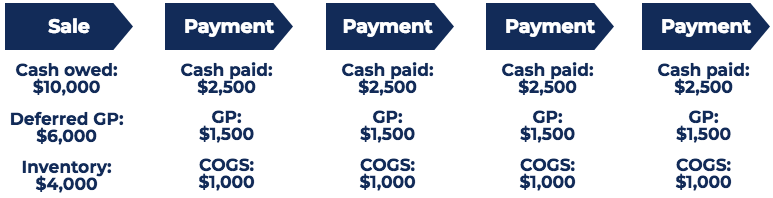
The journal entries for Company A would be as follows:
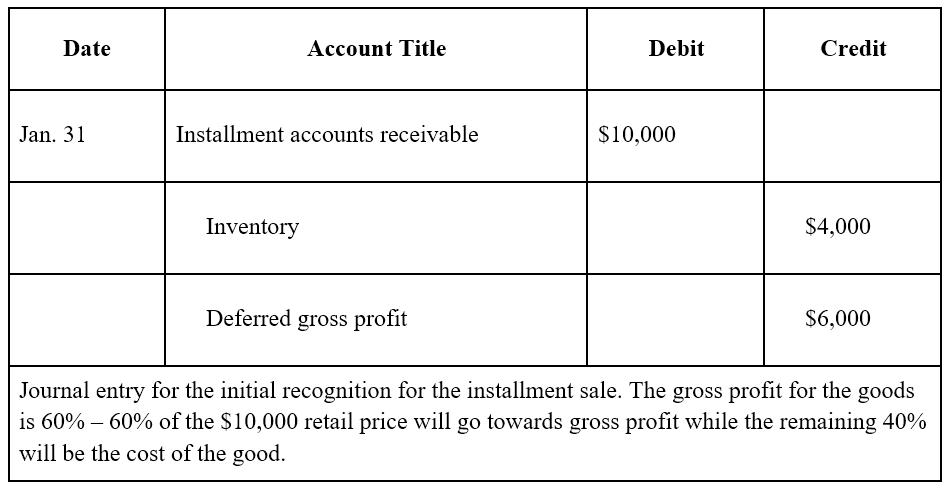
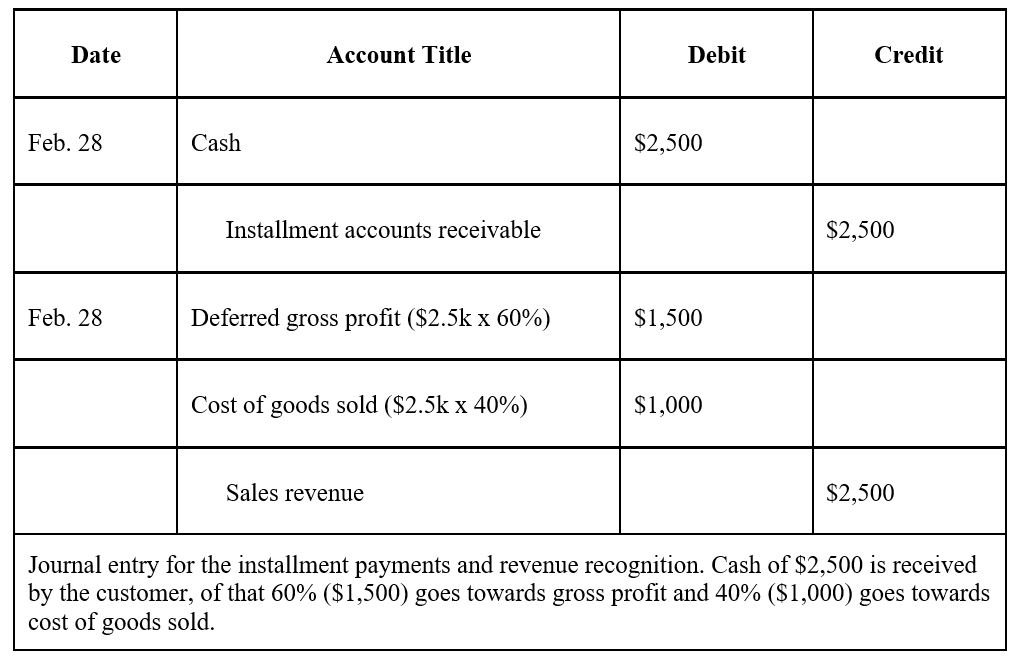
The journal entries for the end of March, April, and May would be the same as the journal entry above.
Related Readings
CFI is the official provider of the global Financial Modeling & Valuation Analyst (FMVA)Become a Certified Financial Modeling & Valuation Analyst (FMVA)®CFI's Financial Modeling and Valuation Analyst (FMVA)® certification will help you gain the confidence you need in your finance career. Enroll today!®Become a Certified Financial Modeling & Valuation Analyst (FMVA)®CFI's Financial Modeling and Valuation Analyst (FMVA)® certification will help you gain the confidence you need in your finance career. Enroll today! certification program for anyone looking to become a world-class financial analyst. To keep advancing your career, the additional CFI resources below will be useful:
- Credit SalesCredit SalesCredit sales refer to a sale in which the amount owed will be paid at a later date. In other words, credit sales are purchases made by
- Sales and Collection CycleSales and Collection CycleThe Sales and Collection Cycle, also known as the revenue, receivables, and receipts (RRR) cycle, is comprised of various classes of
- Trade CreditTrade CreditA trade credit is an agreement or understanding between agents engaged in business with each other that allows the exchange of goods and services
- Sales and Purchase AgreementSale and Purchase AgreementThe Sale and Purchase Agreement (SPA) represents the outcome of key commercial and pricing negotiations. In essence, it sets out the agreed elements of the deal, includes a number of important protections to all the parties involved and provides the legal framework to complete the sale of a property.
-
Revenue Bonds: A Comprehensive Guide for Investors
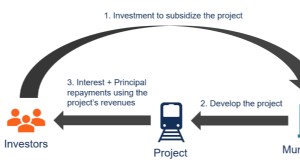
A revenue bond is a type of municipal bond in which the repayment of the obligation is primarily guaranteed by the operating revenuesRevenueRevenue is the value of all sales of goods and services reco
-
Understanding Wash Sales: IRS Rules and Implications
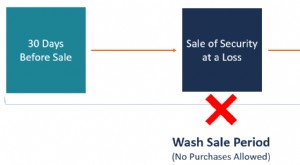
A wash sale is categorized when an investor sells a stockStockWhat is a stock? An individual who owns stock in a company is called a shareholder and is eligible to claim part of the company’s re
Accounting
- LTM Revenue: Definition & Importance in Financial Analysis
- Accrued Revenue: Definition, Examples & Accounting Explained
- Ancillary Revenue: Definition, Examples & Maximization
- Understanding Deferred Revenue: A Comprehensive Guide
- Marginal Revenue: Definition, Calculation & Importance
- Understanding Revenue: A Comprehensive Guide for Businesses
- Revenue Recognition: A Comprehensive Guide (IFRS & GAAP)
- Revenue vs. Income: Understanding the Key Differences
- ARPU: Understanding and Calculating Average Revenue Per User
-
![Revenue Run Rate: Definition & Calculation | [Your Company Name]](https://www.etffin.com/article/uploadfiles/202110/2021100815174169_S.jpeg) Revenue Run Rate: Definition & Calculation | [Your Company Name]
Revenue Run Rate: Definition & Calculation | [Your Company Name]RevenueSales RevenueSales revenue is the income received by a company from its sales of goods or the provision of services. In accounting, the terms sales and Run Rate is an indicator of financia...
-
 Hospital Revenue Bonds: Financing Healthcare Infrastructure
A hospital bond is a type of municipal bondMunicipal BondA municipal bond refers to a bond or fixed income security that is issued by a government municipality, township, or state to finance its gover...