
Accounting Rate of Return (ARR): Definition & Capital Budgeting
Accounting Rate of Return (ARR) is the average net incomeNet IncomeNet Income is a key line item, not only in the income statement, but in all three core financial statements. While it is arrived at through an asset is expected to generate divided by its average capital cost, expressed as an annual percentage. The ARR is a formula used to make capital budgeting decisions. It is used in situations where companies are deciding on whether or not to invest in an asset (a project, an acquisition, etc.) based on the future net earnings expected compared to the capital cost.
To learn more, launch our financial analysis courses!
ARR Formula
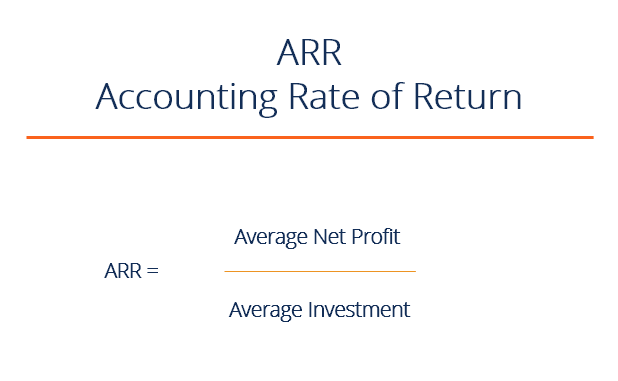
The formula for ARR is:
ARR = Average Annual Profit / Average Investment
Where:
- Average Annual Profit = Total profit over Investment Period / Number of Years
- Average Investment = (Book Value at Year 1 + Book Value at End of Useful Life) / 2
Components of ARR
If the ARR is equal to 5%, this means that the project is expected to earn five cents for every dollar invested per year.
In terms of decision making, if the ARR is equal to or greater than a company’s required rate of returnHurdle Rate DefinitionA hurdle rate, which is also known as minimum acceptable rate of return (MARR), is the minimum required rate of return or target rate that investors are expecting to receive on an investment. The rate is determined by assessing the cost of capital, risks involved, current opportunities in business expansion, rates of return for similar investments, and other factors, the project is acceptable because the company will earn at least the required rate of return.
If the ARR is less than the required rate of return, the project should be rejected. Therefore, the higher the ARR, the more profitable the company will become.
Read more about hurdle ratesHurdle Rate DefinitionA hurdle rate, which is also known as minimum acceptable rate of return (MARR), is the minimum required rate of return or target rate that investors are expecting to receive on an investment. The rate is determined by assessing the cost of capital, risks involved, current opportunities in business expansion, rates of return for similar investments, and other factors.
ARR – Example 1
XYZ Company is looking to invest in some new machinery to replace its current malfunctioning one. The new machine, which costs $420,000, would increase annual revenueSales RevenueSales revenue is the income received by a company from its sales of goods or the provision of services. In accounting, the terms "sales" and by $200,000 and annual expenses by $50,000. The machine is estimated to have a useful life of 12 years and zero salvage value.
Step 1: Calculate Average Annual ProfitInflows, Years 1-12(200,000*12)$2,400,000Less: Annual Expenses(50,000*12)-$600,000Less: Depreciation-$420,000Total Profit$1,380,000Average Annual Profit(1,380,000/12)$115,000
Step 2: Calculate Average Investment
Average Investment($420,000 + $0)/2 = $210,000Step 3: Use ARR Formula
ARR = $115,000/$210,000 = 54.76%
Therefore, this means that for every dollar invested, the investment will return a profit of about 54.76 cents.
ARR – Example 2
XYZ Company is considering investing in a project that requires an initial investment of $100,000 for some machinery. There will be net inflows of $20,000 for the first two years, $10,000 in years three and four, and $30,000 in year five. Finally, the machine has a salvage value of $25,000.
Step 1: Calculate Average Annual ProfitInflows, Years 1 & 2(20,000*2)$40,000Inflows, Years 3 & 4(10,000*2)$20,000Inflow, Year 5$30,000Less: Depreciation(100,000-25,000)-$75,000Total Profit$15,000Average Annual Profit(15,000/5)$3,000
Step 2: Calculate Average Investment
Average Investment($100,000 + $25,000) / 2 = $62,500Step 3: Use ARR Formula
ARR = $3,000/$62,500 = 4.8%
Download the Free Template
Enter your name and email in the form below and download the free template now!
Limitations to Accounting Rate of Return
Although ARR is an effective tool to grasp a general idea of whether to proceed with a project in terms of its profitability, there are several limitations to this approach:
- It ignores the time value of money. It assumes accounting income in future years has the same value as accounting income in the current year. A better metric that considers the present value of all future cash flowsCash FlowCash Flow (CF) is the increase or decrease in the amount of money a business, institution, or individual has. In finance, the term is used to describe the amount of cash (currency) that is generated or consumed in a given time period. There are many types of CF is NPVNPV FormulaA guide to the NPV formula in Excel when performing financial analysis. It's important to understand exactly how the NPV formula works in Excel and the math behind it. NPV = F / [ (1 + r)^n ] where, PV = Present Value, F = Future payment (cash flow), r = Discount rate, n = the number of periods in the future and Internal Rate of Return (IRRInternal Rate of Return (IRR)The Internal Rate of Return (IRR) is the discount rate that makes the net present value (NPV) of a project zero. In other words, it is the expected compound annual rate of return that will be earned on a project or investment.).
- It does not consider the increased risk of long-term projects and the increased variability associated with prolonged projects.
- It is only a financial guide for projects. Sometimes projects are proposed and implemented to enhance other important variables such as safety, environmental concerns, or governmental regulations.
- It is not an ideal comparative metric between projects because different projects have different variables such as time and other non-financial factors to consider.
To learn more, launch our financial analysis courses!
Additional resources
We hope the above article has been a helpful guide to understanding the Accounting Rate of Return, the formula, and how you can use it in your career. CFI is the provider of the Financial Modeling & Valuation Analyst (FMVA)®,Become a Certified Financial Modeling & Valuation Analyst (FMVA)®CFI's Financial Modeling and Valuation Analyst (FMVA)® certification will help you gain the confidence you need in your finance career. Enroll today! a program designed to help anyone become a world-class financial analyst. To keep learning and advancing your career these additional CFI resources will be helpful:
- Internal Rate of Return (IRR)Internal Rate of Return (IRR)The Internal Rate of Return (IRR) is the discount rate that makes the net present value (NPV) of a project zero. In other words, it is the expected compound annual rate of return that will be earned on a project or investment.
- Goodwill Impairment AccountingGoodwill Impairment AccountingGoodwill is acquired and recorded on the books when an entity purchases another entity for more than the fair market value of its assets.
- Modified Internal Rate of Return (MIRR)MIRR GuideThe Modified Internal Rate of Return (MIRR) is a function in Excel that takes into account the financing cost (cost of capital) and a reinvestment rate for cash flows from a project or company over the investment’s time horizon.
- Financial Modeling GuideFree Financial Modeling GuideThis financial modeling guide covers Excel tips and best practices on assumptions, drivers, forecasting, linking the three statements, DCF analysis, more
-

Rate of Return vs. Interest Rate: Understanding the Key Differences
The rate of return is an internal measure of the return on money invested in a project. The interest rate is the external rate at which money can be borrowed from lenders. Rate of R
-

Understanding Rate of Return (RoR): Calculation & Investment Performance
You may be happy if your investment statements show steady gains from year to year. But does that mean you’re getting a good rate of return? And for that matter, what is a good rate of return? As it t
Accounting
- Indexed Annuities: A Comprehensive Guide for Retirees
- Understanding Rate of Return: A Comprehensive Guide
- Return on Capital Employed (ROCE): Definition & Calculation
- Annualized Rate of Return: Definition & Calculation
- Nominal Rate of Return: Definition & Calculation
- Accounting Profit Explained: Calculation & Importance
- Understanding Journal Entries in Accounting: A Comprehensive Guide
- Understanding Rate of Return (ROR): Calculation & Applications
- Accounting Rate of Return (ARR): Definition & Calculation
-
 Hedge Accounting Explained: A Comprehensive Guide
Hedge accounting is a practice in accounting where the entries used to adjust the fair value of a derivative also include the value of the opposing hedge for the security. In other words, hedge accoun...
-
 Understanding Inflation Accounting: A Guide for Multinational Corporations
Inflation accounting is used during times of increasing or plummeting prices in certain areas of the world, usually with respect to multinational corporationsMultinational Corporation (MNC)A multinati...