
Understanding Additional Paid-In Capital (APIC): Definition & Significance
APIC (Additional Paid-In Capital) is a component of shareholders’ equityStockholders EquityStockholders Equity (also known as Shareholders Equity) is an account on a company's balance sheet that consists of share capital plus that reflects the price investors are willing to pay above the par value of issued stock.
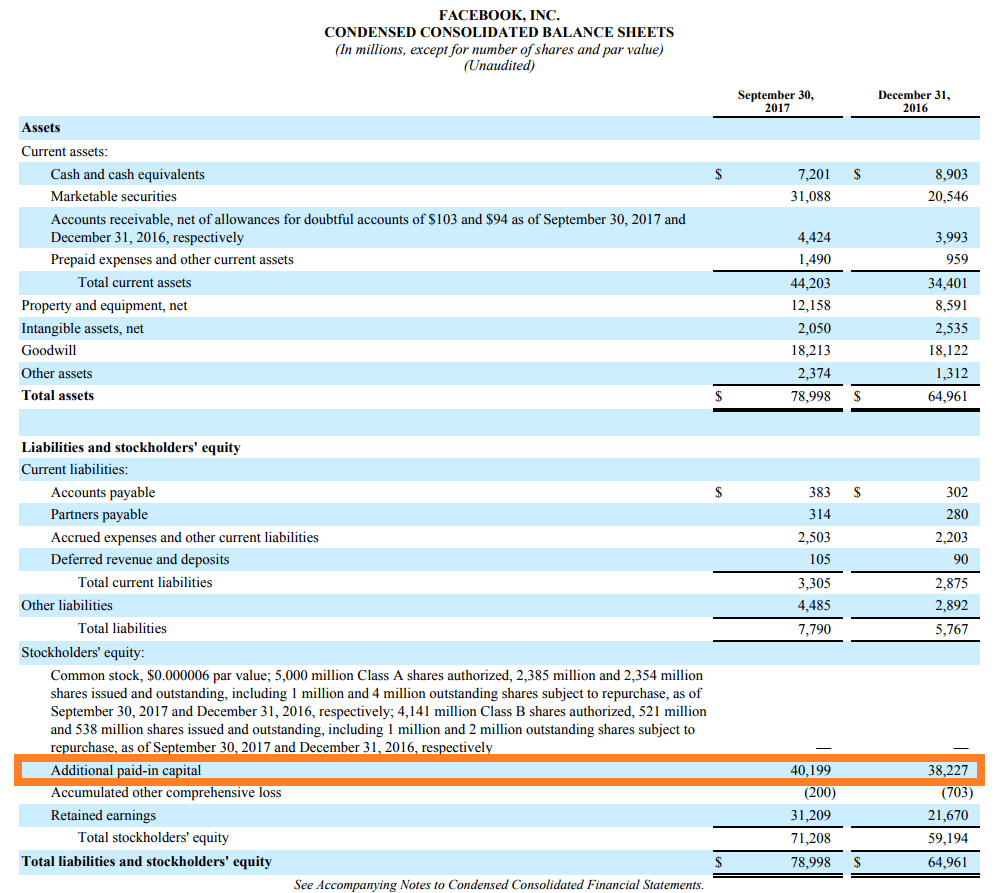
APIC can be thought of as the surplus amount or premium a company receives from issued stock in an Initial Public Offering (IPO)Initial Public Offering (IPO)An Initial Public Offering (IPO) is the first sale of stocks issued by a company to the public. Prior to an IPO, a company is considered a private company, usually with a small number of investors (founders, friends, family, and business investors such as venture capitalists or angel investors). Learn what an IPO is over and above the issue price. It is used to represent what investors paid above the par value denominated by the company on a share of the stock. It is important to note that additional paid-in capital only occurs in the primary markets; in other words, when the investor buys shares in a company directly from the company itself.
Transactions that occur in the secondary marketSecondary MarketThe secondary market is where investors buy and sell securities from other investors. Examples: New York Stock Exchange (NYSE), London Stock Exchange (LSE)., or between shareholders after the IPO, do not result in profit for the company. As such, they are not included in additional paid-in capital. APIC can apply to both common and preferred stock.
Summary
- APIC (Additional Paid-in Capital) is a representation of the cash inflow from the difference in the issue price of a stock and its par value.
- Additional paid-in capital is recorded in the shareholders’ equity portion of a company’s balance sheet.
- The APIC formula is APIC = (Issue Price – Par Value) x Number of Shares Acquired by Investors.
APIC Formula
In order to calculate APIC, you will need the following information:
- The issue price at the time of the IPO;
- The par value assigned to a share by the issuing company; and
- The number of shares outstanding.
The additional paid-in capital is derived from the difference in the issue price and par value, which will give you the premium per share resulting from the stock issue. The premium per share is then multiplied by the number of shares outstanding to give the company’s APIC value. The above relationship can be expressed by the following formula:
Additional Paid-In Capital = (Issue Price – Par Value) * Number of Shares Outstanding
By applying the formula above to all public offerings, you will be able to determine the APIC of an organization.
What is Par Value?
Par value is the listed price of a company’s shares that is sold in the primary market. Par value is analogous to an “ask” on a secondary market. It is the amount a company “asks” for a share of equity in its company.
The issue price is reflective of the market value or the assessment of investors as to what the value of a share in the company is worth. The disparity between what a company asks and what the market thinks of a share is the resulting per share profitability in the above equation.
The par value is determined by a company’s management even before there is a market value for the security. In order to minimize any potential legal liability, issuing companies will minimize the par value as much as possible to avoid any downside risk.
Usually, it will mean issuing shares at a par value that is the smallest denomination of currency possible, i.e., 1 cent, $0.01 in the United States. In some jurisdictions, it is mandated by law that shares are issued at the smallest value possible, while in others, shares cannot be sold under par value, pushing companies to issue stocks at the very small par value as a result.
APIC in the Real World
To frame our understanding of APIC, we will use a relatively recent real-world example. In early 2019, Beyond Meat Inc., a Los Angeles-based producer of plant-based meat alternatives, held its initial public offering.
Pre-IPO, Beyond Meat attributed a par value of $0.0001 per share, while the issue price was $25 per share. The number of common shares the company issued at IPO was 9.625 million. Putting it all together, the additional paid-in capital from common stock at Beyond Meat’s IPO would be:
APIC = ($25 – $0.0001) * $9,625,000
APIC = $240,624,037.50
Therefore, the cash collected as a result of additional paid-in capital at IPO attributed to common stock was $240.6 million.
APIC in Financial Statements
APIC is accounted for in shareholders’ equity and serves to counterbalance the increase in the cash account on the assets side of the balance sheet. Along with retained earningsRetained EarningsThe Retained Earnings formula represents all accumulated net income netted by all dividends paid to shareholders. Retained Earnings are part, it is generally the largest component of shareholder equity. In fact, additional paid-in capital will usually reflect a large majority of shareholder equity immediately after a company’s IPO, as retained earnings have yet to accumulate.
This initial APIC can later act as a “cushion,” or “safety net,” against any potential losses in net income. It is important to note that, despite the interaction with net income, the APIC appears only on the balance sheet, not on the income statement.
Additional Resources
CFI is the official provider of the global Commercial Banking & Credit Analyst (CBCA)™Program Page - CBCAGet CFI's CBCA™ certification and become a Commercial Banking & Credit Analyst. Enroll and advance your career with our certification programs and courses. certification program, designed to help anyone become a world-class financial analyst. To keep advancing your career, the additional resources below will be useful:
- Additional Paid-In Capital vs. Contributed CapitalAdditional Paid-In Capital vs. Contributed CapitalThe key difference between additional paid-in capital vs. contributed capital is that the latter is referred to as the total value of cash
- Capital StructureCapital StructureCapital structure refers to the amount of debt and/or equity employed by a firm to fund its operations and finance its assets. A firm's capital structure
- Contributed SurplusContributed SurplusContributed surplus is an account in the shareholders’ equity section of the balance sheet that reflects excess amounts collected from the
- Equity ValueEquity ValueEquity value can be defined as the total value of the company that is attributable to shareholders. To calculate equity value follow, this guide from CFI.
-
![Capital Gains Yield (CGY): Definition & Formula | [Your Brand]](https://www.etffin.com/article/uploadfiles/202110/2021100815125839_S.png)
Capital Gains Yield (CGY): Definition & Formula | [Your Brand]
Capital gains yield (CGY) is the price appreciation on an investment or a securityEquity Capital Market (ECM)The equity capital market is a subset of the capital market, where financial instituti
-

Qualifying Transactions: Understanding Public Offerings via Capital Pool Companies
A qualifying transaction is a transaction where a private Canadian company issues public stockPublic SecuritiesPublic securities, or marketable securities, are investments that are openly or easily tr
Accounting
- Nominal Capital Explained: Definition & Importance for Businesses
- Understanding and Calculating Additional Paid-In Capital
- Contributed Capital: Definition & Understanding | [Your Company Name]
- Capital Employed: Definition, Calculation & Importance
- Invested Capital: Definition & How It Fuels Business Growth
- Additional Paid-In Capital vs. Contributed Capital: Key Differences Explained
- Understanding Book Value: A Key Financial Metric
- Understanding Salvage Value: Definition & Importance
- Understanding Additional Paid-In Capital (APIC): Definition & Significance
-
 Working Capital Management: A Comprehensive Guide
Working capital management refers to the set of activities performed by a company to make sure it got enough resources for day-to-day operating expensesOperating ExpensesOperating expenses, operating ...
-
 Value Traps: Identifying & Avoiding Investment Pitfalls
A value trap occurs when an investor looks at the fundamentals and market priceDow Jones Industrial Average (DJIA)The Dow Jones Industrial Average (DJIA), also referred to as Dow Jones” or the D...