
Return on Capital Employed (ROCE): Definition & Calculation
Return on Capital Employed (ROCE), a profitability ratio, measures how efficiently a company is using its capitalCapital StructureCapital structure refers to the amount of debt and/or equity employed by a firm to fund its operations and finance its assets. A firm's capital structure to generate profits. The return on capital employed metric is considered one of the best profitability ratiosProfitability RatiosProfitability ratios are financial metrics used by analysts and investors to measure and evaluate the ability of a company to generate income (profit) relative to revenue, balance sheet assets, operating costs, and shareholders' equity during a specific period of time. They show how well a company utilizes its assets to produce profit and is commonly used by investors to determine whether a company is suitable to invest in or not.

Formula for Return on Capital Employed
The formula for computing ROCE is as follows:
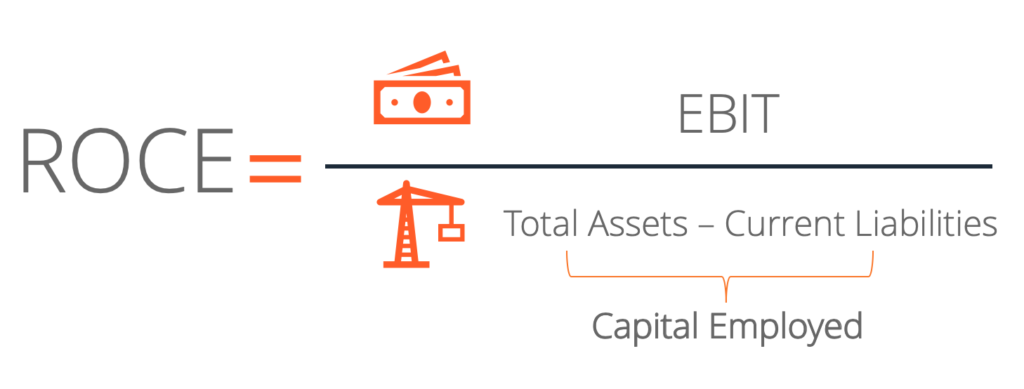
Where:
- Earnings before interest and tax (EBIT) EBIT GuideEBIT stands for Earnings Before Interest and Taxes and is one of the last subtotals in the income statement before net income. EBIT is also sometimes referred to as operating income and is called this because it's found by deducting all operating expenses (production and non-production costs) from sales revenue.is the company’s profit, including all expenses except interest and tax expenses.
- Capital employed is the total amount of equity invested in a business. Capital employed is commonly calculated as either total assets less current liabilitiesCurrent LiabilitiesCurrent liabilities are financial obligations of a business entity that are due and payable within a year. A company shows these on the or fixed assets plus working capital.
Some analysts will use net operating profit in place of earnings before interest and taxes when calculating the return on capital employed.
Example of Return on Capital Employed
Let us compute the return on capital employed for Apple Inc. We will look at the financial statements of Apple for 2016 and 2017 and calculate the ROCE for each year.
The following information is taken from Apple’s financial statements:

Apple’s capital employed is calculated as total assets minus total current liabilities:

Therefore:
- Capital employed in 2017: 375,319,000,000 – 100,814,000,000 = 274,505,000,000
- Capital employed in 2016: 321,686,000,000 – 79,006,000,000 = 242,680,000,000
The returns on capital employed for Apple Inc. for 2016 and 2017 are as follows:

- ROCE in 2017: 64,089,000,000 / 274,505,000,000 = 0.23 = 23%
- ROCE in 2016: 61,372,000,000 / 242,680,000,000 = 0.25 = 25%
Download the Free Template
Enter your name and email in the form below and download the free template now!
Interpretation of Return on Capital Employed
The return on capital employed shows how much operating income is generated for each dollar of capital invested. A higher ROCE is always more favorable, as it indicates that more profits are generated per dollar of capital employed. However, as with any other financial ratios, calculating just the ROCE of a company is not enough. Other profitability ratios such as return on assetsReturn on Assets & ROA FormulaROA Formula. Return on Assets (ROA) is a type of return on investment (ROI) metric that measures the profitability of a business in relation to its total assets., return on invested capital, and return on equityReturn on Equity (ROE)Return on Equity (ROE) is a measure of a company’s profitability that takes a company’s annual return (net income) divided by the value of its total shareholders' equity (i.e. 12%). ROE combines the income statement and the balance sheet as the net income or profit is compared to the shareholders’ equity. should be used in conjunction with ROCE to determine whether a company is likely a good investment or not.
In the example with Apple Inc., a ROCE of 23% in 2017 means that for every dollar invested in capital, the company generated 23 cents in operating income. To determine whether Apple’s ROCE is good, it is important to compare it against its competitors and not across different industries.
Return on Capital Employed Comparisons
When comparing ROCE among companies, there are key things to keep in mind:
- Ensure that the companies are both in the same industry. Comparing the ROCE across industries does not offer much value.
- Ensure that the ROCE comparison between companies in the same industry uses numbers for the same accounting period. Companies sometimes follow different year ends and it is misleading to compare the ROCE of companies over different time periods.
- Determine the benchmark ROCE of the industry. For example, a company with a ROCE of 20% may look good compared to a company with a ROCE of 10%. However, if the industry benchmark is 35%, both companies are considered to have a poor ROCE.
Key Takeaways
Here are the key takeaways on return on capital employed:
- Return on capital employed is a profitability ratio used to show how efficiently a company is using its capital to generate profits.
- Variations of the return on capital employed use NOPAT (net operating profit after tax) instead of EBIT (earnings before interest and taxes).
- A higher return on capital employed is favorable, as it indicates a more efficient use of capital employed.
- The return on capital employed should be used in conjunction with other profitability ratios such as return on equity, return on assets, etc., when evaluating a company.
- This metric should only be compared for companies operating in the same industry – comparisons across industries offer very little value.
Other Resources
CFI offers the Financial Modeling & Valuation Analyst (FMVA)™Become a Certified Financial Modeling & Valuation Analyst (FMVA)®CFI's Financial Modeling and Valuation Analyst (FMVA)® certification will help you gain the confidence you need in your finance career. Enroll today! certification program for those looking to take their careers to the next level. To keep learning and advancing your career, the following CFI resources will be helpful:
- Return on Invested Capital (ROIC)ROICROIC stands for Return on Invested Capital and is a profitability ratio that aims to measure the percentage return that a company earns on invested capital.
- Net Working CapitalNet Working CapitalNet Working Capital (NWC) is the difference between a company's current assets (net of cash) and current liabilities (net of debt) on its balance sheet.
- Stockholders EquityStockholders EquityStockholders Equity (also known as Shareholders Equity) is an account on a company's balance sheet that consists of share capital plus
- Types of AssetsTypes of AssetsCommon types of assets include current, non-current, physical, intangible, operating, and non-operating. Correctly identifying and
-

Understanding Capital Gains: A Comprehensive Guide
A capital gain is an increase in the value of an asset or investment resulting from the price appreciation of the asset or investment. In other words, the gain occurs when the current or sale price of
-

Understanding Capital Gains Tax: A Comprehensive Guide
Capital gains tax is a tax imposed on capital gains or the profits that an individual makes from selling assets. The tax is only imposed once the asset has been converted into cash, and not when it&rs
finance
- Understanding Return of Capital (ROC): Definition & Tax Implications
- Understanding Alpha: A Guide to Investment Performance
- Basel I: Understanding Core Banking Regulations & Capital Requirements
- Understanding Capital: Types, Categories & Value Creation
- Capital Employed: Definition, Calculation & Importance
- Capital Rationing: Definition, Strategy & Impact on Investment Decisions
- Cash-on-Cash Return: Definition, Calculation & Importance
- Return on Invested Capital (ROIC): Definition & Calculation
- Return on Total Capital (ROTC): Definition & Calculation
-
 Basel II: Understanding International Banking Regulations
Basel II is the second set of international banking regulations defined by the Basel Committee on Bank Supervision (BCBS). It is an extension of the regulations for minimum capital requirements as def...
-
 Understanding CAPM: A Comprehensive Guide to Capital Asset Pricing
The Capital Asset Pricing Model (CAPM) is a model that describes the relationship between the expected returnExpected ReturnThe expected return on an investment is the expected value of the proba...