
ARPPU: Understanding Average Revenue Per Paying User
Average revenue per paying user (ARPPU) is a non-GAAP metric used to assess the average revenue generated from a paying customer. Although similar to average revenue per user (ARPU), the fundamental difference with ARPPU is that the calculation of the metric only involves active paying customers and not the company’s entire customer base. This metric is used to assess the profitability garnered from each paying customer and the company’s revenue-generating capabilities.

Formula for Average Revenue Per Paying User
The formula for average revenue per paying user is as follows:

Where:
- Total revenue is the total revenue generated over the desired measurement period.
- Average number of paying users is the average number of users that pay for the service and/or good over the desired measurement period.
Note:
- If the measurement period is just one day, it is called average revenue per paying daily active user (ARPPDAU).
- If the measurement period is a period of one month, it is called average revenue per paying monthly active user (ARPPMAU).
Example of ARPPU
Marie is an equity research analystEquity Research Interview QuestionsEquity research interview questions and answers. This list includes the most common interview questions used to hire an equity research looking to perform an analysis of ABC Company. The company offers both free and paid services to customers. It reports ARPU but does not disclose ARPPU.
The company’s ARPU was reported to be $1.30 from an average total user base of 769,231, and revenue generated was $1,000,000. In ABC Company’s latest earnings callEarnings GuidanceAn earnings guidance is the information provided by the management of a publicly traded company regarding its expected future results, including estimates, Marie recalls the CFO mentioning that paying customers make up 70% of the total customer base. The following information was compiled by Maria:
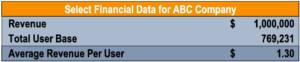

Marie could then determine the company’s ARPPU as follows:

The ARPPU for ABC Company is $1.86 versus its average revenue per user of $1.30.
Usefulness of Average Revenue Per Paying User
ARRPU is seen as an extension to average revenue per user (ARPU)Average Revenue Per User (ARPU)Average revenue per user (ARPU), also known as average revenue per unit, is a non-GAAP metric commonly used by digital media companies,. It is sometimes favored by analysts because the figure takes into consideration paying customers only. With that said, ARPPU is seldom reported by companies and is less commonly used, as opposed to ARPU. The ARPPU can be:
- Used to compare among peer companies – a higher ARPPU is desirable;
- Used in financial modeling and forecasting to generate revenue forecasts; or
- Used to determine the profitability and revenue generation capacity of a company if analyzed on a trended basis.
Key Takeaways
Average revenue per paying user (ARRPU) is a non-GAAP metric used as an alternative to average revenue per user (ARPU). The fundamental difference between ARPPU and ARPU is the fact that the former only takes into consideration paying customers.
Calculated as total revenue divided by the average number of paying users, the ARPPU metric’s usefulness includes being used to compare among peer companies in financial modeling, forecasting, and profitability analysis. It may be a key metric for an internet firm that has a substantial number of both free and paying users.
Additional Resources
CFI offers the Financial Modeling & Valuation Analyst (FMVA)®Become a Certified Financial Modeling & Valuation Analyst (FMVA)®CFI's Financial Modeling and Valuation Analyst (FMVA)® certification will help you gain the confidence you need in your finance career. Enroll today! certification program for those looking to take their careers to the next level. To keep learning and advancing your career, the following CFI resources will be helpful:
- Profitability RatiosProfitability RatiosProfitability ratios are financial metrics used by analysts and investors to measure and evaluate the ability of a company to generate income (profit) relative to revenue, balance sheet assets, operating costs, and shareholders' equity during a specific period of time. They show how well a company utilizes its assets to produce profit
- Revenue StreamsRevenue StreamsRevenue Streams are the various sources from which a business earns money from the sale of goods or provision of services. The types of
- Total Addressable Market (TAM)Total Addressable Market (TAM)Total Addressable Market (TAM), also referred to as total available market, is the overall revenue opportunity that is available to a product or service if
- Types of CustomersTypes of CustomersCustomers play a significant role in any business. By better understanding the different types of customers, businesses can be better equipped to develop
-

Activity-Based Costing (ABC): A Comprehensive Guide
Activity-based costing is a more specific way of allocating overhead costs based on “activities” that actually contribute to overhead costs. In job-order costingJob Order Costing GuideJob
-

ARPU: Understanding and Calculating Average Revenue Per User
ARPU is the amount of money a company earns from each of its users. The more you bill your customers, the more important understanding your average revenue per user becomes. For software businesses
Accounting
- Revenue Per Employee: Definition, Calculation & Importance
- Accrued Revenue: Definition, Examples & Accounting Explained
- Ancillary Revenue: Definition, Examples & Maximization
- Understanding Average Inventory: Definition & Calculation
- Average Revenue Per Account (ARPA): Definition & Calculation
- ARPU: Understanding Average Revenue Per User & Its Significance
- Marginal Revenue: Definition, Calculation & Importance
- Understanding Revenue: A Comprehensive Guide for Businesses
- Revenue vs. Income: Understanding the Key Differences
-
 Understanding Loan Lifespan: What is Average Life?
Average life is the length of time that each unit of unpaid principal is expected to remain outstanding. The average life of mortgagesMortgageA mortgage is a loan – provided by a mortgage lender...
-
 Understanding Average Return: A Simple Guide
Average return is the mathematical average of a sequence of returns that have accrued over time. In its simplest terms, average return is the total return over a time period divided by the number of p...