
Revenue vs. Income: Understanding the Key Differences
This guide provides an overview of the main differences between revenue vs income. RevenueSales RevenueSales revenue is the income received by a company from its sales of goods or the provision of services. In accounting, the terms "sales" and is the sales amount a company earns from providing services or selling products (the “top line”). Income can sometimes be used to mean revenue, or it can also be used to refer to net income, which is revenue less operating expenses (the “bottom line”).

Learn more in CFI’s Free Accounting Courses.
Types of Revenue
Let’s take a closer look at what revenue can mean by looking at examples of the different types that frequently appear in finance and accountingAccountingAccounting is a term that describes the process of consolidating financial information to make it clear and understandable for all.
Types of revenue include:
- The sale of goods, products, or merchandise
- The sale of services, such as consulting
- Rental income from a commercial property (notice the use of “income”)
- The sale of tickets to a concert
- Interest income from lending
Types of Income
As we explained above, the term “income” can sometimes be confusing, as accountants often use it to refer to a revenue. The term net income clearly means after all expenses have been deducted.
Types of income include:
- Gross income (before any expenses are deducted)
- Net incomeNet IncomeNet Income is a key line item, not only in the income statement, but in all three core financial statements. While it is arrived at through (after all expenses are deducted)
Learn more about “Gross vs Net.”
Examples of Revenue vs Income
Let’s look at some examples to further illustrate the point. Read through each case below and see if you can determine what you would categorize it as.
Example #1
Tom’s Pizza Inc sells pizzas, soft drinks, snacks, and dips directly to customers. The customers either pay for the products with a credit card or with cash. At the end of the year, Tom gives his accountant all the receipts from sales, as well as invoices and receipts for all employee wages, supplies, energy, and food/drink costs. His accountant takes all the receipts and tells Tom his ________ is $125,869. The answer is “net income.”
Example #2
Sara’s Photography Ltd provides a wide range of services, including portrait photos, wedding shots, family photos, and special occasions. She charges clients for these services upfront and at the end of the year, enters all the invoices into a spreadsheet and determines that her _______ is $248,120. The answer is “revenue.”
Learn more in CFI’s Free Accounting Courses.
Income Statement
In accounting, the income statement (also called the Statement of Profit and Loss) summarizes a company’s revenues, expenses, and net income.
Below is an example of Amazon’s 2016 annual report (10-k), which contains both revenue (which they label as “net sales”) and net income.
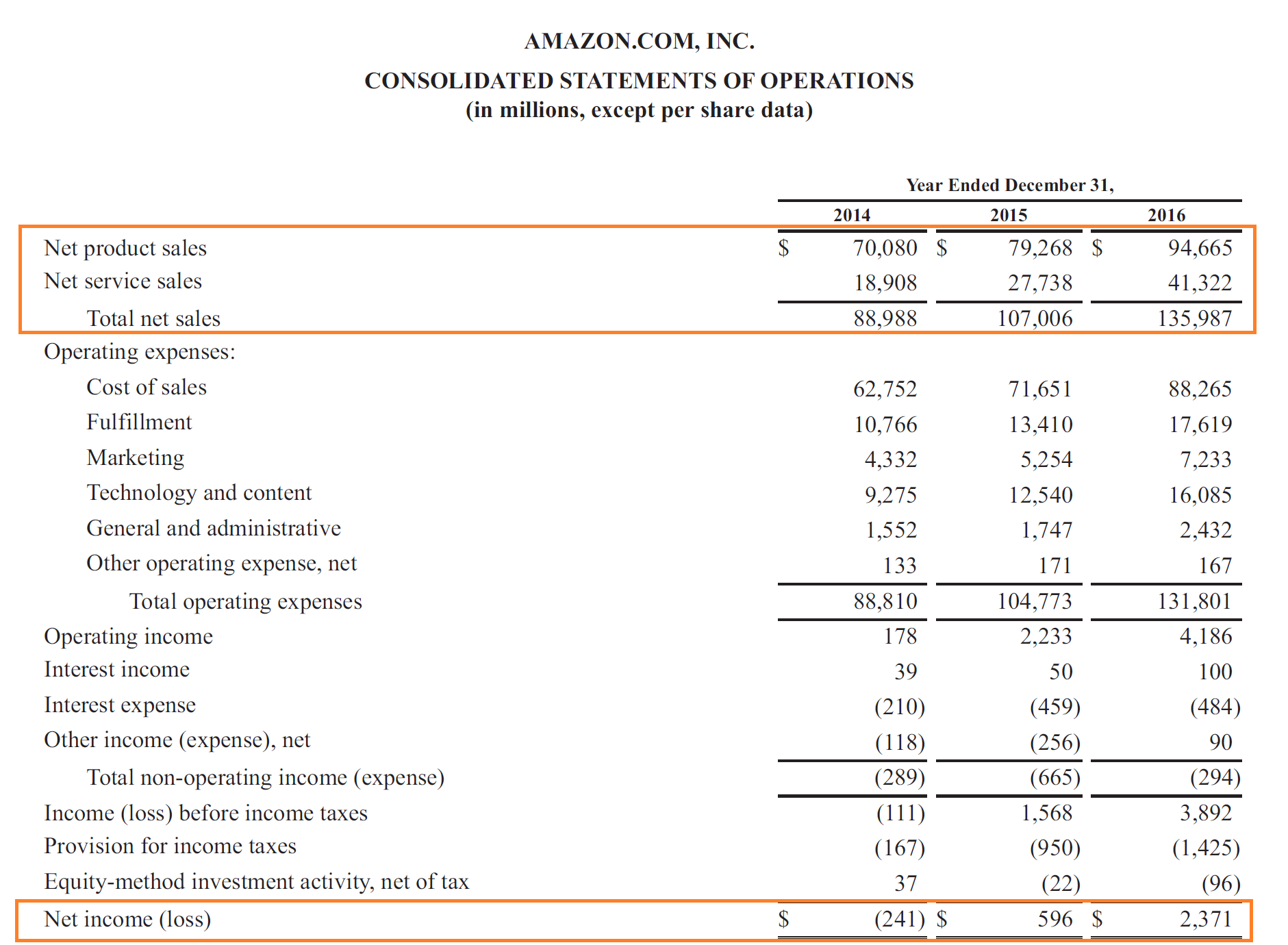
Hopefully, the examples above have provided a clearer view of how a company reports certain items, and the difference between top line and bottom line is a little clearer.
Additional Resources
Thank you for reading this guide on revenue vs income. We hope it has helped your understanding of accounting and financial reporting.
CFI is the official provider of the Financial Modeling and Valuation Analyst (FMVA)Become a Certified Financial Modeling & Valuation Analyst (FMVA)®CFI's Financial Modeling and Valuation Analyst (FMVA)® certification will help you gain the confidence you need in your finance career. Enroll today!®Become a Certified Financial Modeling & Valuation Analyst (FMVA)®CFI's Financial Modeling and Valuation Analyst (FMVA)® certification will help you gain the confidence you need in your finance career. Enroll today! designation. To learn more and advance your career, check out the additional CFI resources below:
- Analysis of Financial StatementsAnalysis of Financial StatementsHow to perform Analysis of Financial Statements. This guide will teach you to perform financial statement analysis of the income statement,
- Balance SheetBalance SheetThe balance sheet is one of the three fundamental financial statements. The financial statements are key to both financial modeling and accounting.
- The Ultimate Cash Flow GuideThe Ultimate Cash Flow Guide (EBITDA, CF, FCF, FCFE, FCFF)This is the ultimate Cash Flow Guide to understand the differences between EBITDA, Cash Flow from Operations (CF), Free Cash Flow (FCF), Unlevered Free Cash Flow or Free Cash Flow to Firm (FCFF). Learn the formula to calculate each and derive them from an income statement, balance sheet or statement of cash flows
- Finance Interview QuestionsFinance Interview QuestionsFinance interview questions and answers. This list includes the most common and frequent interview questions and answers for finance jobs and
-

Understanding Taxable Income: Definition & Calculation
Taxable income refers to any individual’s or business’ compensation that is used to determine tax liability. The total income amount or gross income is used as the basis to calculate how m
-

Net Income Explained: A Comprehensive Guide for Businesses & Individuals
Net income is revenue minus expenses, interest, and taxes. Here’s what you need to know about net income and why businesses and individuals pay close attention to it.What is net income?Net income is a
Accounting
- Understanding Accounting Income: A Key Financial Metric
- Accrued Income Explained: Definition & Accounting
- Ancillary Revenue: Definition, Examples & Maximization
- Income Smoothing: Definition, Methods & Implications
- Marginal Revenue: Definition, Calculation & Importance
- Understanding Net Income: A Comprehensive Guide
- Non-Operating Income: Definition, Examples & Significance
- Understanding Revenue: A Comprehensive Guide for Businesses
- Sales Revenue: Definition, Calculation & Importance
-
 Understanding Interest Income: A Comprehensive Guide
Interest income is the amount paid to an entity for lending its money or letting another entity use its funds. On a larger scale, interest income is the amount earned by an investor’s money that...
-
 LTM Revenue: Definition & Importance in Financial Analysis
LTM stands for “Last Twelve Months” and is similar in meaning to TTM, or “Trailing Twelve Months.” LTM Revenue is a popular term used in the world of finance as a measurement o...