
Understanding Revenue: A Comprehensive Guide for Businesses
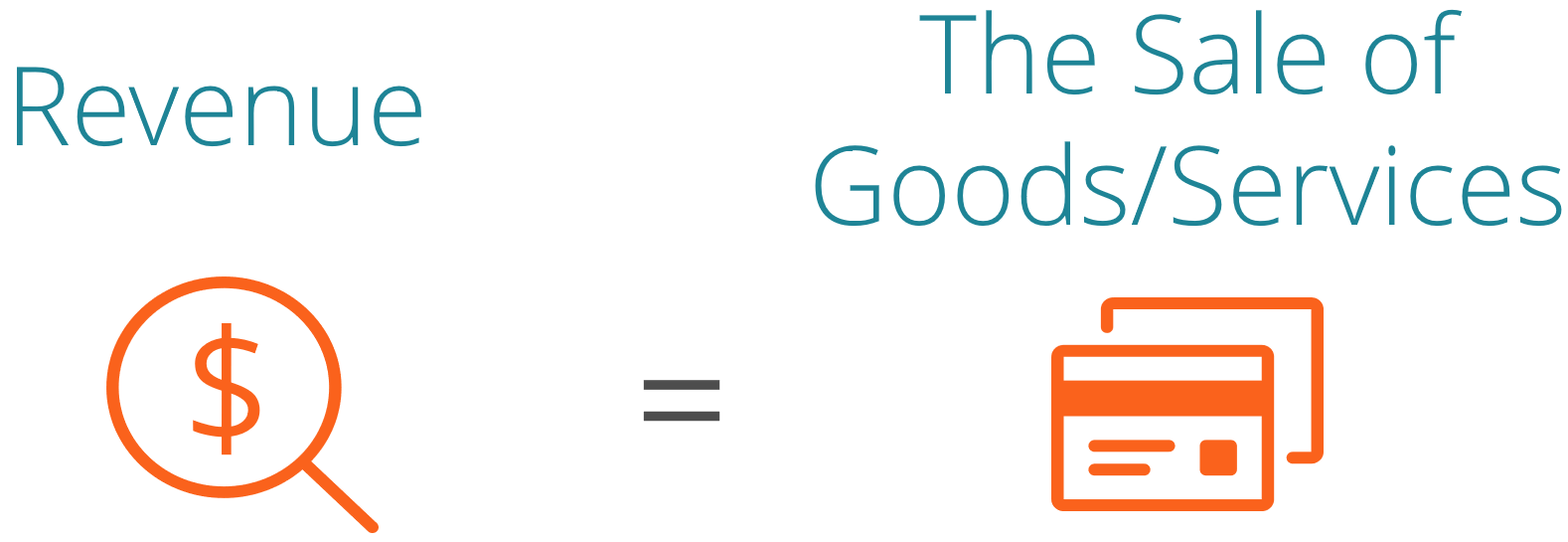
Revenue is the value of all sales of goods and services recognized by a company in a period. Revenue (also referred to as Sales or Income) forms the beginning of a company’s income statementIncome StatementThe Income Statement is one of a company's core financial statements that shows their profit and loss over a period of time. The profit or and is often considered the “Top Line” of a business. Expenses are deducted from a company’s revenue to arrive at its Profit or Net Income.
Revenue Recognition Principle
According to the revenue recognition principle in accounting, revenue is recorded when the benefits and risks of ownership have transferred from seller to buyer, or when the delivery of services has been completed.
Notice that this definition doesn’t include anything about payment for goods/services actually being received. This is because companies often sell their products on credit to customers, meaning that they won’t receive payment until later.
When goods or services are sold on credit, they are recorded as revenue, but since cash payment is not received yet, the value is also recorded on the balance sheet as accounts receivable.
When cash payment is finally received later, there is no additional income recorded, but the cash balance goes up, and accounts receivable goes down.
To learn more, explore CFI’s free Accounting Fundamentals Course.
Revenue Example
Below is an example of Amazon’s 2017 income statement. Let’s take a closer look to understand how revenue works for a very large public company.
Amazon refers to its revenue as “sales,” which is equally as common as a term. It reports sales in two categories, products and services, which then combine to form total net sales.
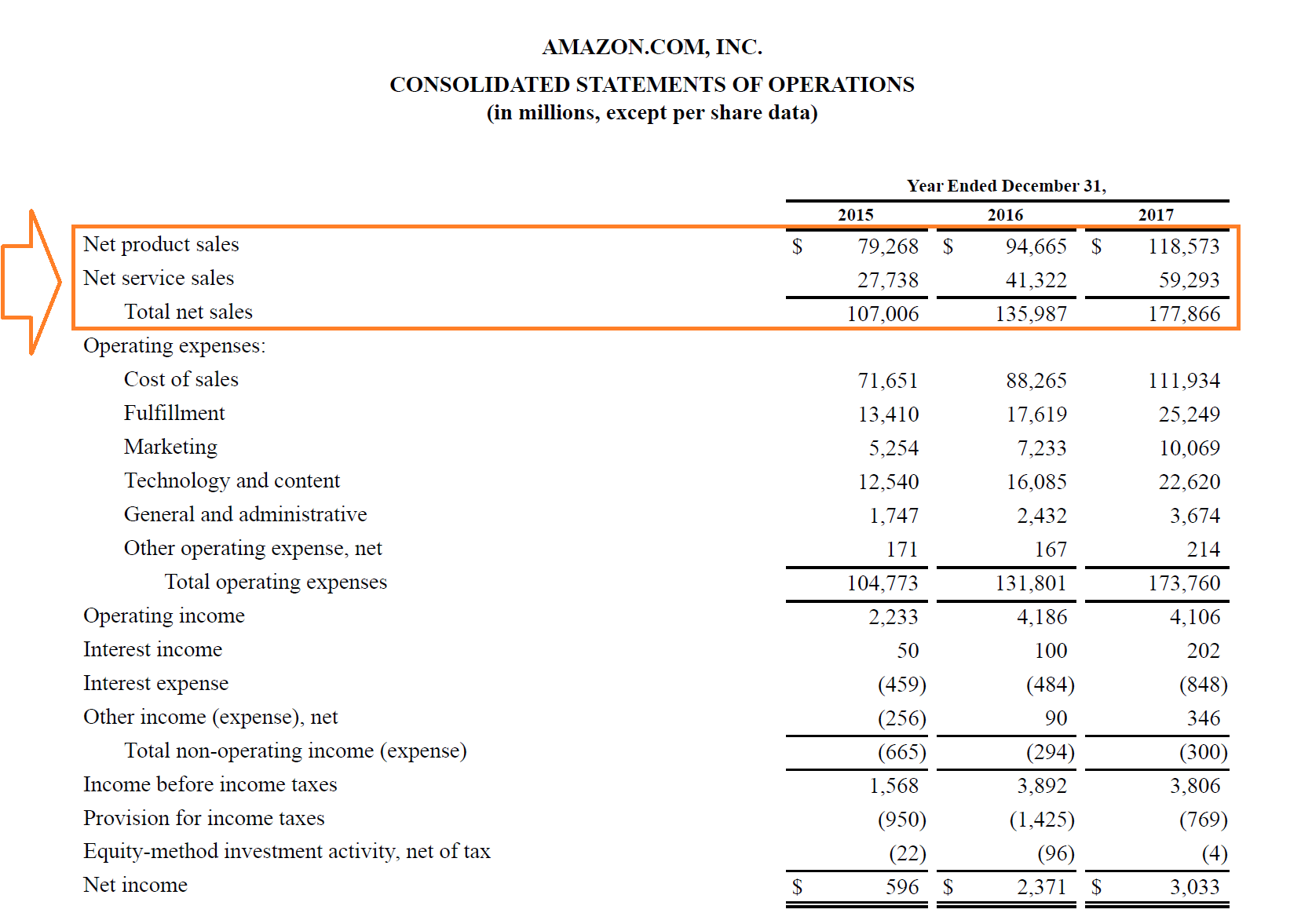
In 2017, Amazon recorded $118.6 billion of product sales and $59.3 billion of service sales, for a grand total of $177.9 billion. The figure forms the top line of the income statement.
Beneath that are all operating expenses, which are deducted to arrive at Operating Income, also sometimes referred to as Earnings Before Interest and Taxes (EBIT).
Finally, interest and taxes are deducted to reach the bottom line of the income statement, $3.0 billion of net income.
Revenue Formula
The revenue formula may be simple or complicated, depending on the business. For product sales, it is calculated by taking the average price at which goods are sold and multiplying it by the total number of products sold. For service companies, it is calculated as the value of all service contracts, or by the number of customers multiplied by the average price of services.
Revenue = No. of Units Sold x Average Price
or
Revenue = No. of Customers x Average Price of Services
The formulas above can be significantly expanded to include more detail. For example, many companies will model their revenue forecastForecasting MethodsTop Forecasting Methods. In this article, we will explain four types of revenue forecasting methods that financial analysts use to predict future revenues. all the way down to the individual product level or individual customer level.
Revenue Forecast
Below is an example of a company’s forecast based on many drivers, including:
- Website traffic
- Conversion rates
- Product prices
- Volume of different products
- Discounts
- Return and refunds
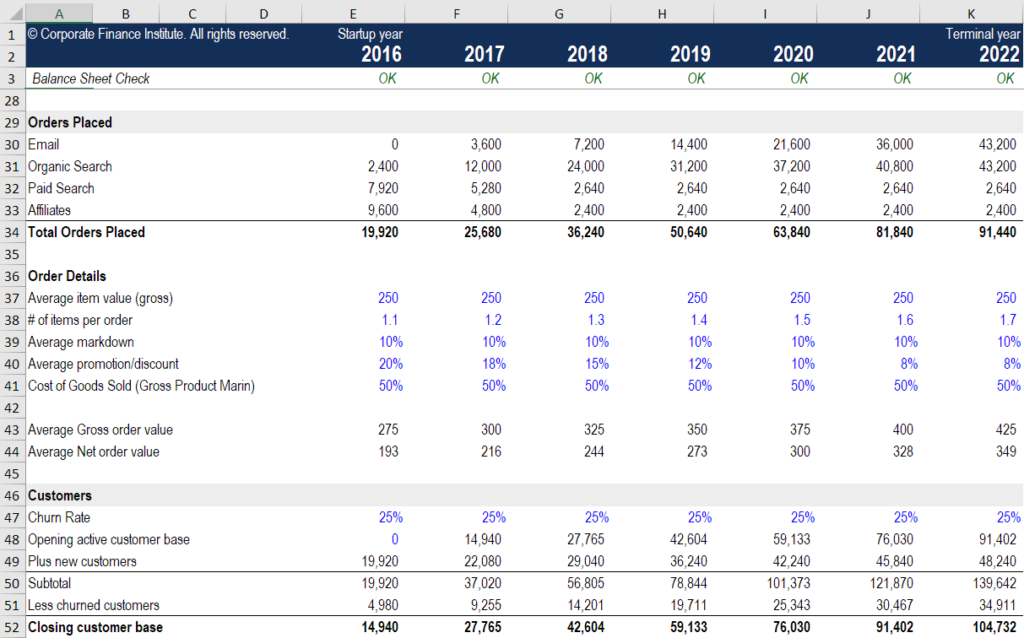
As you can see in the example above, there is much more that can be included in a forecast other than just No. of Units x Average Price.
CFI’s e-Commerce Financial Modeling Course provides a detailed breakdown of how to build this type of model, which is extremely important for forecasting and business valuation.
Revenue on the Income Statement (and other financials)
Sales are the lifeblood of a company, as it’s what allows the company to pay its employees, purchase inventory, pay suppliers, invest in research and development, build new property, plant, and equipment (PP&E), and be self-sustaining.
If a company doesn’t have sufficient revenue to cover the above items, it will need to use an existing cash balance on its balance sheet. The cash can come from financing, meaning that the company borrowed the money (in the case of debt), or raised it (in the case of equity).
In order to perform a comprehensive analysis of a business, it’s important to know how the three financial statements are linked and see how a company either uses its sales to fund the business or must turn to financing alternatives to fund the business.
To learn more, watch CFI’s free webinar on how to link the 3 financial statements in Excel.
Revenue in Different Sectors
Below, we will explore what the concept of revenue means in different sectors. As you will see, it can be composed of many different things and varies widely in terms of what the most common examples are, by sector.
Personal finance:
- Salaries
- Bonuses
- Hourly wages
- Dividends
- Interest
- Rental income
Public finance:
- Income tax
- Corporate tax
- Sales tax
- Duties and tariffs
Corporate finance:
- Sale of goods
- Sales of services
- Dividends
- Interest
Non-profits:
- Membership Dues
- Fundraising
- Sponsorships
- Product/service sales
The three main areas that typically make up the finance industry are public finance, personal finance, and corporate financeCorporate Finance OverviewCorporate finance deals with the capital structure of a corporation, including its funding and the actions that management takes to increase the value of. As we demonstrated above, the various sources of income in each type can be quite different. While the above lists are not exhaustive, they do provide a general sense of the most common types of income you’ll encounter.
Additional Resources
CFI offers the Financial Modeling & Valuation Analyst (FMVA)Become a Certified Financial Modeling & Valuation Analyst (FMVA)®CFI's Financial Modeling and Valuation Analyst (FMVA)® certification will help you gain the confidence you need in your finance career. Enroll today!®Become a Certified Financial Modeling & Valuation Analyst (FMVA)®CFI's Financial Modeling and Valuation Analyst (FMVA)® certification will help you gain the confidence you need in your finance career. Enroll today! certification program for those looking to take their careers to the next level. To help you advance your career, check out the additional CFI resources below:
- EBIT GuideEBIT GuideEBIT stands for Earnings Before Interest and Taxes and is one of the last subtotals in the income statement before net income. EBIT is also sometimes referred to as operating income and is called this because it's found by deducting all operating expenses (production and non-production costs) from sales revenue.
- Financial ForecastingFinancial ForecastingFinancial forecasting is the process of estimating or predicting how a business will perform in the future. This guide on how to build a financial forecast
- Net IncomeNet IncomeNet Income is a key line item, not only in the income statement, but in all three core financial statements. While it is arrived at through
- Public FinancePublic FinancePublic finance is the management of a country's revenue, expenditures, and debt load through various government and quasi-government institutions. This guide provides an overview of how public finances are managed, what the various components of public finance are
-

Understanding Taxable Income: Definition & Calculation
Taxable income refers to any individual’s or business’ compensation that is used to determine tax liability. The total income amount or gross income is used as the basis to calculate how m
-

Net Income Explained: A Comprehensive Guide for Businesses & Individuals
Net income is revenue minus expenses, interest, and taxes. Here’s what you need to know about net income and why businesses and individuals pay close attention to it.What is net income?Net income is a
Accounting
- Understanding Accounting Income: A Key Financial Metric
- Accrued Income Explained: Definition & Accounting
- Ancillary Revenue: Definition, Examples & Maximization
- Income Smoothing: Definition, Methods & Implications
- Marginal Revenue: Definition, Calculation & Importance
- Understanding Net Income: A Comprehensive Guide
- Non-Operating Income: Definition, Examples & Significance
- Revenue vs. Income: Understanding the Key Differences
- Sales Revenue: Definition, Calculation & Importance
-
 Understanding Interest Income: A Comprehensive Guide
Interest income is the amount paid to an entity for lending its money or letting another entity use its funds. On a larger scale, interest income is the amount earned by an investor’s money that...
-
 LTM Revenue: Definition & Importance in Financial Analysis
LTM stands for “Last Twelve Months” and is similar in meaning to TTM, or “Trailing Twelve Months.” LTM Revenue is a popular term used in the world of finance as a measurement o...