
Capital Expenditures (CapEx): Definition & Investment Explained
A capital expenditure (“CapEx” for short) is the payment with either cash or credit to purchase long term physical or fixed assets used in a business’s operations. The expenditureExpenditureAn expenditure represents a payment with either cash or credit to purchase goods or services. An expenditure is recorded at a single point ins are capitalized (i.e., not expensed directly on a company’s income statement) on the balance sheet and are considered an investment by a company in expanding its business.
CapEx is important for companies to grow and maintain their business by investing in new property, plant, equipment (PP&E), products, and technology. Financial analysts and investors pay close attention to a company’s capital expenditures, as they do not initially appear on the income statementIncome StatementThe Income Statement is one of a company's core financial statements that shows their profit and loss over a period of time. The profit or but can have a significant impact on cash flow.
When to Capitalize vs. Expense
The decision of whether to expense or capitalize an expenditure is based on how long the benefit of that spending is expected to last. If the benefit is less than 1 year, it must be expensed directly on the income statement. If the benefit is greater than 1 year, it must be capitalized as an asset on the balance sheet.
For example, the purchase of office supplies like printer ink and paper would not fall under-investing activities, but instead as an operating expense.
The purchase of a building, by contrast, would provide a benefit of more than 1 year and would thus be deemed a capital expenditure.
Learn more about when to capitalize on the IFRS website.
CapEx on the Cash Flow Statement
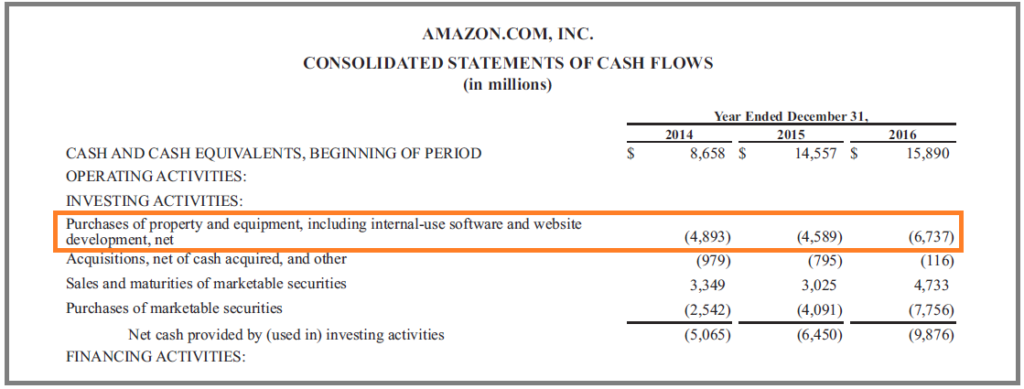
A capital expenditure can be found on a company’s cash flow statementCash Flow StatementA cash flow Statement contains information on how much cash a company generated and used during a given period., under “investing activities.” As you can see in the screenshot above from Amazon’s 2016 annual report (10-k10-KForm 10-K is a detailed annual report that is required to be submitted to the U.S. Securities and Exchange Commission (SEC). The filing provides a comprehensive summary of a company’s performance for the year. It is more detailed than the annual report that is sent to shareholders), in 2016, they had $6,737 million of capital expenditure related to “purchase of property and equipment, including internal-use software and website development, net.”
Since this spending is considered an investment, it does not appear on the income statement.
CapEx on the Balance Sheet
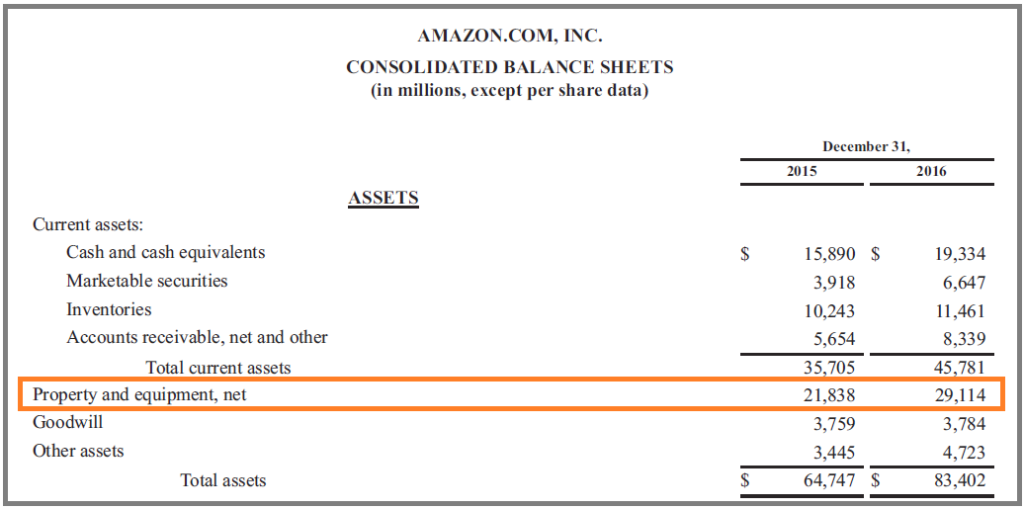
CapEx flows from the cash flow statement to the balance sheet. Once capitalized, the value of the asset is slowly reduced over time (i.e., expensed) via depreciation expenseDepreciation ExpenseWhen a long-term asset is purchased, it should be capitalized instead of being expensed in the accounting period it is purchased in..
How to Calculate Net Capital Expenditure
Net CapEx can be calculated either directly or indirectly. In the direct approach, an analyst must add up all of the individual items that make up the total expenditures, using a schedule or accounting software. In the indirect approach, the value can be inferred by looking at the value of assets on the balance sheet in conjunction with depreciation expense.
Direct method:
- Amount spent on asset #1
- Plus: Amount spent on asset #2
- Plus: Amount spent on asset #3
- Less: Value received for assets that were sold
- = Net CapEx
Indirect Method:
- PP&E Balance in the current period
- Less: PP&E balance in the previous period
- Plus: Depreciation in the current period
- = Net CapEx
Read more about the CapEx FormulaHow to Calculate CapEx - FormulaThis guide shows how to calculate CapEx by deriving the CapEx formula from the income statement and balance sheet for financial modeling and analysis..
Capital Expenditure and Depreciation
As a recap of the information outlined above, when an expenditure is capitalized, it is classified as an asset on the balance sheet. In order to move the asset off the balance sheet over time, it must be expensed and move through the income statement.
Accountants expense assets onto the income statement via depreciation. There is a wide range of depreciation methodsDepreciation MethodsThe most common types of depreciation methods include straight-line, double declining balance, units of production, and sum of years digits. that can be used (straight lineStraight Line DepreciationStraight line depreciation is the most commonly used and easiest method for allocating depreciation of an asset. With the straight line, declining balance, etc.) based on the preference of the management team.
Over the life of an asset, total depreciation will be equal to the net capital expenditure. This means if a company regularly has more CapEx than depreciation, its asset base is growing.
Here is a guideline to see if a company is growing or shrinking (over time):
- CapEx > Depreciation = Growing Assets
- CapEx < Depreciation = Shrinking Assets
Capital Expenditure in Free Cash Flow
Free Cash FlowFree Cash Flow (FCF)Free Cash Flow (FCF) measures a company’s ability to produce what investors care most about: cash that's available be distributed in a discretionary way. is one of the most important metrics in corporate finance. Analysts regularly evaluate a company’s ability to generate cash flow and consider it one of the main ways a company can create shareholder valueShareholder ValueShareholder value is the financial worth owners of a business receive for owning shares in the company. An increase in shareholder value is created.
The formula for Free Cash Flow (FCF) is:
FCF = Cash from Operations – Capital Expenditures
CapEx in Valuation
In financial modelingWhat is Financial ModelingFinancial modeling is performed in Excel to forecast a company's financial performance. Overview of what is financial modeling, how & why to build a model. and valuation, an analyst will build a DCF modelDCF Model Training Free GuideA DCF model is a specific type of financial model used to value a business. The model is simply a forecast of a company’s unlevered free cash flow to determine the net present value (NPVNPV FormulaA guide to the NPV formula in Excel when performing financial analysis. It's important to understand exactly how the NPV formula works in Excel and the math behind it. NPV = F / [ (1 + r)^n ] where, PV = Present Value, F = Future payment (cash flow), r = Discount rate, n = the number of periods in the future) of the business. The most common approach is to calculate a company’s unlevered free cash flow (free cash flow to the firm) and discount it back to the present using the weighted average cost of capital (WACCWACCWACC is a firm’s Weighted Average Cost of Capital and represents its blended cost of capital including equity and debt.).
Below is a screenshot of a financial model calculating unlevered free cash flow, which is impacted by capital expenditures.
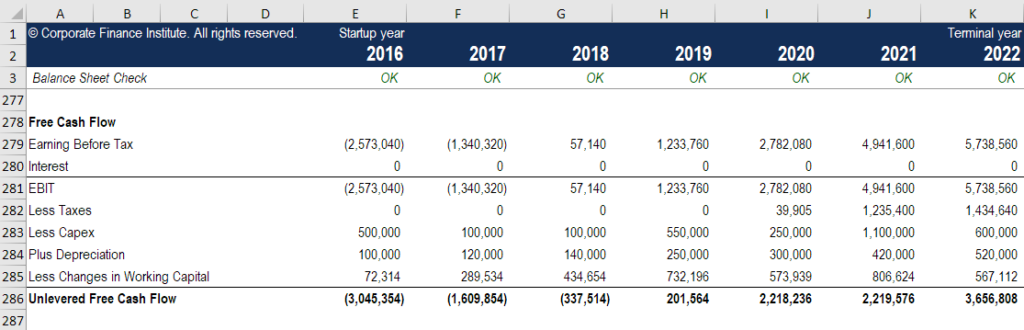
Source: CFI’s Financial Modeling Course.
Additional Resources
CFI is the official provider of the global Financial Modeling & Valuation Analyst (FMVA)®Become a Certified Financial Modeling & Valuation Analyst (FMVA)®CFI's Financial Modeling and Valuation Analyst (FMVA)® certification will help you gain the confidence you need in your finance career. Enroll today! certification program, designed to help anyone become a world-class financial analyst. To keep advancing your career, these additional CFI resources will be useful:
- Valuation MethodsValuation MethodsWhen valuing a company as a going concern there are three main valuation methods used: DCF analysis, comparable companies, and precedent transactions
- Analysis of Financial StatementsAnalysis of Financial StatementsHow to perform Analysis of Financial Statements. This guide will teach you to perform financial statement analysis of the income statement,
- EBITDA MarginEBITDA MarginEBITDA margin = EBITDA / Revenue. It is a profitability ratio that measures earnings a company is generating before taxes, interest, depreciation, and amortization. This guide has examples and a downloadable template
- Projecting Balance Sheet Line ItemsProjecting Balance Sheet Line ItemsProjecting balance sheet line items involves analyzing working capital, PP&E, debt share capital and net income. This guide breaks down how to calculate
-
Understanding Capital Structure: Debt vs. Equity
Capital structure refers to the amount of debtMarket Value of DebtThe Market Value of Debt refers to the market price investors would be willing to buy a companys debt at, which differs from the book
-
Understanding Business Financing: A Comprehensive Guide
Financing refers to the methods and types of funding a business uses to sustain and grow its operations. It consists of debtSenior and Subordinated DebtIn order to understand senior and subordinated d
Accounting
- Basel I: Understanding Core Banking Regulations & Capital Requirements
- Understanding Capital: Types, Categories & Value Creation
- Capital Rationing: Definition, Strategy & Impact on Investment Decisions
- Cost of Capital: Definition, Calculation & Importance
- Venture Capital: Funding Startups & Understanding Equity
- Understanding Capital Losses: Definition, Calculation & Examples
- Understanding Mispricing: Market Prices vs. True Value
- Understanding Expenditures: Definition and Types
- Understanding Intellectual Capital: Definition & Value
-
 Understanding Capital Gains: A Comprehensive Guide
A capital gain is an increase in the value of an asset or investment resulting from the price appreciation of the asset or investment. In other words, the gain occurs when the current or sale price of...
-
 Understanding Capital Gains Tax: A Comprehensive Guide
Capital gains tax is a tax imposed on capital gains or the profits that an individual makes from selling assets. The tax is only imposed once the asset has been converted into cash, and not when it&rs...