
Capital Rationing: Definition, Strategy & Impact on Investment Decisions
Capital rationing is a strategy used by companies or investors to limit the number of projects they take on at a time. If there is a pool of available investments that are all expected to be profitable, capital rationing helps the investor or business owner choose the most profitable ones to pursue.
Companies that employ a capital rationing strategy typically produce a relatively higher return on investment (ROI)Return on Investment (ROI)Return on Investment (ROI) is a performance measure used to evaluate the returns of an investment or compare efficiency of different investments.. This is simply because the company invests its resources where it identifies the highest profit potential.

Capital Rationing Example
Capital rationing is about putting restrictions on investments and projects taken on by a business. To illustrate this better, let’s consider the following example:
VV Construction is looking at five possible projects to invest in, as shown below:
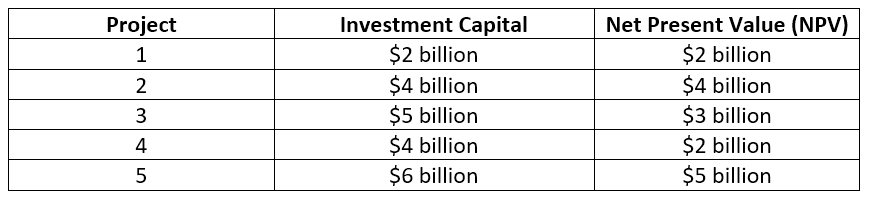
To determine which project offers the greatest potential profitabilityProfitability IndexThe Profitability Index (PI) measures the ratio between the present value of future cash flows to the initial investment. The index is a, we compute each project using the following formula:
Profitability = NPV / Investment Capital
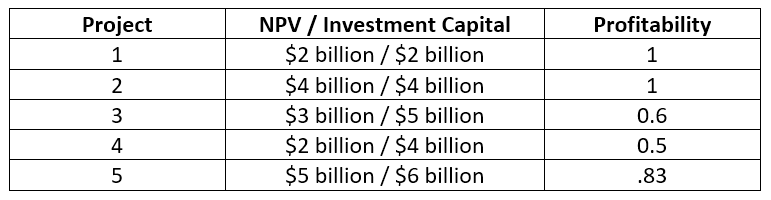
Based on the table above, we can conclude that projects 1 and 2 offer the greatest potential profit. Therefore, VV Construction will likely invest in those two projects.
Types of Capital Rationing
There are two types of capital rationing – hard and soft rationing.
1. Hard capital rationing
Hard capital rationing represents rationing that is being imposed on a company by circumstances beyond its control. For example, a company may be restricted from borrowing money to finance new projects because it has suffered a downgrade in its credit rating. Thus, it may be difficult or effectively impossible for the company to secure financing, or it may only be able to do so at exorbitant interest ratesInterest RateAn interest rate refers to the amount charged by a lender to a borrower for any form of debt given, generally expressed as a percentage of the principal..
2. Soft capital rationing
In contrast, soft capital rationing refers to a situation where a company has freely chosen to impose some restrictions on its capital expenditures, even though it may have the ability to make much higher capital investments than it chooses to. The company may choose from any of a number of methods for imposing investment restrictions on itself. For example, it may temporarily require that a project offer a higher rate of return than is usually required in order for the company to consider pursuing it. Or the company may simply impose a limit on the number of new projects that it will take on during the next 12 months.
Why is Capital Rationing Used? – Benefits
Capital rationing is used by many investors and companies in order to ensure that only the most feasible investments are made. It helps ensure that businesses will invest only in those projects that offer the highest returns. It may appear that all investments with high projected returns should be taken. However, there are times when funds are low or when a company or an individual investor merely want to improve their cash flows before making any more investments. It may also be the case that the investor has reason to believe that they can make the investment under more favorable terms by waiting a bit longer before pursuing it. For example, the company’s management may expect a significant drop in interest rates within the next six months, which would make for less expensive financing costs.
Limited Numbers of Projects are Easier to Manage
When a company invests in a large number of projects simultaneously, the sharing of funds means less capital available for each individual project. This typically translates to more time and effort being required to monitor and manage each project. Also, allocating limited resources across several projects may actually threaten the success of the projects, if, for example, the projected budget for one or more projects turns out to have significantly underestimated costs. Wise capital rationing can help a company avoid such problems.
Capital Rationing Offers Increased Investment Flexibility
Investment opportunities are constantly changing. Portfolio managers usually keep a significant portion of available investment funds in the form of cash. Maintaining a ready supply of excess cash, first of all, provides greater financial stability and makes it easier for investors to adjust to sudden adverse circumstances that may arise.
Keeping some excess cash in reserve accomplishes something else as well. It ensures that if a particularly attractive unseen golden opportunity should suddenly arise, the investor has funds available to take immediate advantage of the situation. The ability to act quickly may be the difference between a good investment opportunity and a great one.
Potential Disadvantages of Capital Rationing
Capital rationing also comes with its own set of potential disadvantages, including the following:
1. High capital requirements
Because only the most profitable investments are taken on under a capital rationing scenario, rationing can also spell high capital requirements.
2. Goes against the efficient capital markets theory
Instead of investing in all projects that offer high profits, capital rationing only allows for selecting the projects with the highest estimated returns on investment. But the efficient markets theory holds that it is virtually impossible, over time, to continually select superior investments that significantly outperform others. Capital rationing may, in fact, expose an investor to greater risk by failing to hold a diversified investment portfolio.
More Resources
We hope you have enjoyed reading CFI’s guide to Capital Rationing. CFI is the official provider of the global Financial Modeling & Valuation Analyst (FMVA)™Become a Certified Financial Modeling & Valuation Analyst (FMVA)®CFI's Financial Modeling and Valuation Analyst (FMVA)® certification will help you gain the confidence you need in your finance career. Enroll today! certification program, designed to help anyone become a world-class financial analyst. To keep advancing your career, the additional CFI resources below will be useful:
- Due Diligence in Project FinanceDue Diligence in Project FinanceDue diligence in project finance involves managing and reviewing the aspects related to a deal. Proper due diligence ensures no surprises arise in regard to a financial transaction. The process involves a comprehensive examination of the transaction and preparation of a credit appraisal note.
- Incremental Cash FlowIncremental Cash FlowIncremental cash flow refers to cash flow that is acquired by a company when it takes on a new project. To estimate an incremental cash flow,
- Project Evaluation Review Technique (PERT)Project Evaluation Review Technique (PERT)In project management, the Project Evaluation Review Technique or PERT is used to identify the time it takes to finish a particular task or activity. It is
- Types of BudgetsTypes of BudgetsThere are four common types of budgeting methods that companies use: (1) incremental, (2) activity-based, (3) value proposition, and (4)
-
Return on Total Capital (ROTC): Definition & Calculation
Return on Total Capital (ROTC) is a return on investment ratio that quantifies how much return a company has generated through the use of its capital structureCapital StructureCapital structure refers
-

ROIC: Understanding Return on Invested Capital - Definition & Calculation
ROIC stands for Return on Invested Capital and is a profitability or performance ratio that aims to measure the percentage return that a company earns on invested capitalStockholders EquityStockholder
finance
- Capital Appropriation: Definition, Process & Examples
- Basel I: Understanding Core Banking Regulations & Capital Requirements
- Understanding Capital: Types, Categories & Value Creation
- Cost of Capital: Definition, Calculation & Importance
- Venture Capital: Funding Startups & Understanding Equity
- Understanding Capital Losses: Definition, Calculation & Examples
- Understanding Mispricing: Market Prices vs. True Value
- Understanding Intellectual Capital: Definition & Value
- Capital Rationing: Understanding Investment Constraints & Strategies
-
 Invested Capital: Definition & How It Fuels Business Growth
Invested capital is the investment made by both shareholdersShareholderA shareholder can be a person, company, or organization that holds stock(s) in a given company. A shareholder must own a minimum ...
-
 Return on Invested Capital (ROIC): Definition & Calculation
Return on Invested CapitalInvested CapitalInvested capital is the investment made by both shareholders and debtholders in a company. When a company needs capital to expand, it can obtain it either by ...