
Understanding Accounts Receivable Aging: A Comprehensive Guide
Accounts receivable aging refers to a management technique used by accountants to evaluate the accounts receivablesAccounts ReceivableAccounts Receivable (AR) represents the credit sales of a business, which have not yet been collected from its customers. Companies allow of a company and identify existing irregularities. The aging method categorizes the receivables based on the length of time an invoice has been due, in order to determine which customers to send to collections and who to target for follow-up invoices.
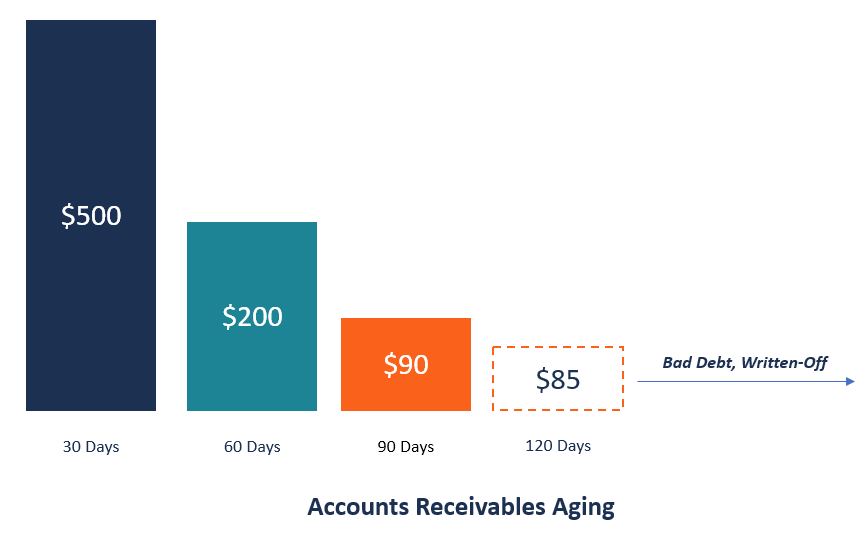
Aging the accounts receivables sorts the unpaid customers and credit memos by date ranges, such as due within 30 days, past due 31 to 60 days, and past due 61 to 90 days. The aging report itemizes each invoice by date and number. Management uses the information to determine the financial health of the company and to see if the company is taking on more credit riskCredit RiskCredit risk is the risk of loss that may occur from the failure of any party to abide by the terms and conditions of any financial contract, principally, than it can handle.
How Management Uses Accounts Receivable Aging
Below are a few ways that company management can use the accounts receivable aging report:
1. Collection practices
One of the ways that management can use accounts receivable aging is to determine the effectiveness of the company’s collections function. If the aging report shows a lot of older receivables, it means that the company’s collection practices are weak.
Some customers tend to not pay their invoices when they are due, and they may wait until the second and third invoice reminders to settle their outstanding balance. If some customers are taking too long to settle pending invoices, the company should review the collection practices so that it follows up on outstanding debts immediately when they fall due.
2. Credit risk
The accounts receivable aging report can also indicate which customers are becoming a credit risk to the company. Older accounts receivable expose the company to insolvencyInsolvencyInsolvency refers to the situation in which a firm or individual is unable to meet financial obligations to creditors as debts become due. Insolvency is a state of financial distress, whereas bankruptcy is a legal proceeding. due to the risk that the debtors may be unable to pay the invoice.
If the report shows that some customers are slower payers than others, then the company may decide to review its billing policy or stop doing business with customers who are chronically late payers. Management may also compare its credit risk against industry standards, in order to determine if it is taking too much credit risk or if the risk is within the normal allowed limits in the specific industry.
3. Allowance for bad debts
Management may also use the aging report to estimate potential bad debts during the reporting period. They evaluate the percentage of an invoice dollar amount that becomes bad debts per period and then applies the percentage to the current period’s aging reports.
For example, assume that Company XYZ allows for a 1% bad debts allowance for the 0 to 30 days period and a 3% bad debts allowance in the 31 to 60 days period. In the current period, the company reports $100,000 debts in the 0 to 30 days period and $50,000 debts in the 31 to 60 days period. This means that the allowance for bad debts is $2,500 based on the following calculation:
Allowance for Bad Debts = [($100,000 x1%) + ($50,000 x 3%)]
= $1,000 + $1,500
= $2,500
Accounts Receivable Aging Reports
An aging report provides information about specific receivables based on the age of the invoices. It gives the management team a historical overview of the company’s receivables portfolio. It groups outstanding invoices based on the duration they’ve been due and unpaid.
Main Categories of an Aging Report
- Current: Invoices that are due immediately.
- 0 to 30 days: Invoices that are due within the next 30 days.
- 31-60 days: Invoices that are 31 to 60 days past their due date.
- 61- 90 days: Invoices that are 61 to 90 days past their due date.
- Greater than 90 days: Invoices that are more than 90 days past their due date.
How an Aging Report Works
An aging report is used to show the outstanding customer invoices and the number of days they’ve been outstanding. If the company’s billing policy is to allow customers to pay for products and servicesProducts and ServicesA product is a tangible item that is put on the market for acquisition, attention, or consumption while a service is an intangible item, which arises from in the future, the aging report allows the company to keep track of the customers’ invoices and when they are due.
The aging report also shows the total invoices due for each customer when grouped based on the age of the invoice. The company’s management should generate an aging report once a month so that they know the invoices that are coming due. They can then notify customers of invoices that are past their due date.
Possible issues in Accounts Receivable Aging Reports
Although an accounts receivable aging report helps the management team track the financial state of the company, it may provide information that is misleading, depending on the time when the aging report is generated.
For example, most companies bill their customers toward the end of the month, and the aging report is generated days later. This means that the report will show the previous month’s invoices as past the due date, when, in fact, some could have been paid shortly after the aging report was generated.
Also, generating the report before the month ends will show fewer receivables whereas, in reality, there are more receivables pending payment for the company. Management should match their credit terms to the periods of the aging reports to get an accurate presentation of the accounts receivable.
Related Readings
CFI offers the Financial Modeling and Valuation Analyst (FMVA)®Become a Certified Financial Modeling & Valuation Analyst (FMVA)®CFI's Financial Modeling and Valuation Analyst (FMVA)® certification will help you gain the confidence you need in your finance career. Enroll today! certification program for those looking to take their careers to the next level. To keep learning and advancing your career, the following CFI resources will be helpful:
- Cash Conversion CycleCash Conversion CycleThe Cash Conversion Cycle (CCC) is a metric that shows the amount of time it takes a company to convert its investments in inventory to cash. The cash conversion cycle formula measures the amount of time, in days, it takes for a company to turn its resource inputs into cash. Formula
- How to Record Payment in AccountingHow to Record Payments in AccountingRecording payments in accounting can otherwise be referred to as "accounts payable," which means the total amount a given company owes to
- Sales and Collection CycleSales and Collection CycleThe Sales and Collection Cycle, also known as the revenue, receivables, and receipts (RRR) cycle, is comprised of various classes of
- Top Accounting ScandalsTop Accounting ScandalsThe last two decades saw some of the worst accounting scandals in history. Billions of dollars were lost as a result of these financial disasters. In this
-

Days Inventory Outstanding (DIO): Calculation & Significance
Days inventory outstanding (DIO) is the average number of days that a company holds its inventoryInventoryInventory is a current asset account found on the balance sheet, consisting of all raw ma
-

Understanding Days of Inventory on Hand (DOH): A Comprehensive Guide
Days of Inventory on Hand (DOH) is a metric used to determine how quickly a company utilizes the average inventory available at its disposal. It is also known as days inventory outstanding (DIO)Days I
Accounting
- Accounts Payable vs. Accounts Receivable: A Clear Explanation
- Accounts Payable (AP): Definition, Function & Importance
- Accounts Receivable Financing: A Comprehensive Guide for Businesses
- Accounts Receivable (AR): Definition, Management & Forecasting
- Accounts Receivable Aging Report: Understanding & Analysis
- Accounts Receivable Factoring: A Comprehensive Guide
- Accounts Receivable Turnover Ratio: Definition & Calculation
- Understanding Accounts Receivable Quality: A Key Indicator of Financial Health
- Understanding Accounts Receivable (AR): A Comprehensive Guide
-
 Understanding the Chart of Accounts: A Comprehensive Guide
The chart of accounts is a tool that lists all the financial accounts included in the financial statementsThree Financial StatementsThe three financial statements are the income statement, the balance...
-
 Closing Entries: A Comprehensive Guide for Accounting
A closing entry is a journal entryJournal Entries GuideJournal Entries are the building blocks of accounting, from reporting to auditing journal entries (which consist of Debits and Credits) that is m...