
Understanding Economic Life: Definition & Calculation
Economic life refers to the length of time an asset is expected to be useful to the owner. It is also called useful life or depreciable life. The measure of an asset’s usefulness is how profitable it is to keep – in other words, how long an asset generates more income than it costs to maintain and operate.
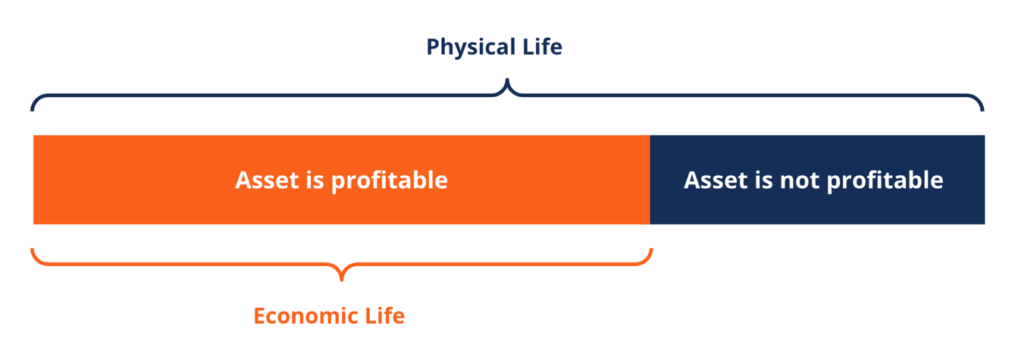
When calculating economic life, it is commonly assumed that the asset will be operated at a normal level of usage and with preventative maintenance. An asset’s economic life is not always the same length as its physical life. An asset could still be functioning as it is supposed to, but not considered economically useful. Because economic life is an estimation, an asset’s physical life can exceed its economic life or vice versa. This is also the case when new technological innovations make old technology obsolete.
Summary
- Economic life is the length of time an asset is expected to be useful to the owner.
- Assumptions when calculating economic life are that the asset will be operated at a normal level of usage and with preventative maintenance.
- Economic life can be reduced or ended by asset wear and damage, asset obsolescence, and changes in business operations.
Determining an Asset’s Economic Life
In some cases, the owner or company will designate an arbitrary number of years to define an asset’s economic life. To estimate the number, owners must consider the asset’s net present value (NPV)Net Present Value (NPV)Net Present Value (NPV) is the value of all future cash flows (positive and negative) over the entire life of an investment discounted to the present., internal rate of return (IRR), and return on investment (ROI)Return on Investment (ROI)Return on Investment (ROI) is a performance measure used to evaluate the returns of an investment or compare efficiency of different investments..
An asset’s economic life can be reduced or ended by several factors. Asset wear, degradation, or damage reduces an asset’s economic life. It lowers asset performance and also raises the costs needed for maintenance and repair.
Asset obsolescence occurs when new innovations and technology replace current ones. It reduces economic life if it raises maintenance costs, and sometimes it ends an asset’s economic life because it renders the asset’s performance inefficient compared to current alternatives.
For example, the widespread use of email replaced faxing and ended the economic life of many fax machines. Lastly, changes in business operations or business models reduce economic life if it affects the value certain assets can deliver to a business.
How is Economic Life Used?
The concept of economic life is useful for accountants of a company, operators of the asset, and company decision-makers. For accounting purposes, economic life is used as the time period in which depreciationDepreciation MethodsThe most common types of depreciation methods include straight-line, double declining balance, units of production, and sum of years digits. is charged against an asset. Companies use it to allocate depreciation expenses charged for the use of the asset.
Effectively managing assets is the key to economic life. It is also one of the important considerations of a company’s decision-making process to purchase new assets or replace current assets.
By studying and determining when machines, equipment, and other technologies become less effective and uneconomic, companies can effectively plan to replace such assets with new ones at appropriate intervals. The right planning will reduce maintenance and other overhead costs.
Practical Example
For example, in farm businesses machinery and equipment are major cost items. Owners that make smart decisions about how to acquire machinery, how to properly maintain the machinery, when to trade in old machinery, and how much capital to invest, can help to maximize the benefit while reducing the total costs. The economic life of each machine will indicate the number of years over which costs will be allocated.
In such a case, it is usually shorter than the machine’s actual period of usefulness, as most farmers trade machines for newer ones before the old machine is completely worn out. For most farm machines, a 10- to 12-year economic life is a good rule of thumb and 15 years for tractors. At the end of a machine’s economic life, the farmer can either trade it in, sell it, or dispose of it.
Salvage value, the estimate of the sale value of the machine at the end of its economic life, is also always specified. It is the monetary amount the farmer can expect to receive if they trade in the machine for a newer one or if they sell the machine outright at the end of its economic life. The salvage value can be zero if the machine is being kept until it’s worn out completely.
More Resources
CFI is the official provider of the global Commercial Banking & Credit Analyst (CBCA)™Program Page - CMSAEnroll in CFI's CMSA® program and become a certified Capital Markets &Securities Analyst. Advance your career with our certification programs and courses. certification program, designed to help anyone become a world-class financial analyst. To keep advancing your career, the additional CFI resources below will be useful:
- Internal Rate of Return (IRR)Internal Rate of Return (IRR)The Internal Rate of Return (IRR) is the discount rate that makes the net present value (NPV) of a project zero. In other words, it is the expected compound annual rate of return that will be earned on a project or investment.
- Maintenance ExpensesMaintenance ExpensesMaintenance expenses are costs incurred on a regular basis to keep an asset working in its optimal condition. Maintenance costs come into
- OverheadsOverheadsOverheads are business costs that are related to the day-to-day running of the business. Unlike operating expenses, overheads cannot be
- PP&E (Property, Plant, & Equipment)PP&E (Property, Plant and Equipment)PP&E (Property, Plant, and Equipment) is one of the core non-current assets found on the balance sheet. PP&E is impacted by Capex,
-

Annual Renewable Term Life Insurance: Explained | [Company Name]
Annual renewable term insurance is a type of life insurance coverage that an individual can renew every year. With this type of life insurance, life insurance company agrees to insure the indivi
-

Understanding Recessions: Causes, Symptoms & Current Economic Outlook
For many, the idea of a recession can be extremely unsettling. In fact, it’s been a little more than a decade since Americans faced one of the worst recessions in history: The Great Reces
Accounting
- Understanding Life Insurance: Purposes & Benefits
- DOT Insurance Rider: Understanding Dividend Options & Term Life Insurance
- Understanding Economic Life: Definition & Importance
- Decoupling: Understanding Its Meaning and Applications
- Understanding Economic Moats: A Guide to Sustainable Competitive Advantage
- Understanding Loan Lifespan: What is Average Life?
- Understanding Amortization of Intangible Assets: A Comprehensive Guide
- Understanding Normal Profit: A Key Concept in Economics
- Embrace Stoicism: A Practical Guide to a Meaningful Life
-
 Understanding Economic Life: Definition & Calculation
Economic life refers to the length of time an asset is expected to be useful to the owner. It is also called useful life or depreciable life. The measure of an asset’s usefulness is how profitab...
-
 Understanding the Industry Life Cycle: Stages & Dynamics
An industry life cycle depicts the various stages where businesses operate, progress, and slump within an industry. An industry life cycle typically consists of five stages — startup, growth, sh...