
Decoupling: Understanding Its Meaning and Applications
Decoupling represents the creation of gaps. In finance, decoupling happens when different asset classes or markets that typically demonstrate positive correlations start to move in opposite directions.

In organizational studies, decoupling takes place when there are gaps between formal policies and actual practices in an organization. Eco-economic decoupling considers the environmental impacts of economic growth. It refers to economic growth without leading to greater environmental pressure.
Summary
- Decoupling happens when markets with high positive correlations start to move in opposite directions.
- Decoupling also refers to the gaps between formal policies and actual practices in organizations. It may result from a conflict of interest.
- Eco-economic decoupling happens when an economy can grow without causing more environmental pressure or damages.
Decoupling in Finance
In financial markets, many different asset classesAsset ClassAn asset class is a group of similar investment vehicles. They are typically traded in the same financial markets and subject to the same rules and regulations. are positively correlated. The values of the asset classes usually move in the same direction, though at different rates. The higher the correlation, the closer the asset values move together.
When the correlation between the two assets equals 1, the values of the two assets always move together. For example, oil prices and natural gas prices are highly correlated. When oil price increases (decreases), the natural gas price increases (decreases) correspondingly. When the prices of two positively correlated assets start to move in opposite directions, decoupling takes place.
The concept of decoupling not only applies to asset classes but can also apply to different markets. As the economies of developing countries grow, emerging marketsEmerging MarketsEmerging markets is a term that refers to an economy that experiences considerable economic growth and possesses some, but not all, become less dependent on the U.S. market. Thus, emerging markets are said to be decoupling from the U.S. market.
A country’s investment market shows a high correlation with its economic environment. Decoupling also refers to the investment market performance detaching from the economic state.
During the COVID-19 shutdown, the U.S. economy experienced a sharp slowdown. The country’s GDP fell as the unemployment rate spiked. After an initial jump, the U.S. stock performance recovered much sooner than the economy. The equity market decoupled from the economy.
Decoupling in Organizational Studies
Decoupling happens when gaps between formal policies and actual practices appear in organizations. It is a concept in neo-institutionalism, which studies institutions through the enabling and constraining effects of rules. Such a type of decoupling can take place in a variety of organizations. Government agencies, social organizations, schools, and corporationsCorporationA corporation is a legal entity created by individuals, stockholders, or shareholders, with the purpose of operating for profit. Corporations are allowed to enter into contracts, sue and be sued, own assets, remit federal and state taxes, and borrow money from financial institutions. are some examples.
Organizational decoupling is criticized for serving the interests of organizational leaders. The top executives may avoid practicing the policies that do not align with their benefits. However, decoupling also allows internal flexibility regarding practical considerations while keeping legitimate with the external parts. It is beneficial to an organization itself.
Eco-Economic Decoupling
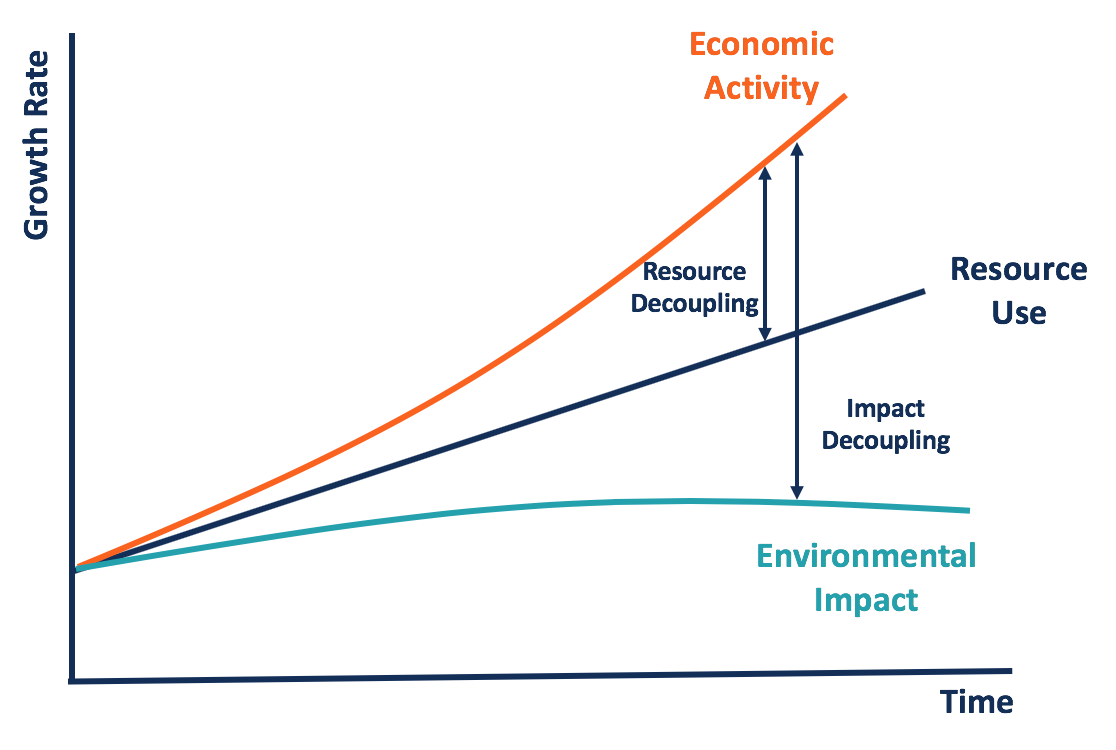
In economics and environmentalism, decoupling happens when an economy is able to grow without causing more environmental pressure or damage. Such a type of decoupling is known as eco-economic decoupling. Most of the time, increasing economic activities requires a greater consumption of resources, especially fossil fuels. It also causes more emissions and pollutants, which will lead to greater environmental pressure.
With eco-economic decoupling, countries should be able to sustain economic growth with reduced resource consumption and pollutant emissions. Resource decoupling measures the reduced rate of using resources for every unit of economic growth. Impact decoupling measures the reduced economic impact for every unit of economic growth.
Impact decoupling consists of two parts. One is the decoupling between economic growth and resource consumption. It can be created by improving the efficiency of energy and resource consumption. The other part is the decoupling between resource consumption and the corresponding environmental impact. It can be reached by switching to clean energies and reducing the waste and pollutant emission per unit of resource consumption.
Decoupling and Recoupling
In the areas of finance and organizational studies, decoupling is not permanent. When the gaps shrink and the two parts start to converge, recoupling takes place. Before the 2008 Global Financial Crisis2008-2009 Global Financial CrisisThe Global Financial Crisis of 2008-2009 refers to the massive financial crisis the world faced from 2008 to 2009. The financial crisis took its toll on individuals and institutions around the globe, with millions of American being deeply impacted. Financial institutions started to sink, many were absorbed by larger entities, and the US Government was forced to offer bailouts, developing countries in Asia and Latin America experienced rapid growth in their economies. They were decoupling from the U.S. economy. During the financial crisis, emerging markets and the U.S. market recoupled and dropped together dramatically. The correlation between them rose.
The demand for capital and resources declines in certain countries during their recession periods. The remaining markets can maintain their economic health due to lower interest rates and commodity prices.
In such a case, decoupling happens among global markets. When global lenders significantly suffer from a crisis, capital supply drops. It will hurt the rest of the markets. Consequently, emerging markets and developed markets recouple.
More Resources
CFI offers the Commercial Banking & Credit Analyst (CBCA)™Program Page - CBCAGet CFI's CBCA™ certification and become a Commercial Banking & Credit Analyst. Enroll and advance your career with our certification programs and courses. certification program for those looking to take their careers to the next level. To keep learning and developing your knowledge base, please explore the additional relevant resources below:
- Emerging MarketsEmerging MarketsEmerging markets is a term that refers to an economy that experiences considerable economic growth and possesses some, but not all,
- Gross Domestic Product (GDP)Gross Domestic Product (GDP)Gross domestic product (GDP) is a standard measure of a country’s economic health and an indicator of its standard of living. Also, GDP can be used to compare the productivity levels between different countries.
- Environmental, Social, and Governance (ESG)ESG (Environmental, Social and Governance)ESG is the acronym for Environmental, Social, and Governance, the three broad categories of interest for what is termed socially responsible investors.
- UnemploymentUnemploymentUnemployment is a term referring to individuals who are employable and actively seeking a job but are unable to find a job. Included in this
-

DeFi Explained: A Beginner's Guide to Decentralized Finance
The Beginner’s Guide to Decentralized FinanceIf you’re diving deep into the world of cryptocurrency, you have probably heard the term “DeFi” used to describe a variety of new protocols and assets. Fi
-
0x: A Comprehensive Guide to Decentralized Ethereum Trading
What Is 0x? 0x is a decentralized exchange for trading ERC 20 tokens. (See also: What Is ERC 20 And What Does It Mean For Ethereum?). It is among the most high-profile examples of decentra
finance
- Understanding Economic Moats: A Guide to Sustainable Competitive Advantage
- Understanding Economic Value of Equity (EVE): A Comprehensive Guide
- Jumbo CDs: Higher Rates & Deposits Explained
- Understanding Economic Life: Definition & Calculation
- Understanding Normal Profit: A Key Concept in Economics
- Understanding Recessions: Causes, Symptoms & Current Economic Outlook
- Understanding Regulation Z: Your Rights as a Borrower
- Understanding Economic Depressions: Causes, Effects & Financial Impact
- Economic Austerity Measures: Definition, Impact & Effectiveness
-
Understanding Cryptocurrency: A Beginner's Guide to Digital Currency
Cryptocurrency is a kind of digital currency that is intended to act as a medium of exchange. Cryptocurrency has become popular in the last decade, in particular, with Bitcoin becoming the most widel...
-
DB(k) Plans: A Hybrid Retirement Solution for Employers & Employees
The DB(k) plan is a type of retirement plan that is available for employers. This type of retirement plan combines features from the 401(k) plan with features from a defined benefit pension plan...