
EBITA Explained: Understanding Earnings Before Interest, Taxes, and Amortization
EBITA is an acronym that refers to the earnings of a company before interest, tax, and amortization expenses are deducted. Investors use EBITA as an indicator to measure the profitability and efficiency of a company and compare it with similar companies.
EBITA includes the cost of capital assets (depreciation) but excludes the associated financing costs as well as amortization of any intangible assets; hence it can more accurately present a company’s performance. It can be compared with EBIT (earnings before interest and taxes) and EBITDA (earnings before interest, taxes, depreciation, and amortization)EBITDAEBITDA or Earnings Before Interest, Tax, Depreciation, Amortization is a company's profits before any of these net deductions are made. EBITDA focuses on the operating decisions of a business because it looks at the business’ profitability from core operations before the impact of capital structure. Formula, examples to better understand a company’s earnings.
Summary
- EBITA is the earnings of a company before interest, taxes, and amortization are deducted from the net income.
- The metric shows the company’s true performance by excluding the financing costs and reflects the profitability of the company’s operations.
- EBITA allows investors to make an easy comparison of different companies operating in the same business.
Significance of EBITA
Income and expenses from investments, taxes, loan interests, and various types of depreciation, considered to determine the net profit of a company, often do not directly relate to a company’s success. The net income reflects the overall profitability of a company, whereas EBITA reflects the operating profitability.
Therefore, the true performance of a company’s operations can be determined when the effects associated with taxes, interest, and amortization are removed. Since the effect of such items is excluded in EBITA, investors consider it an important measure to determine a company’s true earnings.
EBITA value can be either positive or negative. A positive EBITA value indicates the efficiency of the operation of a company, showing the cash flow amount available with the company to pay dividends or reinvest in business growth. A negative EBIT is not acceptable as it indicates that the company may be facing troubles in managing the cash flows or making profits.
Furthermore, the EBITA figure helps in comparing the operating successes of various companies. Lenders can use EBITA figures to determine a company’s creditworthinessCreditworthinessCreditworthiness, simply put, is how "worthy" or deserving one is of credit. If a lender is confident that the borrower will honor her debt obligation in a timely fashion, the borrower is deemed creditworthy. as EBITA describes a company’s real earnings, which, in turn, reflects the company’s capability to settle its debts.
A high EBITA figure is important for a business; however, it should also lead to a high net income figure as well. A company may be taking loans to grow its business, which may decrease its net income in the coming years. Hence, tracking the company’s increasing EBITA may provide a glimpse of the future after the debts are paid.
How to Calculate EBITA
EBITA can be calculated by the following methods:
Direct method
In the direct method, the cost of goods sold (COGS)Cost of Goods Sold (COGS)Cost of Goods Sold (COGS) measures the “direct cost” incurred in the production of any goods or services. It includes material cost, direct and operating expenses less amortization are subtracted from the company’s total revenue. Thus,
EBITA = Total Revenue – COGS – (Operating Expenses – Amortization)
Companies sometimes may not provide a breakdown of either the operating expenses or the cost of goods sold in the financial statements. In such cases, a company’s EBITA can be calculated using the indirect method.
Indirect method
In the indirect method, the interest, taxes, and amortization are added back to the net incomeNet IncomeNet Income is a key line item, not only in the income statement, but in all three core financial statements. While it is arrived at through, giving the EBITA value.
EBITA = Net income + Interest + Taxes + Amortization
Since all the above items are available on the income statement, such a method of calculating EBITA is straightforward.
Practical Example
Suppose the income statement of Company X for 2018 and 2019 shows the following sections:
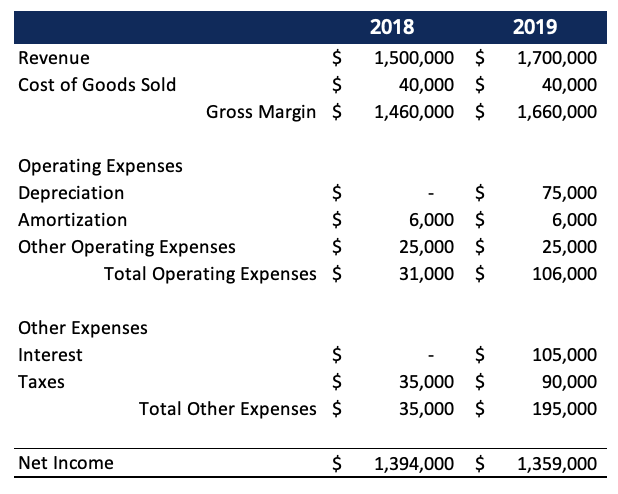
The company’s total revenue in 2018 was $1,500,000, and the net income was $1,394,000. The company wanted to increase the revenue and hence took a loan to buy inventory. The company’s revenue was reported as $1,700,000 at the end of 2019. However, the net profit of the company reduced to $1,359,000 in 2019.
The higher sales with smaller profit can be explained using EBITA. When the company’s net income is adjusted for taxes, interest, and amortization expenses, the profit instead increases.
EBITA for 2018 = $1,394,000 + $6,000 + $35,000 + $0 = $1,435,000
EBITA for 2019 = $1,359,000 + $6,000 + $90,000 + $105,000 = $1,560,000
The above calculation shows that even though the company’s net income decreased by $35,000, the earnings before interest taxes and amortization for the company increased by $125,000 in 2019.
Related Readings
CFI offers the Commercial Banking & Credit Analyst (CBCA)™Program Page - CBCAGet CFI's CBCA™ certification and become a Commercial Banking & Credit Analyst. Enroll and advance your career with our certification programs and courses. certification program for those looking to take their careers to the next level. To keep learning and advancing your career, the following resources will be helpful:
- Comparable Company AnalysisComparable Company AnalysisThis guide shows you step-by-step how to build comparable company analysis ("Comps") and includes a free template and many examples.
- Depreciation MethodsDepreciation MethodsThe most common types of depreciation methods include straight-line, double declining balance, units of production, and sum of years digits.
- Free Cash FlowFree Cash Flow (FCF)Free Cash Flow (FCF) measures a company’s ability to produce what investors care most about: cash that's available be distributed in a discretionary way.
- EBIT vs. EBITDAEBIT vs EBITDAEBIT vs EBITDA - two very common metrics used in finance and company valuation. There are important differences, pros/cons to understand.
-

Accrued Revenue: Definition, Examples & Accounting Explained
Accrued revenue is revenue that has been earned by providing goods or services but the payment has yet to be received. In other words, cash collection will occur in a subsequent period after the goods
-
Understanding Book Value: A Key Financial Metric
Book value is a company’s equity value as reported in its financial statementsThree Financial StatementsThe three financial statements are the income statement, the balance sheet, and the statem
Accounting
- Acquirer Definition: Understanding Corporate Acquisitions
- Understanding Clawbacks: Protecting Stakeholders from Failed Performance
- Understanding Financial Gearing: Debt & Leverage Explained
- Leverage in Finance: Strategies, Types & Risks
- Understanding Expenditures: Definition and Types
- Goodwill in Accounting: Definition & Value
- OIBDA Explained: Understanding Operating Income Before Depreciation & Amortization
- Understanding Vouchers: A Guide to Accounts Payable Documents
- EBITA: Understanding Earnings Before Interest, Taxes, and Amortization
-
 Understanding the Role of an Accountant: Key Responsibilities & Importance
An accountant plays a very crucial role in an organizationTypes of OrganizationsThis article on the different types of organizations explores the various categories that organizational structures can ...
-
 Streamlining Processes: Definition, Benefits & Techniques
Streamlining refers to the improvement of the efficiency of a certain process within an organization. It can be done by automationExcel vs Automation in Financial ModelingBefore we discuss Excel vs au...