
Revenue Bonds: A Comprehensive Guide for Investors
A revenue bond is a type of municipal bond in which the repayment of the obligation is primarily guaranteed by the operating revenuesRevenueRevenue is the value of all sales of goods and services recognized by a company in a period. Revenue (also referred to as Sales or Income) of an entity. Revenue bonds are primarily utilized by government entities to subsidize infrastructure projects. The most common projects include the construction of airports, roads, bridges, and sewer facilities.
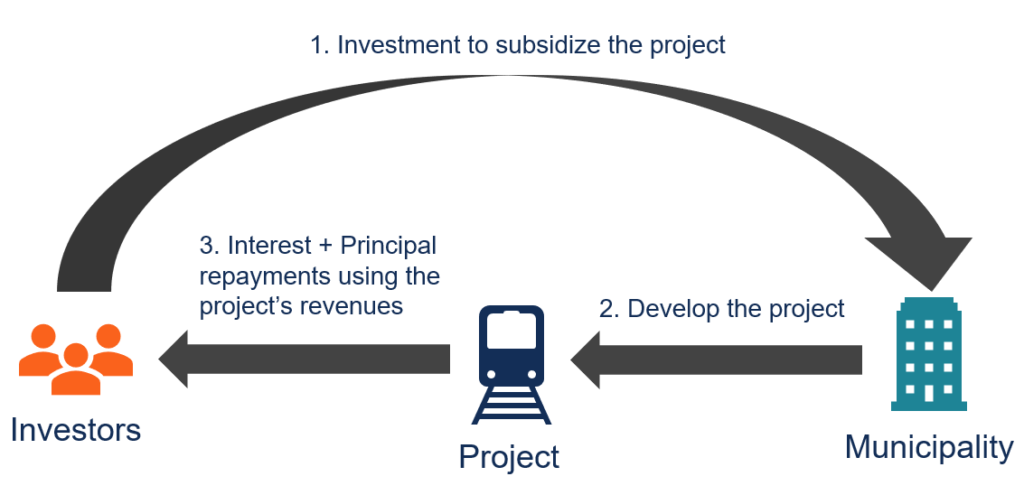
Note that revenue bonds are different from another type of municipal bonds called general obligation (GO) bondsGeneral Obligation BondA general obligation (GO) bond is a type of municipal bond in which the bond repayments (interest and principal) are guaranteed by the total revenue generated by the relevant government entity or agency. In other words, the repayment is guaranteed by both tax revenue and operating revenue generated by various projects.. The repayment of general obligation bonds is secured by all the revenues generated by an entity, including their tax revenues. The repayment of revenue bonds is guaranteed only by revenues obtained by the projects that were subsidized using the bonds. Tax revenues are not used at all.
Characteristics of Revenue Bonds
1. Longer time to maturity
Since revenue bonds are used for long-term projects, the bonds feature long maturities. Generally, the maturity dates of the bonds often range from 20 to 30 years. In addition, they come with a face valuePar ValuePar Value is the nominal or face value of a bond, or stock, or coupon as indicated on a bond or stock certificate. It is a static value of $1,000 or $5,000.
Both the interest and principal payments are made from the operating revenues of a project. However, if a project does not produce enough revenues to make the payments, the payments can be deferred to a later date.
2. Higher returns than general obligation bonds
At the same time, revenue bonds usually provide higher returns to investors compared to general obligation bonds. The higher returns can be justified for several reasons. First, there is a greater probability of non-repayment because they are only secured by the revenue streams generated by a project.
Also, these bonds do not provide investors with a claim to the assets of a project if a project does not generate the expected revenues. Finally, the bonds frequently include provisions that the issuers may call the issued bonds if the project’s assets are destroyed in catastrophic events.
Practical Example
John invests in fixed-income securitiesFixed Income SecuritiesFixed income securities are a type of debt instrument that provides returns in the form of regular, or fixed, interest payments and repayments of the. He identifies that the local municipality aims to raise $5 million by issuing revenue bonds to subsidize the construction of the new toll bridge.
John analyzes the project and determines that the new bridge will twice reduce the travel time between the two adjacent cities. Therefore, he is confident that the toll bridge will generate sufficient revenue streams and decides to buy the bonds.
The bonds come with a face value of $1,000, a maturity of 30 years, and an interest rate is 2.5%. The interest and principal repayments are secured by revenues that will be generated by tolls when the construction is completed.
More Resources
CFI is the official provider of the Capital Markets & Securities Analyst (CMSA)®Program Page - CMSAEnroll in CFI's CMSA® program and become a certified Capital Markets &Securities Analyst. Advance your career with our certification programs and courses. certification program, designed to transform anyone into a world-class financial analyst.
To keep learning and developing your knowledge of financial analysis, we highly recommend the additional resources below:
- Capital Raising ProcessCapital Raising ProcessThis article is intended to provide readers with a deeper understanding of how the capital raising process works and happens in the industry today. For more information on capital raising and different types of commitments made by the underwriter, please see our underwriting overview.
- Callable BondCallable BondA callable bond (redeemable bond) is a type of bond that provides the issuer of the bond with the right, but not the obligation, to redeem the bond before its maturity date. The callable bond is a bond with an embedded call option. These bonds generally come with certain restrictions on the call option.
- Convertible BondConvertible BondA convertible bond is a type of debt security that provides an investor with a right or an obligation to exchange the bond for a predetermined number of shares in the issuing company at certain times of a bond’s lifetime. A convertible bond is a hybrid security
- Revenue StreamsRevenue StreamsRevenue Streams are the various sources from which a business earns money from the sale of goods or provision of services. The types of
-

Understanding High-Yield Bond Spreads: A Comprehensive Guide
A high-yield bond spread, also known as a credit spread, is the difference in yields between multiple high-yield bonds, expressed in basis points or percentage points. A high-yield bond is a term that
-

Understanding Term to Maturity: A Key Bond Concept
Term to maturity is the remaining life of a bond or other type of debt instrument. The duration ranges between the time when the bond is issued until its maturity date when the issuer is required to r
invest
- Understanding Bonds: A Comprehensive Guide for Investors
- Callable Bonds: Understanding Issuer Redemption Rights
- Convertible Bonds: A Comprehensive Guide for Investors
- Green Bonds: Financing a Sustainable Future | [Your Company Name]
- High-Yield Bonds: Understanding Risk & Potential Returns
- Hospital Revenue Bonds: Financing Healthcare Infrastructure
- Kangaroo Bonds: A Guide to Australian Dollar Debt
- L Bonds: Understanding Unrated Life Insurance Bonds
- Understanding Bonds: A Comprehensive Guide for Investors
-
 Development Impact Bonds: Investing in Social Change
A development impact bond is a type of financial security that is used to finance development programs in low-resource countries by attracting private investors. Development impact bonds are considere...
-
 General Obligation Bonds (GO Bonds): A Comprehensive Guide
A general obligation (GO) bond is a type of municipal bond in which the bond repayments (interest and principalPrincipal PaymentA principal payment is a payment toward the original amount of a loan th...