
Understanding Audit Evidence: A Comprehensive Guide
Evidence in an audit is information that is collected and required in the review of an entity’s financial transactions, balances, and internal controls to certify the financial statements as being fairly represented.

Evidence is used by auditors and certified public accountants (CPAs)CPA vs CFA®When considering a career in corporate finance or the capital markets you will often hear people asking, “Should I get a CPA or CFA?” and “Which is better?”. In this article, we will outline the similarities and differences of the CPA vs CFA designations and try to steer you in the right direction about in determining whether an audit results in an unqualified or clean opinion. An unqualified opinion means that the auditor has found reasonable assurance that an entity’s accounting statements are not materially misstated.
Auditing Explained
Auditing is the process of checking and verifying an entity’s financial statements for accuracy and fairness. Transactions that are recorded within the financial records of an entity must be a fair representation of the entity’s financial positioning and actual operations.
Financial statements are generated internally within a company. The process introduces a level of risk for manipulation or fraudulent behavior from insiders who can alter information when preparing the financials. Auditing is an essential process that ensures that manipulation or fraudulent behavior is not being conducted.
Audits are also important in ensuring that an entity is complying with relevant accounting standards, be it the International Financial Reporting Standards (IFRS)IFRS StandardsIFRS standards are International Financial Reporting Standards (IFRS) that consist of a set of accounting rules that determine how transactions and other accounting events are required to be reported in financial statements. They are designed to maintain credibility and transparency in the financial world, Generally Accepted Accounting Principles (GAAP), or other applicable accounting standards.
Public companies are required to provide fully audited financial statements to owners and shareholders periodically. Therefore, auditing is important in maintaining the transparency and accuracy of the financial records to protect shareholders.
Evidence in an Audit Explained
Evidence in an audit protects investors by allowing auditors to issue accurate, transparent, and independent audit reports. Within the United States, the Public Company Accounting Oversight Board (PCAOB) created the Sarbanes-Oxley Act of 2002Sarbanes Oxley ActThe Sarbanes-Oxley Act is a U.S. federal law that aimed to protect investors by making corporate disclosures more reliable and accurate. to enforce proper auditing and in response to the Enron/Arthur Andersen scandal.
In the Enron scandal, billions of dollars of debt were hidden by using several accounting loopholes. The auditors, Arthur Andersen, allowed the fraudulent behavior to occur.
Evidence is a very important aspect of auditing. Financial statements can easily be misstated. It is required by auditors to verify the truth within financial records.
Evidence provides support and verifies financial information that is provided by internal members of an entity, such as management and internal finance teams. On the other hand, evidence can contradict the information that is provided by internal members, and it is an indication of errors or fraud.
Characteristics of Evidence in an Audit
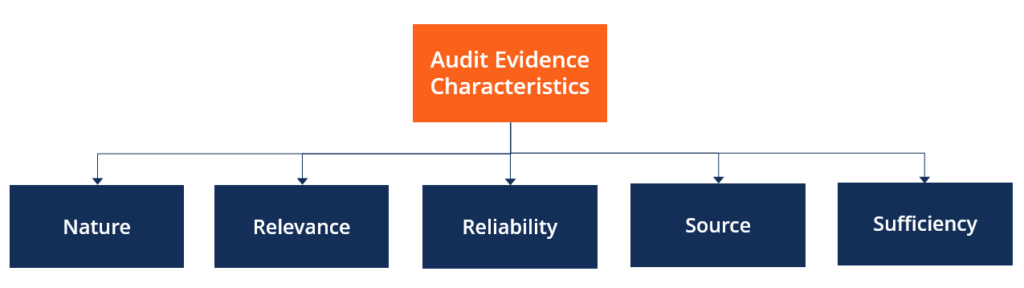
Evidence in an audit requires a few characteristics to be considered valid. The characteristics are as follows:
- Nature refers to the type of information received. It can be received in many forms – presentations, orally, or through physical records.
- Relevance refers to the pertinence of the information to provide an opinion.
- Reliability refers to determining whether the material can be trusted or relied upon to form an opinion. The source of the information needs to be considered.
- Source refers to whether the accounting evidence was obtained directly from the audited company or an external source. External source information is preferable since it is less subject to manipulation than internally sourced information.
- Sufficiency refers to whether the information provided is enough to provide an opinion or make an accurate judgment.
Examples of Evidence in an Audit
Evidence in an audit is collected to complete the auditing process. Some examples include:
- Bank statementsBank StatementA bank statement is a financial document that provides a summary of the account holder’s activity, generally prepared at the end of each month.
- Bank accounts
- Transaction records
- Management accounts
- Payrolls
- Billing invoices
- Receipts
- Inventory counts
The compilation of the items of evidence is used to conclude whether financial statements have been accurately presented.
Evidence in an Audit Example
Consider a company that has enlisted the auditing services of a professional services firm to audit its financial statements for a fiscal year. The company has prepared its financial statements and will rely on the professional services firm to provide a fair opinion.
The professional services firm will request information regarding the company’s revenues, expenses, and bank balances. For compiling accurate and reliable information, the auditing team requests all sales receipts, invoices, and a physical examination of inventories.
All bank statements and balances are collected from the company’s bank as well. All of the information is considered auditing evidence for the audit process.
Related Readings
CFI offers the Commercial Banking & Credit Analyst (CBCA)™Program Page - CBCAGet CFI's CBCA™ certification and become a Commercial Banking & Credit Analyst. Enroll and advance your career with our certification programs and courses. certification program for those looking to take their careers to the next level. To keep learning and developing your knowledge base, please explore the additional relevant resources below:
- Audited Financial StatementsAudited Financial StatementsPublic companies are obligated by law to ensure that their financial statements are audited by a registered CPA. The purpose of the
- IFRS StandardsIFRS StandardsIFRS standards are International Financial Reporting Standards (IFRS) that consist of a set of accounting rules that determine how transactions and other accounting events are required to be reported in financial statements. They are designed to maintain credibility and transparency in the financial world
- Top Accounting ScandalsTop Accounting ScandalsThe last two decades saw some of the worst accounting scandals in history. Billions of dollars were lost as a result of these financial disasters. In this
- Voodoo AccountingVoodoo Accounting“Voodoo accounting” is a slang term that describes a system through which profits for a company can be inflated. Unscrupulous and/or flat-out illegal
-

Understanding Financial Performance: A Comprehensive Overview
Financial performance is a complete evaluation of a company’s overall standing in categories such as assets, liabilities, equity, expenses, revenue, and overall profitability. It is measured thr
-

Comprehensive Financial Planning: Your Path to Financial Security
A financial plan is a document that covers an individual’s current financial situation, short-term and long-term economic goals, and an in-depth strategy to achieve the goals. A finan
Accounting
- Understanding Financial Hardship: Causes, Impacts & Relief
- Understanding Auditors: Roles, Responsibilities & Audit Processes
- EBITDARM Explained: A Comprehensive Guide to Financial Analysis
- Accounting Explained: Understanding Financial Records & Reporting
- Understanding Financial Audits: A Comprehensive Guide
- Audit Committees: Role, Responsibilities & Importance
- Audit Sampling: A Comprehensive Guide for Auditors
- Understanding Finance: A Comprehensive Overview
- The Critical Role of Audits in Legal Compliance
-
 Financial Literacy: Understanding Key Concepts & Skills
Financial literacy is the cognitive understanding of financial components and skills such as budgeting, investing, borrowing, taxation, and personal financial management. The absence of such skil...
-
 Financial Mathematics: Applications & Quantitative Finance Explained
Financial mathematics describes the application of mathematics and mathematical modeling to solve financial problems. it is sometimes referred to as quantitative financeQuantitative FinanceQuantitativ...