
Understanding Net Loss: Causes, Impact, and Accounting Principles
Net loss is an accounting term, and it refers to a negative value for income. In other words, a company incurs a net loss when the expenses for a specific period are higher than the revenues for the same period. The principle for which expenses and revenues must be recorded in the same period is called the matching principleMatching PrincipleThe matching principle is an accounting concept that dictates that companies report expenses at the same time as the revenues they are related. The period considered is typically a fiscal year.

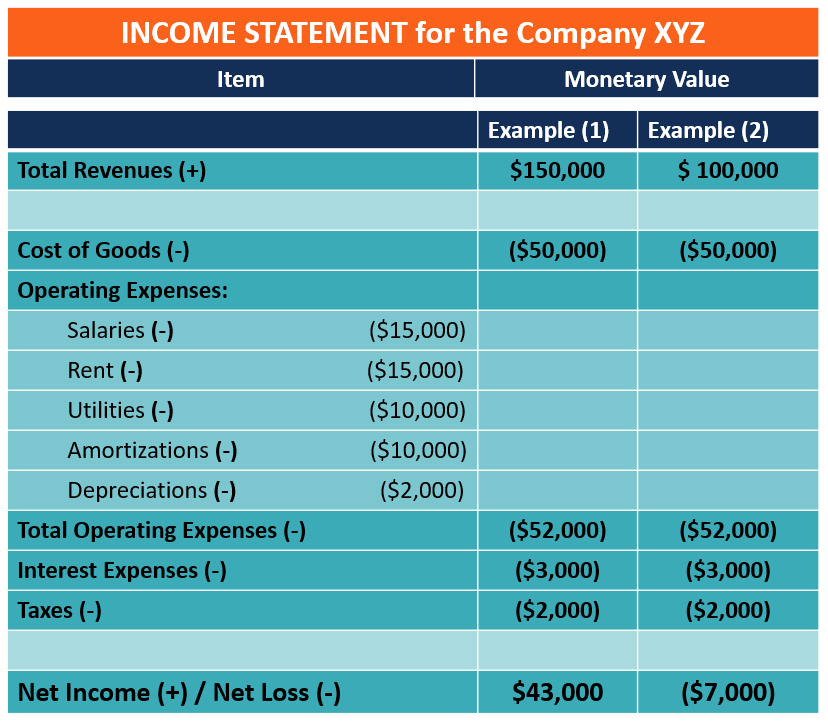
Revenues and expenses are part of the income statement, and at the bottom line, you will find the net income or net loss. When you subtract the expenses and costs from revenue, the result will be either positive or negative. A positive result is called net income, and a negative result is a net loss.
Key Components of Net Loss
To better understand what a net loss is and how to calculate it, let’s break down the key components from the definition we saw above.
1. Revenues
The term revenue refers to all the goods or servicesProducts and ServicesA product is a tangible item that is put on the market for acquisition, attention, or consumption while a service is an intangible item, which arises from that a company sells to the public. In the income statement, the revenues are positive items.
Interpretation
Looking at the revenues, an increase is a signal that the company is growing, selling more goods or services, and generating more money. In this case, the company can increase its investments or expenses. If the revenues are decreasing, it means that the company is shrinking. If it wants to remain profitable, it needs to quickly reduce its expenses.
2. Expenses
The expenses in the income statement are all the costs the company incurred to provide the services or to produce the goods it is going to sell.
Usually, there are three macro-categories of expenses:
- The cost of goods (e.g., the cost of the raw materials used for the production)
- The operating expenses (e.g., salaries, rent, utilities, amortizations, etc.)
- The interest expensesInterest ExpenseInterest expense arises out of a company that finances through debt or capital leases. Interest is found in the income statement, but can also (interests due to the shareholders)
Interpretation
For a company to be profitable, all its expenses must be lower than its revenues. In other words, the revenues must be substantial enough to settle all the expenses and compensate the employees. When it does not happen and the expenses exceed the revenues, the company incurs a net loss.
Income Statement
The income statement is a document each company creates to show its results from operations. It is a financial statement for a specific period, and it reports all revenues and all expenses of the company. The structure of an income statement is similar for all types of companies, but some industries can include unique line items. Below an example of a simple income statement for Company XYZ.
Importance of Net Income/Net Loss
Net loss or net income is a key indicator used to evaluate the company operating results in a specific period. Investors look at the size of the net loss and trends from previous periods to assess the company’s performance.
Real-world Example
Matching Principle and Accrual Accounting
The matching principle states that to calculate the net income/loss, all the expenses and related revenues be recorded in the same period.
The matching principle is a key factor in the calculation of net income/loss. All the expenses related to a specific earned income must be considered in the calculation regardless of when they will be actually paid.
Example
A good example is payroll wages. An employee who worked in December 2019 will not be paid until January 2020. However, the company, in the calculation of the net income or net loss for 2019, will record the payroll expense in December 2019, even if it will be paid in January 2020. The process is known as accrual accounting.
Additional Resources
CFI offers the Commercial Banking & Credit Analyst (CBCA)™Program Page - CBCAGet CFI's CBCA™ certification and become a Commercial Banking & Credit Analyst. Enroll and advance your career with our certification programs and courses. certification program for those looking to take their careers to the next level. To keep learning and developing your knowledge base, please explore the additional relevant resources below:
- Accrual AccountingAccrual PrincipleThe accrual principle is an accounting concept that requires transactions to be recorded in the time period in which they occur, regardless of
- Cost of Goods Sold (COGS)Cost of Goods Sold (COGS)Cost of Goods Sold (COGS) measures the “direct cost” incurred in the production of any goods or services. It includes material cost, direct
- Fixed and Variable CostsFixed and Variable CostsCost is something that can be classified in several ways depending on its nature. One of the most popular methods is classification according
- Projecting Income Statement Line ItemsProjecting Income Statement Line ItemsWe discuss the different methods of projecting income statement line items. Projecting income statement line items begins with sales revenue, then cost
-

Understanding Discretionary Expenses: Definition & Examples
A discretionary expense is a non-essential expense that is incurred by an individual, household, or business. Another way to think of discretionary expenses is to classify them as “wants”
-

Net Cash: Definition, Calculation & Importance for Businesses
Net cash refers to the position of a company with regard to its liquidity position. To calculate net cash, a company will need to deduct its current liabilities from its cash balance. Liabilities are
Accounting
- Understanding Business Erosion: Causes, Risks & Prevention
- Net Settlement Explained: How Banks Settle Transactions
- Understanding Capital Losses: Definition, Calculation & Examples
- Understanding Net Change: Definition & Calculation
- Understanding Accruals in Accounting: A Comprehensive Guide
- Gross vs. Net: Understanding the Difference - Definitions & Examples
- Understanding Net Income: A Comprehensive Guide
- Understanding Net Operating Loss (NOL) Deductions | IRS.gov
- Net Income Explained: A Comprehensive Guide for Businesses & Individuals
-
 Net Banking: A Comprehensive Guide to Online Banking Services
Net banking offers a variety of online services. The net banking meaning refers to allowing customers of financial institutions to perform transactions online through a website interface. Fir...
-
 Understanding Prepaid Expenses: Definition & Accounting
Prepaid expenses represent expendituresExpenditureAn expenditure represents a payment with either cash or credit to purchase goods or services. An expenditure is recorded at a single point in that hav...