
Net Tangible Assets (NTA): Definition, Calculation & Importance
Net Tangible Assets (NTA) is the value of all physical (“tangible”) assets minus all liabilitiesTypes of LiabilitiesThere are three primary types of liabilities: current, non-current, and contingent liabilities. Liabilities are legal obligations or debt in a business. In other words, NTA are the total assets of a company minus intangible assets and total liabilities. The total value of net tangible assets are sometimes referred to as the company’s “book value” or “net asset value.”
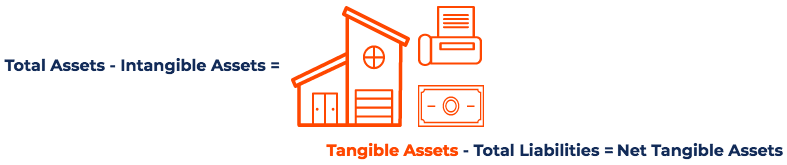
Formula for Net Tangible Assets (NTA)
NTA = Total assets – Intangible assets – Total liabilities
Where:
- Total assets include tangible and intangible assets and can be found on a company’s balance sheet.
- Intangible assets are those that lack a physical form – such as goodwillGoodwill Impairment AccountingGoodwill is acquired and recorded on the books when an entity purchases another entity for more than the fair market value of its assets., trademarks, copyrights.
- Total liabilities include current and non-current liabilities and can be found on a company’s balance sheet.
Example of Net Tangible Assets (NTA)
For example, Company A reports total assets of $1 million, total liabilities of $500,000, intangible assets of $200,000. To calculate the NTA:
NTA = $1 million – $200,000 – $500,000 = $300,000
Importance of Net Tangible Assets (NTA)
Understanding the amount of NTA is important because:
- NTA allows management to determine its asset position without considering intangible assets. Essentially, NTAs exclude difficult-to-value intangible assets.
- A company with high NTA is able to obtain acquisition financing more easily since it owns more assets to use as security for loans.
- NTA can be used to determine company risk levels such as solvency and liquidity.
It is important to know that although determining the NTA for a company offers benefits, its usefulness varies greatly across industries. For example, medical device manufacturers often own intangible assets (patentsPatentsPatents are documents that grant ownership of intellectual property – the idea of, or concept for, something – to an individual, group, or company. A patent) that are far more valuable than their tangible assets. On the other hand, real estate holding companies own little to no intangible assets.
Net Tangible Assets (NTA) per Share
Net tangible assets per share (NTA/share) is an extension of NTA that shows, in theory, the money that each shareholder would receive if the company were to liquidate. The NTA/share is a useful ratio in investment strategy as it can help determine whether a company is undervalued or overvalued or whether the share price accurately reflects the net assets of the company.
Formula for NTA per Share
Net Tangible Assets per Share = NTA / Shares outstanding
Example of NTA per Share
Recall from the example above where Company A reported total assets of $1 million, total liabilities of $500,000 and intangible assets of $200,000 for a resulting $300,000 in net tangible assets. Now, assume that there are 100,000 shares outstanding. To determine the NTA per share:
NTA per share = $300,000 / 100,000 = $3 per share
If shares of this company were trading on the market at $3 per share, then the NTA per share figure would imply that the book value of Company A is at fair market value.
Additional Resources
CFI is the official provider of the Financial Modeling and Valuation Analyst (FMVA)®Become a Certified Financial Modeling & Valuation Analyst (FMVA)®CFI's Financial Modeling and Valuation Analyst (FMVA)® certification will help you gain the confidence you need in your finance career. Enroll today! certification, designed to help anyone become a world-class financial analyst. To continue learning and advancing your career, these free CFI resources will be helpful:
- Types of AssetsTypes of AssetsCommon types of assets include current, non-current, physical, intangible, operating, and non-operating. Correctly identifying and
- Net Identifiable AssetsNet Identifiable AssetsNet Identifiable Assets consist of assets acquired from a company whose value can be measured, used in M&A for Goodwill and Purchase Price Allocation.
- Projecting Balance Sheet ItemsProjecting Balance Sheet Line ItemsProjecting balance sheet line items involves analyzing working capital, PP&E, debt share capital and net income. This guide breaks down how to calculate
- Valuation MethodsValuation MethodsWhen valuing a company as a going concern there are three main valuation methods used: DCF analysis, comparable companies, and precedent transactions
-

Non-Current Assets: Definition, Examples & Accounting
Non-current assets are assets whose benefits will be realized over more than one year and cannot easily be converted into cash. The assets are recorded on the balance sheet at acquisition cost, and th
-

Understanding Stranded Assets: Risks and Impacts
Stranded assets are assets that are unable to earn their original economic return due to changes in the landscape in which the assets operate. In simpler terms, stranded assets are assets that are wor
Accounting
- Investable Assets: A Comprehensive Guide for Investors
- Understanding Net Foreign Assets (NFA): A Comprehensive Guide
- Net Liquid Assets: Definition, Calculation & Importance
- Understanding Unrestricted Net Assets for Nonprofits
- Biological Assets: Definition, Examples & Accounting
- Understanding Financial Assets: Definitions & Types
- Understanding Intangible Assets: Definition & Importance
- Understanding Net Sales: Definition & Importance
- Tangible Assets: Definition, Examples & Importance
-
 Capital Expenditures (CAPEX): Definition & Examples
Capital expenditures refer to funds that are used by a company for the purchase, improvement, or maintenance of long-term assetsLong Term AssetsLong term assets are assets that a company uses in its p...
-
 Understanding Current Assets: Definition & Importance
Current assets are all assets that a company expects to convert to cash within one year. They are commonly used to measure the liquidity of a company. A company’s assets on its balance sheetBala...